How to Compare Drainage Quotes: Compare the Diagnosis, Not the Price
Drainage quotes vary mostly because contractors diagnosed the problem differently, not because one is padding the price. Compare the diagnosis first: two quotes that agree on the cause can be compared on price; two that disagree are pricing different problems, and that gap matters more than the numbers.
Why drainage quotes vary so wildly
Homeowners routinely get drainage quotes that differ by thousands of dollars for what looks like the same wet spot — a $400 suggestion and a $12,000 one for the same puddle. It is tempting to assume the high one is gouging and the low one is honest. Usually neither is true.
The quotes differ because the contractors diagnosed different problems. One looked at your wet yard and saw a downspout discharging at the wall — a cheap fix. Another saw it and proposed a full French drain system. They are not pricing the same job at different rates; they are pricing different jobs. Which means the first thing to compare is not the price. It is the diagnosis.
Compare the diagnosis first
Lay the quotes side by side and read what each contractor says is wrong, before what they propose to do about it.
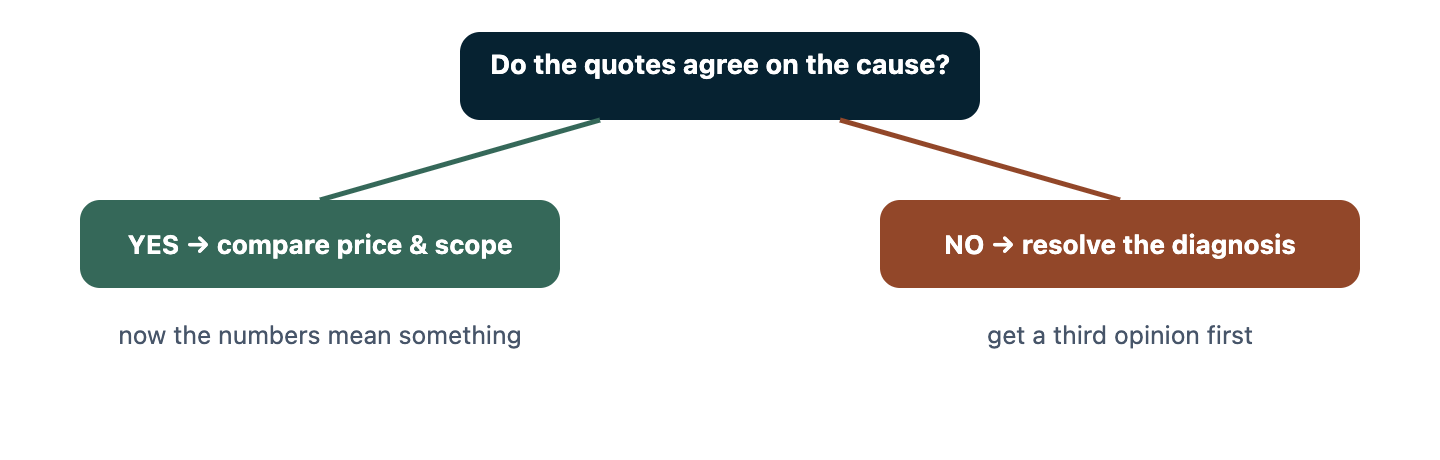
If the quotes agree on the cause — they all say it's roof water, or all say saturated soil — then you can genuinely compare them on price, scope, and materials. The numbers now describe the same job.
If the quotes disagree on the cause, stop. You don't have a price problem, you have a diagnosis problem. Comparing the numbers is meaningless when they're solving different things. Ask each contractor what they observed that led to their diagnosis (see questions to ask), and if it's still unclear, a third opinion is worth more than picking between the first two.
Making quotes actually comparable
Quotes are often hard to compare because they're written differently. To line them up, each should state:
- The diagnosed problem, in the contractor's own words
- The specific solution and materials — not just "drainage system"
- Where the water discharges — a named, lower outlet
- A cost breakdown — labour, materials, and restoration separately
- What's included and excluded — especially turf, beds, and paving restoration
- Timeline and any warranty
If a quote is missing these, ask for them before comparing. A vague quote isn't a cheaper quote — it's an unclear one, and the gaps usually become costs later.
The simplest way to get quotes that line up is to send every contractor the same request. The Contractor Outreach Kit writes one message with these questions built in, so the replies come back on the same footing — and once they do, the Drainage Quote Analyzer checks each one for what it clearly specifies and what it leaves vague.
The price signals worth reading
Once the diagnoses agree, the numbers do carry information:
- A quote far below the others is not automatically the deal. It can mean thinner materials, skipped fabric, no real outlet, or a smaller scope than you think. Ask what it leaves out.
- A large upfront demand — more than about 15% — is a common red flag.
- "Equal substitution of materials" and similar vague clauses let a contractor swap in cheaper components later. Worth clarifying.
- No references or photos of past drainage work is a warning; good contractors are glad to show it.
Overpriced or too cheap? Read both directions
Most advice only warns about lowball bids, but a drainage quote can miss in either direction — padded on one side, too thin to trust on the other. Once the diagnoses agree, these are the patterns worth reading:
| Where to look | May be overpriced | May be too cheap to trust |
|---|---|---|
| Scope | A full French drain system quoted for what a downspout extension or regrade would fix | No real outlet, skipped filter fabric, or a smaller scope than the wet area needs |
| Deposit & pressure | A large upfront demand (more than ~15%) or a "sign today" discount | Eager to start with no site visit or stated diagnosis |
| Materials | Premium components specified where standard ones would do, with no reason given | "Equal substitution" clauses that let cheaper parts get swapped in later |
| Proof | Polished paperwork that never states the diagnosed cause | No references or photos of past drainage work |
A number far above or below the others is a prompt to ask why — not proof on its own that the quote is wrong.
Check your quote
Have a drainage quote in hand?
Paste or upload one quote and the Drainage Quote Analyzer shows what it clearly specifies and what it leaves vague — the discharge point, the fall, the materials, the restoration — so you know exactly what to ask before you sign.
A note on what quotes should cost
For context, most residential drainage work lands between $1,500 and $6,000, with the cheapest fixes — downspouts and grading — often a few hundred, and complex multi-system work higher. If a quote is wildly outside that, it's a prompt to ask why, not proof it's wrong. See the cost and hiring hub for planning ranges by type of work.
Related pages
- Contractor Outreach Kit — message several contractors at once
- Drainage Quote Analyzer
- Questions to ask a drainage contractor
- Who to call for yard drainage
- Compare every yard drainage option
- Standing water in your yard
FAQs
Why do drainage quotes vary so much?
Because contractors diagnosed different problems, not because one is overcharging. One may see a downspout issue costing a few hundred dollars while another proposes a full French drain system. They're pricing different jobs. That's why the diagnosis has to be compared before the price — wide variation is usually a sign the cause isn't obvious.
How do I know if a drainage quote is fair?
Fairness starts with whether the quote solves the right problem. A quote based on an actual site visit, with a stated cause, a named discharge point, and a clear breakdown, is one you can judge. Compare it against others that diagnosed the same cause. A quote that names a product without diagnosing the problem can't really be assessed as fair or not.
Should I always choose the lowest drainage quote?
No. A quote far below the others often reflects thinner materials, no filter fabric, no real outlet, or a smaller scope than you assume — not just efficiency. Find out what the low quote leaves out before choosing it. The right question is which quote solves the problem properly, not which number is smallest.
What makes two drainage quotes comparable?
They're comparable when they diagnose the same cause and describe the same scope. If both say the problem is saturated soil needing a French drain to a specific outlet, you can compare their materials, restoration, and price meaningfully. If one blames roof water and the other blames soil, they're not comparable until that disagreement is resolved.
How much should yard drainage cost?
Most residential projects run $1,500 to $6,000, with simple fixes like burying downspouts or regrading a low spot often under $1,500, and complex multi-system work higher. The biggest cost driver is distance to a usable outlet, followed by site access. These are planning ranges — use them to sanity-check a quote, not as a target price.
What details should a drainage quote include?
The diagnosed problem, the specific solution and materials, where water will discharge, a cost breakdown of labour and materials, what restoration is included and excluded, a timeline, and any warranty. The diagnosis should appear separately from the price. Missing details make a quote harder to compare and are where misunderstandings and extra costs tend to hide.
Sources consulted
- Concrete Network — comparing contractor quotes
- Angi — drainage cost and hiring
- PGC Building — compare contractor quotes before you sign
By Under Your Home Team · Last reviewed 2026-08-09