Clogged Yard Drain: How to Find the Blockage and What It Costs to Fix
A yard drain usually backs up for one of five reasons: a blocked grate, silt or roots in the pipe, a buried outlet, a crushed section, or — on a French drain — gravel that has silted up. The first three are often fixable in an afternoon. The last two need excavation. Check the outlet first.
Check the outlet first
Whether it is clogged backyard drainage, a French drain that has gone slow, or a patio drain that will not clear, start in the same place: before buying anything or calling anyone, go and find where your drain is supposed to let the water out.
This is the most commonly blocked part of a yard drainage system and by far the easiest to fix, yet it is usually the last thing anyone checks. Outlets are at the far end of the property, often in a spot nobody visits, and they disappear quietly: buried under a season of mulch, silted shut, grown over with turf, crushed by a mower wheel, packed with leaves, or blocked by a rodent that decided a pipe was a good place to live.
A drain with a blocked outlet behaves exactly like a drain with a blocked pipe. Water backs up, the grate ponds, and the yard stays wet — but the pipe itself is fine.
Walk the likely discharge route. Look for a pop-up emitter, a pipe end at a bank or ditch, or a gravel bed. If you cannot find it at all, that is itself informative: a drain whose outlet nobody can locate may never have had a proper one. Clear whatever you find, then run a hose into the inlet for a few minutes and watch. If water arrives, you are done.
If water is pooling again within a day of clearing the outlet, the blockage is further up.
The five places a yard drain fails
Almost every blocked yard drain fails at one of five points. Which one it is determines whether this is an afternoon's work or a rebuild — so it is worth locating before you start buying tools.
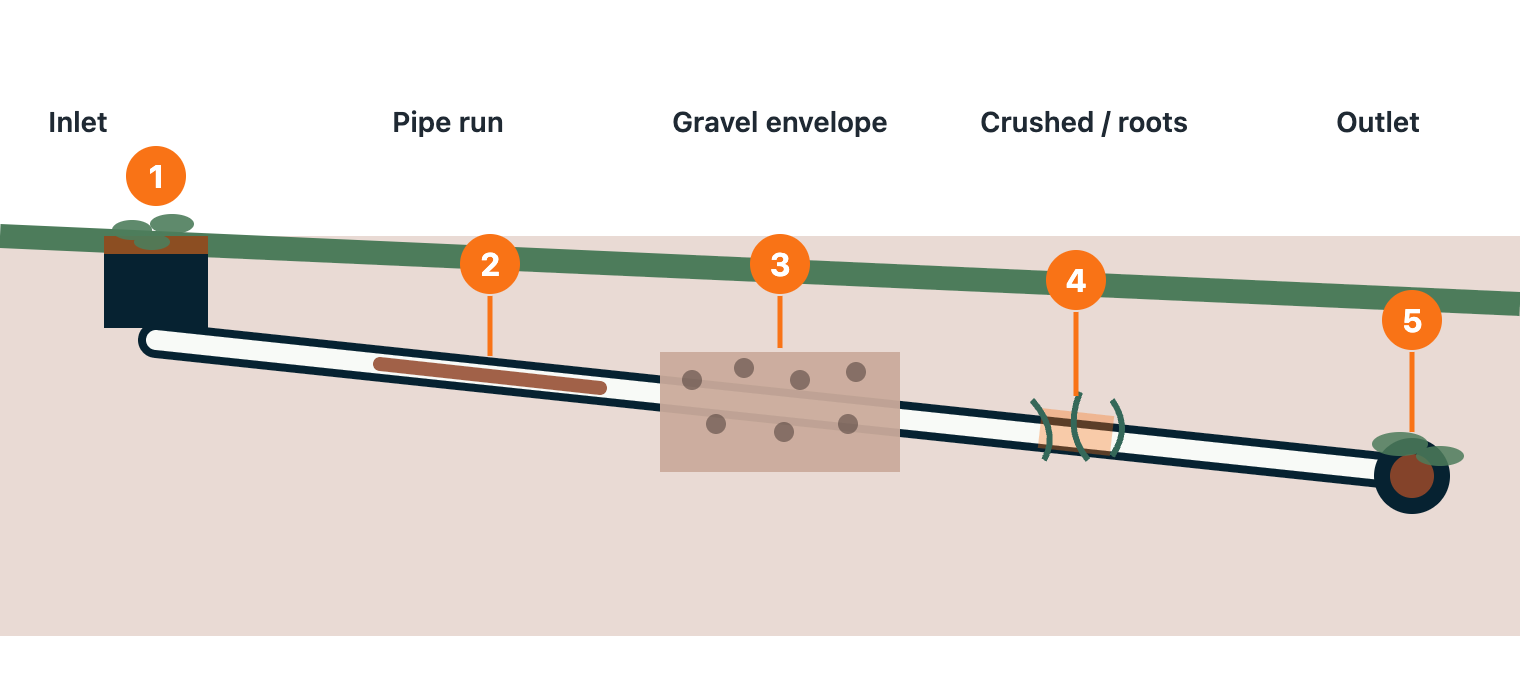
| # | Where | What you'd notice | Likely fix |
|---|---|---|---|
| 1 | Grate or inlet | Water ponds directly over the grate; debris visible in the basin | Lift the grate, clear leaves and silt. Minutes, free |
| 2 | Pipe run | Water enters the inlet but arrives slowly or not at all at the outlet | Flush, then snake. Usually DIY |
| 3 | Gravel envelope (French drains) | No standing water at any inlet — the ground itself just stays saturated, as if the drain were not there | Excavation. Cleaning will not help — see below |
| 4 | Crushed or root-invaded section | Water surfacing partway along the run; a soft or sunken line in the turf; repeat clogs in the same place | Locate and replace that section |
| 5 | Outlet | Everything upstream ponds; outlet is buried, silted, or cannot be found | Clear or rebuild the discharge. Often free |
Points 1, 2 and 5 are maintenance. Points 3 and 4 are repairs. The difference matters enough that it is worth being sure which you have before spending money.
Can it be cleaned, or does it need rebuilding?
This is the question that decides whether you are booking a service call or budgeting a replacement, and it is the one almost nobody answers.
Cleaning works when the pipe is blocked. Silt, leaf litter, and fine roots accumulate inside the pipe and restrict flow. Water still reaches the pipe perfectly well — it just cannot get through it. Flushing, snaking, or jetting clears the obstruction and the system works again.
Cleaning does nothing when the gravel is blocked. On a French drain, the pipe is only the last few inches of the journey. Water's actual route is through soil, into the gravel envelope, and only then into the pipe. If fine soil particles have filled the spaces between the stones, water can no longer reach the pipe at all. Jetting the pipe cleans a pipe that was never the problem.
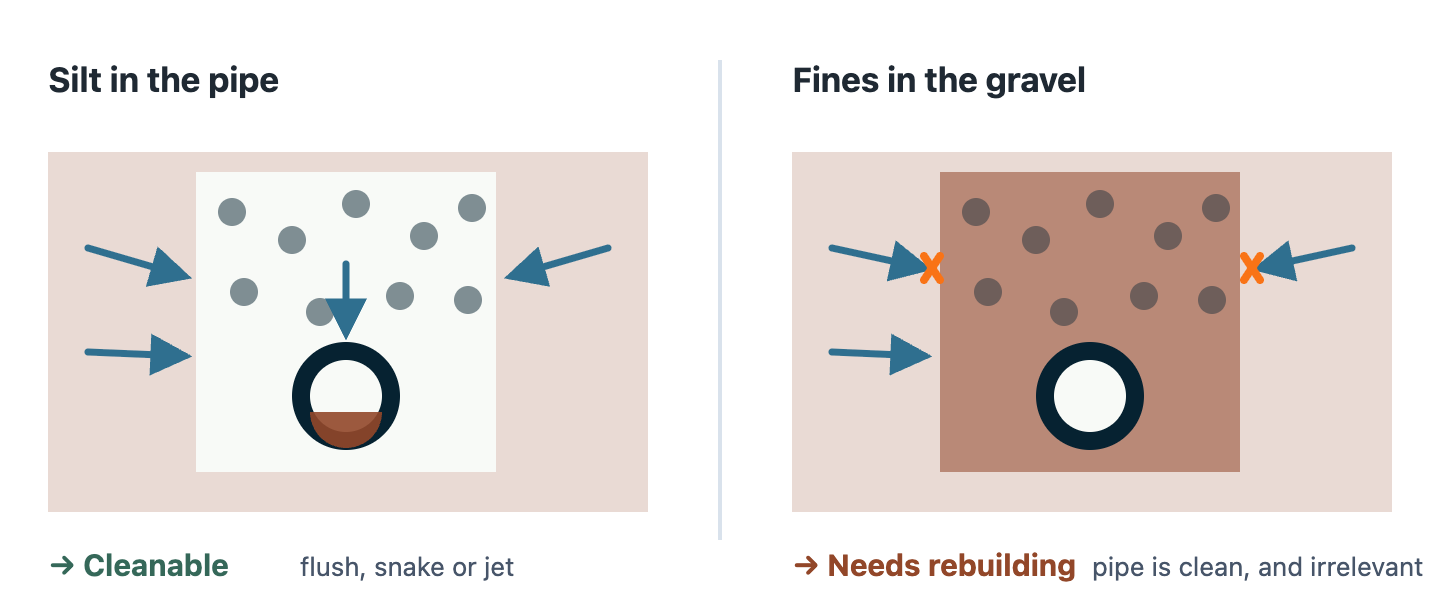
How to tell them apart. Pour water into the drain's inlet or highest access point and watch the outlet.
- Water goes in but comes out slowly or not at all — the pipe is obstructed. Cleanable.
- Water goes in and comes straight out, but the surrounding ground still stays saturated after rain — the gravel is no longer collecting. Not cleanable.
- The ground stays saturated and there was never really an inlet to pour into — this is a French drain that has stopped gathering water. Not cleanable.
The usual cause is filter fabric: omitted entirely, or wrapped around the pipe instead of around the gravel. Fabric's job is to keep fine soil out of the stone. Without it, every rain washes a little more silt into the voids, and the drain quietly loses capacity over three to eight years. It is the single most common reason a drain that worked beautifully at first is useless later.
Try these in order
Work through these in sequence. Each step is cheaper and less invasive than the next, and stopping as soon as water flows saves you the rest.
- Clear the grate and basin. Lift the grate, pull out leaves and silt, scoop the sump if the basin has one.
- Find and clear the outlet. As above — this is where a large share of blockages actually are.
- Flush from the highest point. Put a garden hose into the inlet at full flow for several minutes. Moving silt often needs nothing more. Watch the outlet while it runs.
- Snake or auger the pipe. A drum auger reaches most residential runs. Feed it from the inlet; if you meet a hard stop at a consistent distance, note that distance — it tells you roughly where the problem is.
- Pressure-wash carefully. A pressure washer with a drain-cleaning attachment clears compacted silt. Keep pressure moderate: thin corrugated pipe and old joints will not survive aggressive jetting, and it is possible to turn a clog into a hole.
Chemical drain cleaners are worth skipping entirely here. They are formulated to dissolve grease and hair in sanitary plumbing. They do nothing to silt, gravel, or roots, and a yard drain discharges to open ground, a ditch, or a storm system — so whatever you pour in ends up in the landscape.
When to stop
Some results mean the next step is not another tool.
- No flow after flushing from both ends. Something solid is in the way, and you have reached the limit of what a hose settles.
- Water surfacing partway along the run. Strongly suggests a crushed, separated, or root-broken section at that point.
- A soft or sunken line in the turf above the pipe. Soil is washing into a break and leaving a void. This gets worse, and it can develop into a genuine hole.
- Clogs returning within a season. Repeat blockages in the same place usually mean a belly holding water, roots regrowing, or a partial collapse.
- The ground stays saturated even though water passes through the pipe freely. The gravel has silted. No amount of cleaning changes that.
At that point a camera inspection is worth more than another weekend of effort — it locates the problem instead of guessing at it, and it tells you how much pipe actually needs replacing rather than assuming the whole run. Who to call depends on what you found: a drainage contractor for a collapsed or silted system, a plumber if the line ties into anything else.
If water has begun reaching a basement, yard drainage is no longer the whole problem and interior systems become part of the conversation.
What diagnosis and repair actually cost
A word of caution on the numbers you'll find elsewhere. Most published pricing for drain cleaning and camera inspection — commonly $300 to $800 for jetting and $250 to $900 for a camera — is sewer line pricing. Sewer lines are deeper, longer, under structures, and carry consequences a yard drain does not. Applying those figures to a shallow yard run overstates the cost considerably.
Yard-drain-specific service pricing is not well published, so treat the following as planning estimates rather than quotes:
| Work | Rough planning range |
|---|---|
| Clearing a grate, basin, or outlet | Free — an afternoon of your time |
| Auger or pressure-washer rental | $40–$80 per day |
| Professional clearing of a yard run | Typically a service-call minimum plus labour; below sewer jetting rates |
| Camera inspection of a short yard run | Less than a sewer inspection; ask for it priced separately |
| Excavating and replacing a damaged section | Comparable to new installation per foot — roughly $10–$35 per linear foot for yard work |
| Rebuilding a silted French drain | Effectively a new drain; price it as new installation |
What moves the number: how far the blockage is from an access point, whether machinery can reach the run, depth, and how much turf or paving has to be lifted and restored. Ask for the camera inspection to be quoted separately from the repair — bundling them removes your ability to get a second opinion on what the camera actually found.
Preventing the next one
- Keep grates clear, especially through leaf fall. Two minutes seasonally prevents most inlet blockages.
- Flush the system once a year with a hose at the highest point, before the wet season rather than during it.
- Know where your outlet is and keep it visible. Mark it if it sits somewhere easy to lose track of.
- Plant with the pipe in mind. Willows, poplars and other water-seeking species will find a drain run. Keep them well clear.
- On any rebuild, insist on filter fabric around the gravel — not around the pipe — and washed angular stone rather than rounded pea gravel. This is what determines whether the new drain lasts eight years or twenty-five.
Related pages
- How a French drain is meant to work
- Catch basins — for surface collection
- Standing water in your yard
- Who to call for yard drainage problems
Prevention
Stopping the next one
Once this blockage is cleared, a yearly outlet check and a flush every year or two prevents most repeats — and tells you whether the drain is silting because of how it was built.
FAQs
How do I know if my French drain is clogged?
Pour water into the highest access point and watch the outlet. If water goes in but does not come out, the pipe is obstructed. If water passes through freely yet the surrounding ground still stays saturated after rain, the pipe is fine and the gravel around it has silted up — a different problem with a very different fix. Erosion or a sunken line along the trench suggests a break rather than a blockage.
How can you tell if a French drain is working?
Watch it during and after a real rain. A working French drain runs at its outlet while it rains and for a while afterwards, and the ground along the trench dries out within a day or two of the rain stopping. A dry outlet while the yard stays soggy means water is not reaching the pipe or not leaving it. To test in dry weather, run a hose into the highest access point: water should appear at the outlet within minutes. If it flushes through clear but the ground still stays wet after rain, the pipe is fine and the gravel around it has likely silted up.
Can you snake a French drain?
You can snake the pipe, and for silt or fine roots inside the pipe that often works. But a French drain collects water through the gravel surrounding the pipe, and a snake cannot do anything about gravel that has filled with fine soil. Use a drum auger gently — perforated and corrugated pipe damages more easily than sewer pipe.
How much does it cost to unclog a yard drain?
Clearing a grate or outlet is usually free beyond your own time, and an auger or pressure washer rents for roughly $40 to $80 a day. Professional clearing of a yard run typically costs less than sewer jetting, which commonly runs $300 to $800 — sewer figures do not transfer to shallow yard pipe. Replacing a damaged section is priced more like new installation, roughly $10 to $35 per linear foot. All planning estimates, not quotes.
Why does my yard drain smell?
Standing water trapped in a blocked or bellied pipe goes stagnant, and decomposing leaf litter in a basin produces the same musty smell. It usually indicates water sitting somewhere it should be draining from. A persistent sewage-like odour is different and suggests the line is connected to, or has been cross-connected with, something it should not be — worth having looked at.
Can a clogged French drain be repaired, or does it need replacing?
It depends what is clogged. A blocked pipe can usually be cleared and the system carries on working. A gravel envelope that has silted up cannot be cleaned in place — the stone has to be dug out and replaced, which is effectively rebuilding that section. A crushed or root-broken run needs the damaged length replaced, not necessarily the whole system.
Do French drains need maintenance?
Yes, though not much. Keep any inlets and grates clear, flush the run annually with a hose, and keep the outlet visible and open. Drains that fail early almost always fail from neglected outlets or from missing filter fabric at installation, rather than from lack of routine attention.
How long should a yard drain last?
A properly built drain — washed angular stone, filter fabric around the gravel, consistent fall, a real outlet — should give twenty-five years or more. One built without fabric commonly declines noticeably within three to eight years as fines fill the voids. Build quality matters far more than age here.
Sources consulted
- French Drain Man — Why Would a French Drain Fail
- Ware Landscaping — Common French Drain Mistakes
- Horizon Services / Solvida Landscaping — outdoor drain clearing methods
- Forbes Home, Angi, HomeGuide — sewer jetting and camera pricing (cited for contrast)
By Under Your Home Team · Last reviewed 2026-08-09