Best Drainage System for a Yard: How to Choose Between Them
Two questions decide it. Is the water on the surface or in the soil? And do you have somewhere lower to send it? Surface water with an outlet means a catch basin or channel drain. Saturated soil with an outlet means a French drain. No outlet means storage — a dry well or rain garden. Everything else is detail.
Start with two questions, not eight options
Most guides on this subject list the systems and describe each one. That tells you what exists; it does not tell you what you need. Two observations narrow eight options to two or three before you compare anything.
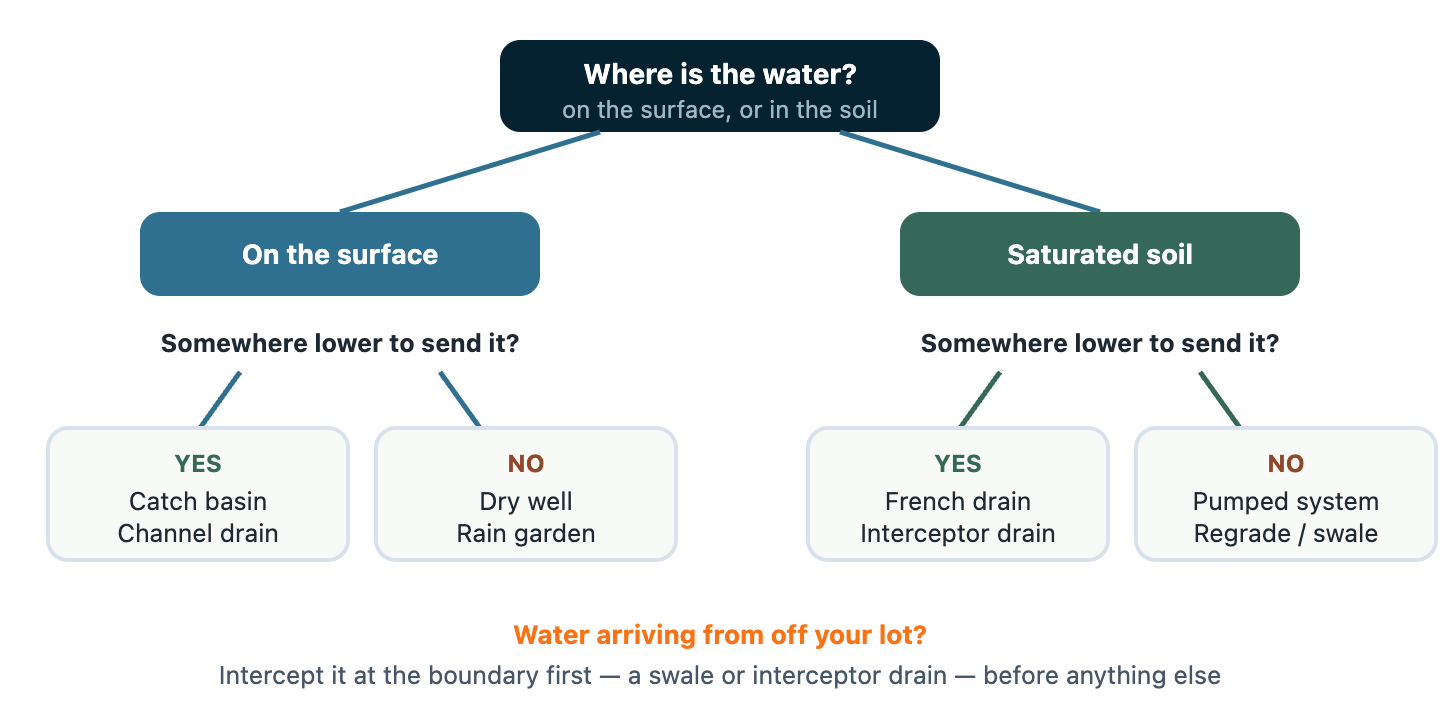
Question 1 — is the water on the surface, or in the soil? Wait for rain. If you can see a puddle, that is surface water. If the surface dries but the ground squelches for days and a screwdriver slides in with no resistance, the soil is saturated. These need different tools, and choosing the wrong category is the most expensive mistake on this page.
Question 2 — is there somewhere lower to send it? Every drain that moves water needs a discharge point lower than the drain itself. If you have one, you can move water. If you do not, you can only store it, absorb it, or pump it. Walk the property and find the low boundary before you shop.
A third question applies where relevant: is the water even yours? If it arrives from uphill, intercepting it at the boundary comes before anything you do downstream. See runoff from a neighbour's yard.
Every option compared
| Solution | Collects | Best for | Needs an outlet | DIY? | Rough cost | Main weakness |
|---|---|---|---|---|---|---|
| Catch basin | Surface, at a point | One clear low spot | Yes | Often | $150–$400 DIY · $600–$2,000 pro | Only drains what reaches it |
| Channel drain | Surface, along a line | Patio and driveway edges | Yes | Rarely | $30–$150 per ft | Costly to retrofit into concrete |
| French drain | Soil, along a line | Ground that stays soggy | Yes | Sometimes | $10–$35 per ft | Useless against surface pooling |
| Interceptor drain | Soil, across a slope | Seeps, uphill water | Yes | Sometimes | $10–$35 per ft | Must cross the flow, not follow it |
| Dry well | Stores and releases | No lower outlet available | No | Sometimes | $500–$3,000 | Poor in heavy clay |
| Rain garden | Absorbs and slows | Moderate runoff, planted areas | No | Yes | $300–$2,500 | Limited capacity in storms |
| Swale | Surface, across a line | Broad flow, boundaries | Yes, eventually | Yes | $500–$3,000 | Needs room and gentle grade |
| Regrading | Prevents collection | Low spots, wrong-way fall | No | Small areas | $500–$3,000 | Cannot fix soil that won't absorb |
| Retaining wall drainage | Behind a wall, full height | Walls holding a slope | Yes | Rarely | 10–20% of wall cost | Cannot be retrofitted cheaply |
All costs are planning ranges, not quotes.
What the table doesn't tell you
Combining beats choosing. These are rarely either/or. A catch basin collecting surface water and piping to a dry well; a French drain discharging into a rain garden; a swale intercepting uphill flow so a smaller basin can handle the rest — combinations are the norm on real properties, not a sign of over-engineering.
Volume and percolation drive the decision more than anything else. Match the system to both what arrives and how fast your soil can move it out. A dry well in soil that percolates at less than an inch an hour is a hole that fills and stays full. A basin sized for a drizzle is irrelevant in the storm you bought it for.
The cheapest fix is usually not on this table. Moving roof water further from the house and correcting a wrong-way grade resolve a large share of yard drainage problems and cost a fraction of any system here. Work through standing water in your yard before buying anything.
Maintenance varies more than cost. A catch basin needs its sump emptied once or twice a year — trivial, but it fails if skipped. A French drain needs almost nothing and is effectively unserviceable when it does fail. A rain garden needs seasonal planting care. Choose something you will actually maintain.
Matching to common situations
| What you're seeing | Usually the right first move |
|---|---|
| One low spot that holds water | Regrade or fill it; catch basin if it must stay |
| Lawn stays soggy for days over a wide area | French drain, once you've confirmed an outlet |
| Water pooling after every storm, gone in a day | Surface routing — basin or swale |
| Wet strip along a patio or driveway | Channel drain at the hardscape edge |
| Wet ground beside the house | Downspouts and grading, before any drain |
| Water sheeting in from uphill | Interceptor drain or swale at the boundary |
| Flat lot, nowhere lower at all | Dry well, rain garden, or a pumped system |
| Wet in dry weather too | Groundwater — interceptor drain, and reset expectations |
| A retaining wall that is wet, leaning or bulging | Find the drain outlet first — see retaining wall drainage |
Work through your own yard's conditions if none of these quite match.
The mistake that costs the most
Installing a French drain for surface water.
It is the most common expensive error in yard drainage, and it happens because "French drain" has become shorthand for "drainage" generally. A French drain collects water that has already soaked into the ground. Water sitting on top of ground that will not absorb it never reaches the pipe, so the drain runs dry while the puddle stays.
The check takes one rainfall: if you can see standing water on the surface, ask specifically why a surface drain is not the answer before agreeing to a trench.
Related pages
- French drains for yards
- Catch basins
- Patio and hardscape drainage
- Standing water in your yard
- Who to call for yard drainage
FAQs
What is the best drainage system for a yard?
There isn't a single best one — the right choice depends on whether water is on the surface or in the soil, and whether you have somewhere lower to discharge it. Surface water with an outlet suits a catch basin or channel drain. Saturated soil with an outlet suits a French drain. No outlet means storage: a dry well or rain garden. Answer those two questions and most options eliminate themselves.
Can I combine two drainage systems?
Yes, and combinations are normal rather than excessive. A catch basin piping into a dry well, a French drain discharging to a rain garden, or a swale intercepting uphill flow so a smaller system handles the rest are all common. Combining lets each part do what it is good at instead of forcing one system to cover everything.
Which yard drainage system is cheapest?
Regrading a low spot and extending downspouts are the cheapest meaningful fixes and often the only ones needed. Among installed systems, a DIY catch basin with a short run is typically $150 to $400 in materials. French drains and channel drains cost most per foot, and channel drain retrofits into existing concrete are the most expensive per foot of anything here.
What drainage works on a flat yard with no slope?
Gravity systems need fall, so on genuinely flat ground the realistic options are storage — a dry well or rain garden that holds water and releases it slowly — a pumped system lifting water to a discharge point, or regrading to create fall where none exists. Check first whether you have less slope than you think: a string line and line level over a long run often finds usable fall that is invisible by eye. The full decision is in how to drain a flat yard.
Which system needs the least maintenance?
A well-built French drain asks for almost nothing, though when it does silt up it is effectively unserviceable without excavation. Catch basins need the sump emptied once or twice a year — minimal effort, but failure is fairly quick if ignored. Rain gardens and swales need seasonal planting attention. The honest answer is to pick the one whose maintenance you will actually do.
Do I need a professional or can I do this myself?
Regrading a small area, extending downspouts, a single catch basin with a short run, and a modest swale are all realistic DIY projects. Anything involving precise fall over a long run, tying several inlets into one system, cutting into concrete, or working close to a foundation is worth having done properly — those are where mistakes are expensive to correct.
What is the most common drainage mistake?
Installing a French drain for water that is sitting on the surface. A French drain collects water from within saturated soil; it does not capture a puddle above it. If you can see standing water, ask why a surface drain is not the answer before agreeing to a trench. The second most common mistake is installing any system without first confirming where the water will discharge.
Sources consulted
- Ware Landscaping — types of yard drains
- Slot Drain Systems — backyard drainage design
- landscapedrains.com — choosing the right type of yard drain
- NDS — drainage product guidance
By Under Your Home Team · Last reviewed 2026-08-09