Dry Wells for Yard Drainage: The Clay Problem Nobody Mentions
A dry well is a buried chamber that holds water and lets it soak slowly into the surrounding soil. It only works if that soil actually drains — and heavy clay, which causes most yard drainage problems, is exactly where dry wells fail. Run a one-hour perc test before you dig; under half an inch per hour and a dry well will just stay full.
What is a dry well, and how does it work?
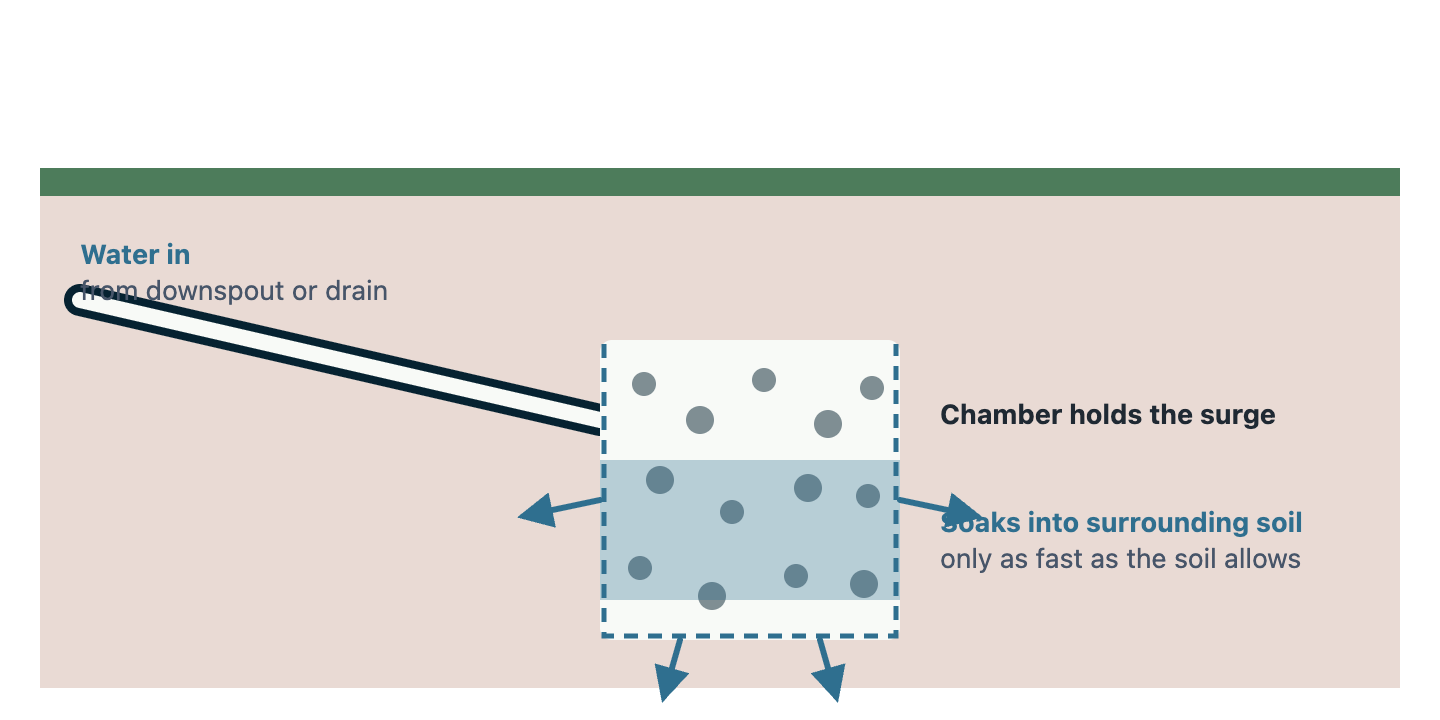
A dry well is a buried container — a gravel-filled pit, a perforated barrel, or a stacked plastic chamber — that receives water from a pipe, holds it, and releases it slowly into the soil around and beneath it. Unlike a French drain or a catch basin, which move water to a lower outlet, a dry well does not send the water anywhere. It stores a surge and lets the ground absorb it over the following hours.
That is what a dry well is used for — one specific situation: you have water to get rid of, and nowhere lower to send it. A flat lot with no daylight outlet, a downspout with no ditch to reach — a dry well buys you somewhere to put the water.
The problem nobody leads with
Here is the paradox that sinks most dry wells: a dry well only works in soil that drains well — and if your soil drained well, you probably wouldn't have a drainage problem.
The soils that create standing water, soggy lawns, and flooding are heavy clay and compacted ground. Those are precisely the soils a dry well cannot empty into. Water goes into the chamber, the surrounding clay refuses to take it, and you have built an expensive underground pond that stays full and overflows in the next storm. One long-standing building advice column bluntly titles its dry-well page around the fact that these installations rarely work — and clay is why.
This does not mean dry wells are useless. It means the decision hinges entirely on one number you can measure yourself before spending anything.
Test your soil first — the one-hour perc test
Do not dig a dry well until you know your soil can empty it.
- Dig a hole about 12 inches deep where the dry well would go.
- Fill it with water and let it drain completely — this pre-soaks the ground.
- Fill it again and time how far the level drops in one hour.
| Drop per hour | What it means for a dry well |
|---|---|
| More than 1 inch | Excellent. A dry well will work well here |
| 0.5 to 1 inch | Workable, but size it generously and expect slow recovery |
| Less than 0.5 inch | A dry well will not empty fast enough. Choose a different approach |
| Barely moves overnight | Heavy clay or a high water table. A dry well is the wrong tool |
If you fail this test, the honest options are moving the water somewhere lower with a catch basin or French drain, a swale to carry it across the surface, or a pump — not a dry well. Work through your yard's conditions if you are not sure which fits.
Sizing — bigger than most people build
Even in good soil, a dry well fails if it is too small for the water it receives. The capacity has to match the surge, not the average.
Roof water is the usual input, and it is large: about 0.62 gallons per square foot of roof, per inch of rain. A 1,000 square foot roof section sheds roughly 620 gallons in a one-inch storm. A dry well fed by that downspout has to hold a meaningful fraction of it while the soil catches up.
As rough planning guidance:
- A common residential dry well is 3 to 4 feet across and 3 to 4 feet deep, holding a few hundred gallons in its gravel voids.
- The worse your perc rate, the bigger the well needs to be, because it drains slower and must store more between absorption.
- One dry well per downspout is often cleaner than trying to feed several into one undersized chamber.
Undersizing is the second most common dry well failure after clay. A well that fills in the first ten minutes of a storm does nothing for the next hour of rain.
To turn your roof area and soil into an actual size, the dry well sizing calculator gives the gallons to store, the pit dimensions and tons of stone, and an estimate of whether your soil will drain it in time — the two numbers that decide whether a dry well is worth building here.
What installation involves
- Perc test first — as above. Everything depends on it.
- Call 811 for utility locating before digging.
- Site it well away from the foundation — typically at least 10 feet — and never uphill of the house.
- Excavate to size, keeping the sides as intact as possible.
- Wrap the chamber or pit in filter fabric to keep soil fines out of the void space — the same failure that silts up a French drain will clog a dry well.
- Feed it with solid pipe from the downspout or catch basin, with a little fall to the inlet.
- Add an overflow path for storms that exceed the well's capacity, so water surfaces somewhere harmless rather than backing up to the house.
What it costs
| Scope | Rough planning range |
|---|---|
| DIY dry well, single downspout | $150 – $800 |
| Professionally installed dry well | $1,500 – $3,500 |
| Large or multiple chambers | $3,000 – $6,000+ |
Planning estimates, not quotes. Cost moves with size, depth, soil (clay is harder to dig and often means a bigger well), and how far the feed pipe runs. If a contractor proposes a dry well without asking about your soil or running a perc test, that is worth questioning — they are recommending the one solution most sensitive to a number they haven't checked.
Related pages
- Standing water in your yard — start here to confirm the cause
- French drains for yards — for saturated soil with an outlet
- Catch basins — for surface water with an outlet
- Swales and berms — to carry water across the surface
- Compare every yard drainage option
FAQs
What is a dry well?
A dry well is an underground chamber — a gravel-filled pit, a perforated barrel, or a stacked plastic tank — that takes water from a downspout or drain pipe, holds it, and lets it soak slowly into the surrounding soil. It is used where there is water to get rid of but nowhere lower to send it, and it only works if the soil around it drains.
Does a dry well work in clay soil?
Usually not. A dry well empties by letting water soak into the surrounding soil, and heavy clay absorbs too slowly to keep up. If your soil drains less than half an inch per hour on a perc test, a dry well will fill and stay full. Since clay is what causes most yard drainage problems in the first place, this rules dry wells out more often than homeowners expect — test before you dig.
How deep should a dry well be?
A typical residential dry well is 3 to 4 feet deep, which balances storage against digging effort. Depth matters less than getting below the topsoil into ground that can absorb, and than total capacity. In very poor soil, going deeper to reach a more permeable layer sometimes helps, but that is a bigger job — and often a sign a different solution fits better.
How big does a dry well need to be?
Big enough to hold a real fraction of the surge it receives. Roof water runs about 0.62 gallons per square foot per inch of rain, so a 1,000 square foot roof section sheds roughly 620 gallons in a one-inch storm. The poorer your soil drains, the larger the well must be, because it stores longer between absorption. Undersizing is a leading cause of dry well failure.
What is the difference between a dry well and a French drain?
A French drain collects water and carries it to a lower outlet — it moves water. A dry well receives water and holds it while the surrounding soil absorbs it — it stores water. Use a French drain when you have somewhere lower to send water; use a dry well when you do not. They are often used together, a drain feeding a dry well at its end.
How long does a dry well last?
A well-built dry well with filter fabric and good soil can last 10 to 30 years. They fail early when fabric is omitted and soil fines silt up the void space, when they are undersized, or when they are installed in soil that never drained well enough to begin with. Keeping the inlet clear and the feeding line unclogged extends its life.
Do I need a permit for a dry well?
Sometimes. Requirements vary by municipality, and some areas regulate dry wells as stormwater infrastructure or restrict them near wells, septic systems, and property lines. Check with your local building or stormwater department before installing, and call 811 for utility locating regardless.
Can a dry well handle my downspouts?
Yes, that is one of the most common uses — provided your soil drains well enough and the well is sized for the roof area feeding it. In poor soil, a dry well on a downspout fills faster than it empties and overflows. Test your soil first, size generously, and include an overflow path for storms beyond its capacity.
What are the disadvantages of a dry well?
The biggest is that it depends entirely on the soil: in clay or over a high water table it fills and stays full, which is where most yard drainage problems occur. It also has a fixed capacity, so a storm bigger than it was sized for overflows; it can silt up if built without filter fabric; it is buried, so problems are hard to see and fix; and some municipalities restrict or permit it as stormwater infrastructure. None of these rule it out in sandy or loamy soil — they are reasons to test and size before digging.
What happens if a dry well fills up?
Water backs up the feed pipe and overflows — at the overflow outlet if one was built, or at the lowest opening in the line, often the downspout by the house, if not. A well that fills in every storm and is still full a day or two after the rain stops is usually undersized, in soil that drains too slowly, or silted up inside. Pumping it out only buys time; the fix is a larger well, a different solution, or moving the water somewhere lower.
How do you know if you have a dry well?
Look for downspouts or yard drains whose pipes disappear underground with no visible outlet at a ditch, curb or slope — the water has to be going somewhere. A round lid, inspection port, or grate set in the lawn is another sign. Previous owners' records, the property's permit history, or a local stormwater office may also show one. A drain camera run down the feed pipe can confirm it if nothing is visible.
Sources consulted
- Bob Vila — dry wells 101
- AsktheBuilder — why dry well installation rarely works
- Hello Gravel — dry well sizing and capacity
- OEHHA California — dry well guidelines
By Under Your Home Team · Last reviewed 2026-08-09