How to Bury a Downspout: Plan It With Your Yard's Numbers
To bury a downspout, call 811, then find a lower outlet and measure the drop to it. Dig a trench that falls at least 1 inch every 8 feet, run solid 4-inch pipe from a downspout adapter to a pop-up emitter or daylight, test it with a hose, then backfill. The fall, not a fixed depth, sets how deep you dig.
Most guides to this job give the same list: dig about a foot, slope it, add an emitter. What they skip is the one check that decides whether the line will drain at all, which is whether your yard has enough fall between the downspout and the outlet. The planner below does that check first. Then every step uses your numbers.
The pipe has to be solid, not perforated. Perforated pipe leaks roof water back into the soil beside the house; here is why buried downspout pipe has to be solid.
Before you dig: is burying the right fix?
- An extension is enough when the water only needs to get 6 to 10 ft away and nothing is in the way. A $15 extension is the right answer more often than people expect.
- Bury it when the extension blocks the mower or a path, when the water has to travel further, or when there's a lower spot it can reach.
- It's the wrong job when there's nowhere lower for the water to go (look at a dry well or regrading instead), or when water is already coming into the house.
If you're still weighing it up, start with whether you need to bury it at all.
Plan your run
You need four things: the run length, how much the ground drops from the downspout to the outlet, the roof area feeding this downspout, and where the pipe will end.
How to measure the ground drop
Drive a stake beside the downspout and another at the outlet. Tie a string to both, level it with a line level, then measure from the string down to the ground at each stake. The difference is your drop. Over longer runs, add a stake every 20 ft and repeat. A hump in the middle matters as much as the total. The slope calculator turns the same measurement into a grade.
Works
Your run works at 1% or better
Dig about 12 in deep at the downspout, tapering to about 8 in at the pop-up emitter. The pipe falls 2.9%, about 3.5 in every 10 ft.
Your run, side view
- Fall the pipe needs
- 5 in
- 40 ft at 1%, 1/8 in per foot
- Fall your yard gives
- 10 in
- Ground drop from the downspout to the outlet
- Trench depth at the downspout
- 12 in
- To the bottom of the pipe
- Trench depth at the pop-up emitter
- 8 in
- Assumes an elbow and emitter with the lid at grade. Check your emitter's instructions
- Pipe slope
- 2.9%
- Roof water in a 1-inch storm
- ≈ 360 gal
- What this line has to carry
- Soil to dig out
- ≈ 0.6 cu yd
Your shopping list
- 5 × 10-ft lengths4-in solid smooth-wall PVC pipe43 ft including fittings. Solid, never perforated
- 1Downspout adapterRectangular to round. Match your downspout (2×3 or 3×4 in) to 4-in pipe
- 190° elbow (or two 45°s) at the downspout
- 1Leaf filter or cleanout teeRecommended. It keeps shingle grit and leaves out of the line
- 4CouplingsSkip if your pipe is bell-end
- 1 small kitPVC primer and cement
- 1Pop-up emitter (4 in)Often sold with its 90° elbow
- 2 × 0.5 cu ft bagsClean ¾-in stone or pea gravelBedding around the emitter
DIY materials typically $80–200. Planning estimate, not a quote.
The roof figure sizes the job: a typical downspout delivers a few hundred gallons in a one-inch storm. The roof runoff calculator works it out for the whole house.
If the fall isn't there
A buried downspout line needs about 1/8 inch of fall per foot of run, and the pipe still needs cover at the downspout. When the yard can't give both, don't bury it and hope. Pick one of these:
| Option | When it works | What it costs you |
|---|---|---|
| Start shallower | You're only an inch or two short | Less cover; keep the route under lawn |
| Move the outlet closer | The first part of the run has most of the drop | Discharge nearer the house; stay 10 ft out |
| Move the outlet lower | There's a lower spot a little further on | A longer run that may still win on fall |
| Switch outlet | Daylight fails but a pop-up emitter or a dry well would work | A dry well needs soil that drains |
| Keep it above ground | The yard is flat to every edge | A surface extension or a channel to the lawn |
Stop and get it priced by a pro when:
- the route has to cross a driveway, sidewalk or patio;
- there's no lower point anywhere on the property;
- utility marks run along the route;
- you're thinking of tying into a storm sewer, which often needs a permit;
- water is already reaching the foundation.
You can get it quoted instead. The planner above will tell a contractor exactly what you measured.
The steps
The steps below carry the numbers from your plan. On a phone, step mode shows one step per screen, with big buttons and your ticks saved.
Step 1. Call 811 before you dig
Call 811, or file a ticket online, a few working days before you dig. In North Carolina the notice is three full working days. The service is free.
The marks cover public lines up to your meter. Private lines such as irrigation, landscape lighting or a gas line to a grill aren't marked, so find those yourself.
You'll need: Phone or 811 website
Watch out: Hand-dig within 18 in either side of any mark.
Step 2. Mark the route and the outlet
Run a string or spray-paint line from the downspout to the pop-up emitter, about 40 ft. Take the most direct route that keeps falling. Go around high spots rather than through them.
Keep the outlet at least 10 ft from the house, on your own land, and away from paths and driveways.
You'll need: Stakes · String · Marking paint · Tape measure
Watch out: A route that crosses a sidewalk or driveway needs boring or cutting. That's a job to price with a pro.
Step 3. Cut the sod and dig the trench
Cut the turf in strips about 8 in wide and roll them onto a tarp so they can go back.
Dig about 12 in deep at the downspout, finishing about 8 in deep at the pop-up emitter. Follow the fall, not a fixed depth. A trench 6 in wide is enough for 4-in pipe.
You'll need: Flat spade · Trenching shovel · Tarp
Watch out: Digging deeper at the house "to be safe" spends fall you need at the outlet.
Step 4. Grade the trench floor
Stretch a string line above the trench and level it, then measure down to the floor. It should drop about 1.5 in every 5 ft (2.9%).
Scrape the high spots, and fill the low ones with sand and tamp them. A dip, or belly, holds water and silt, and that's how buried lines clog.
You'll need: String line and line level, or a 4-ft level · Tape measure · Hand tamper
Watch out: Don't trust your eye on a flat yard. Measure every 5 ft.
Step 5. Connect at the downspout
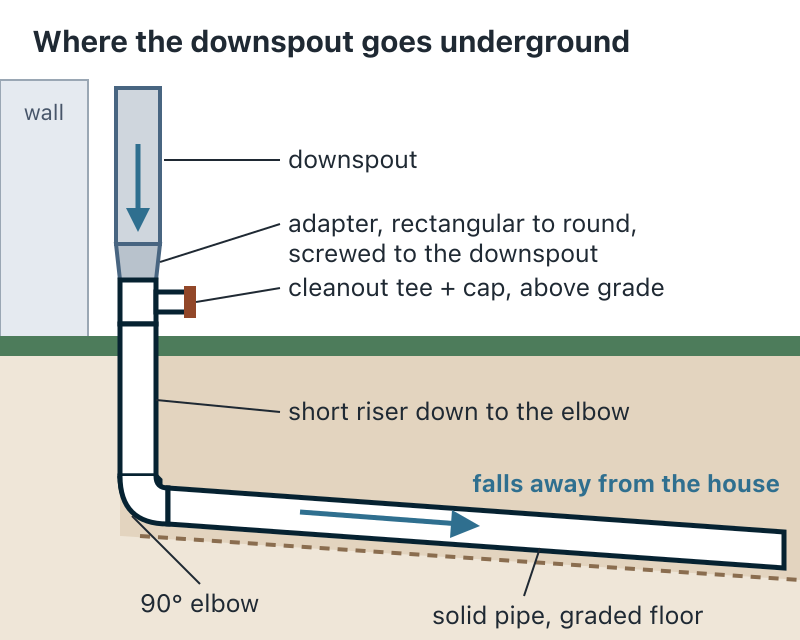
Cut the downspout a few inches above the ground. Fit the adapter and screw it to the downspout, then add an elbow down into the trench.
Put a leaf filter or a cleanout tee here. It's the cheapest way to keep the line flushable for years.
You'll need: Hacksaw or tin snips · Drill and screws · Adapter and elbow
Watch out: An adapter that only friction-fits can work loose in the first big storm.
Step 6. Lay and join the pipe
Dry-fit the 4-in PVC along the trench first, then prime and cement each joint. Turn each joint a quarter turn as it goes on.
Keep the pipe bedded on the floor you graded. Don't let it ride up on a clod or a stone.
You'll need: Hacksaw · PVC primer and cement
Watch out: Use solid pipe only. Perforated pipe leaks roof water back into the soil beside the house.
Step 7. Set the pop-up emitter
Dig a pocket at the end about 8 in wider than the emitter and line it with 2 to 3 in of clean stone. Fit the elbow and emitter so the lid sits flush with the turf. A lid set below the grass collects soil and seals shut.
In clay, wrap the stone pocket in landscape fabric so silt doesn't fill it.
You'll need: Emitter and elbow · Clean stone · Level
Watch out: Keep the emitter at least 10 ft from the house, and where its water runs away from the foundation, not back toward it.
Step 8. Test it before you backfill
Run a garden hose into the downspout for five minutes. The emitter lid should lift and water should flow out.
Walk the trench and look for leaks at the joints, or for a spot where water backs up. Fix it now, while it's still open.
You'll need: Garden hose
Watch out: If water backs up at the downspout, there's a belly or a blocked joint. Don't bury it hoping it clears.
Step 9. Backfill and relay the sod
Backfill in layers of about 4 in, tamping each one by foot. Use stone-free soil against the pipe.
Leave a slight mound, because it settles. Relay the sod and water it in.
You'll need: Shovel · Hand tamper · Hose
Watch out: Stones dropped onto PVC can crack it. Shovel the first layer in, don't dump it.
The video walks the same job in section, from the pipe mistake to why depth should come from the fall:

Mistakes that show up a year later
- Perforated pipe. Roof water soaks into the ground along the house instead of leaving.
- A belly in the line. One low spot holds water and silt, and the line slowly clogs.
- An outlet too close. Discharging within 10 ft of the house re-wets the soil you drained.
- No filter or cleanout. Shingle grit and leaves settle in the first few feet, with no way to flush them.
- An emitter set below the turf. Soil washes over the lid and seals it. Here is how pop-up emitters fail.
Looking after it
Once a year, run a hose into the downspout for a few minutes and watch the outlet. Clear grass from around the emitter lid. If water backs up at the downspout, the line is blocked or has sagged. See clearing a buried downspout line before you dig anything up.
Related pages
- Underground downspout drainage: pipe, depth, slope and the four places a line can end
- Pop-up drain emitters: how they work, how they fail, where to put one
- Connecting a downspout to a catch basin: adding a basin in the run
- Dry wells: storage when there's nowhere to discharge
- Downspout drainage problems: how far the water needs to go
FAQs
Is burying your downspouts a good idea?
Yes, when the water needs to travel further than an extension can carry it and there is a lower outlet for the pipe to reach. Then it clears the lawn and keeps roof water away from the house. It's a poor idea when the yard is too flat for the pipe to keep falling, or when there's nowhere for the water to come out. A buried line with no fall just holds water underground.
What do you put at the bottom of a downspout before burying it?
A rectangular-to-round adapter screwed to the downspout, then an elbow that turns down into the trench. A leaf filter or a cleanout tee just above the ground is worth adding. It catches shingle grit and gives you a place to flush the line without digging. From there, use solid pipe for the whole run.
How deep should the trench be for a buried downspout?
Let the fall decide. About 12 inches at the downspout is a good target, but the trench can only be as deep as the drop to the outlet allows while the pipe keeps falling 1/8 inch per foot. At a pop-up emitter it usually ends about 8 inches deep. On flat lots, shallower and properly sloped beats deeper and flat. The planner works out both ends for your run.
How far from the house should a buried downspout discharge?
At least 10 feet, and further where the yard allows, at a point where the water runs away from the house rather than back toward it. The outlet should also discharge on your own property, not onto a neighbour's lot, a sidewalk or the street.
Can I bury corrugated pipe for a downspout?
Yes, as long as it is solid, not perforated. Corrugated pipe is cheaper and bends around obstacles. Its ribs trap sediment, though, and it is harder to clear with a snake. Smooth-wall PVC carries more water for its size and can be flushed or snaked for years. For a run you never want to dig up again, smooth wall is worth the difference.
Can two downspouts share one buried line?
Yes. Join the second downspout with a wye fitting angled in the direction of flow, never a straight tee. Where two downspouts share a line, use 6-inch pipe for the shared section, especially on a long or flat run. Two roofs' worth of water in a 4-inch pipe at minimum slope can back up at the upper downspout in a heavy storm.
How long does it take to bury a downspout yourself?
A 20 to 40 foot run by hand is typically a day's work for one person, longer in heavy clay or rocky ground. Add the wait for utility marks after you call 811, which is three full working days in North Carolina. DIY materials typically run $80 to $200 for a single downspout. That's a planning estimate, not a quote.
Sources consulted
By Under Your Home Team · Last reviewed 2026-10-07