Pop-Up Drain Emitters: How They Work and Why They Stop Working
Every buried drain line has to end somewhere. On a sloped lot the answer is easy: run the pipe until the ground falls away and let it surface. On a flat lot there is nowhere lower to reach, and that is the problem a pop-up emitter exists to solve.
It is a genuinely useful piece of hardware. It is also the component most likely to be the reason an otherwise well-built drain has stopped working, and the reason is almost always the same.
How it works
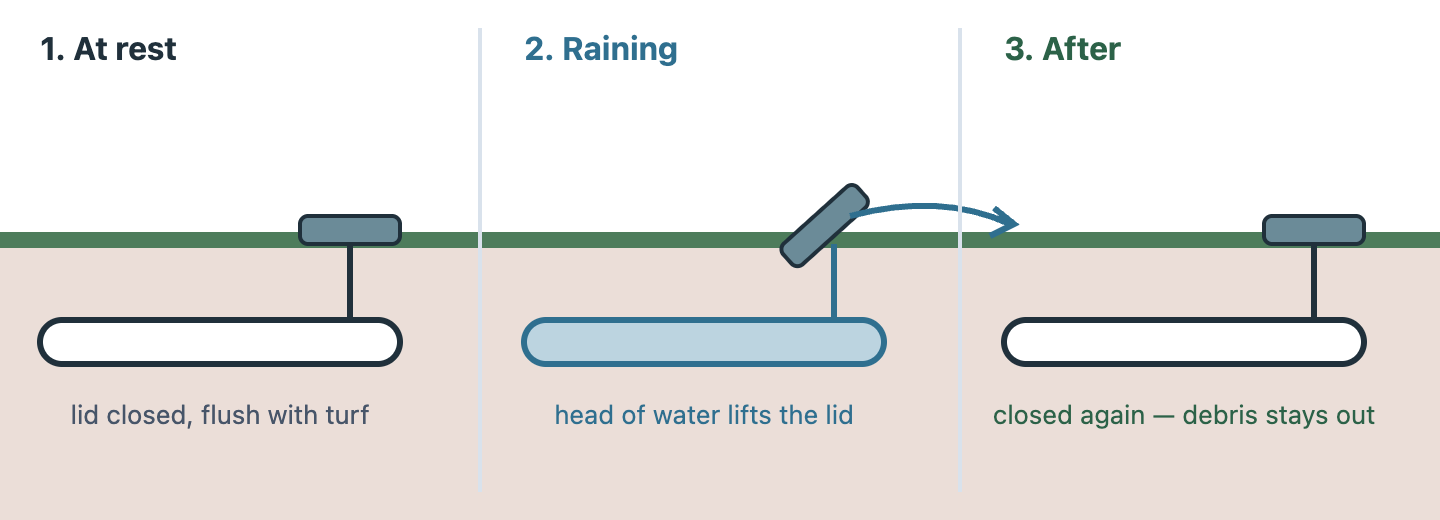
The emitter is a small box set flush with the lawn at the end of the pipe, with a hinged lid. Nothing about it is powered or clever.
When rain fills the buried line, water backs up against the closed lid. Once enough head builds behind it, the pressure lifts the lid and water spills out across the grass. When the flow stops, the lid falls shut under its own weight. Closed, it keeps out leaves, mulch, mice and mosquitoes — which is the entire reason you would not simply leave an open pipe end in the lawn.
The one failure that matters
Ask anyone who installs drainage for a living what goes wrong with pop-up emitters and you will get the same answer: the grass grows over the lid.
It happens slowly and invisibly. Turf creeps in from the edges, thatch builds up over the seam, a season of mowing packs clippings around it, and one day the lid can no longer lift against the head of water behind it. The pipe is fine. The emitter is fine. The lid is simply held shut by the lawn.
What follows is the part that matters, because the water does not just sit there. A drain line with no exit backs up along its whole length to the lowest opening it can find, which is usually the downspout at the house — precisely the water you buried the pipe to move away. People discover this as a flooded garage or a wet crawl space, and they blame the pipe.
Two things follow from that:
- A pop-up emitter is not a fit-and-forget component. It needs the turf cut back around the lid once or twice a year, which takes about a minute per emitter. Mark where they are.
- If you have a buried line that has stopped working, check the emitter before you assume the pipe is blocked. Lift the lid by hand. If it moves freely and the pipe is dry, the blockage is upstream; if the lid is locked in turf, you have found it.
Siting one properly
| Decision | What to do | Why |
|---|---|---|
| Distance from the house | 10 ft or more, and downhill | Discharging close re-wets the soil you drained. |
| Ground around it | Falls away on all sides | Water needs somewhere to go once it surfaces. |
| Depth of the lid | Flush with the turf, not below it | A recessed lid collects soil and seals faster. |
| Pipe into it | Solid pipe, sloped to the emitter | Perforated pipe releases water before it arrives. |
| Fall to the emitter | 1% minimum from the inlet | Below that the line silts and the head never builds. |
| Marking | Note the location; a paver alongside helps | You cannot maintain what you cannot find. |
A detail worth understanding: the emitter needs a head of water to open. That is why the pipe should arrive with the emitter as the lowest point in the run, and why an emitter set higher than a sag in the pipe will never open reliably — the water pools in the sag instead of pushing against the lid.
To plan the whole run to an emitter, with the trench depth at each end and a parts list, use the step-by-step downspout planner.
Winter: why a buried line freezes, and how to stop it
A buried downspout line rarely freezes because it is buried too shallow. It freezes because water is left sitting in it when the cold arrives. A line that drains empty after each storm has almost nothing in it to freeze.
Water collects in three places:
- Dips in the run. Any low spot holds water, like the trap under a sink. That pocket freezes first, then blocks the line, and freezing water can crack the pipe.
- The emitter and its elbow. The lid and the last few feet of pipe sit closest to the surface. When melting roof snow runs at midday and freezes again at night, the lid can freeze shut. A frozen lid plugs the whole system.
- Behind a buried or snow-covered outlet. If snow or ice covers the emitter, the water has nowhere to go and stays in the pipe.
Can't you just bury it below the frost line?
Frost depth is shallow in most of North Carolina and runs to several feet in the northern states. You can look up your own on our frost line depth by ZIP code tool. Installers in cold climates point out that a downspout line is almost never buried entirely below the frost line. The pipe has to come up to an emitter at the surface, and every extra inch of depth at the house costs fall at the outlet. So the line has to be designed to empty itself instead.
Five things that keep a line from freezing
- Steady fall, no dips. Our minimum is 1% (about ⅛ inch per foot). Cold-climate installers use ¼ inch per foot, so the line drains faster and leaves less behind.
- An emitter with a weep hole. Some pop-up emitter elbows have a small weep hole that lets the last of the water soak out after a storm. Keep it clear of silt.
- A way out near the house. An air gap or a disconnect at the downspout lets water spill out above ground if the buried line freezes, instead of backing up against the foundation. In cold regions, some homeowners disconnect the buried line for winter and run an above-ground extension until the ground thaws.
- Clear the outlet. Keep snow and ice off the emitter lid after storms.
- Smooth PVC over thin corrugated pipe for runs you want to last. Rigid pipe holds its shape, and its smooth wall doesn't trap silt the way corrugated ribs do.
In most of North Carolina, a hard freeze is an occasional inconvenience, and the line thaws before the next big rain. These steps matter most where the ground stays frozen for weeks.
When to use something else
A pop-up emitter is the right answer for a flat lot where a buried line has nowhere to daylight. It is the wrong answer in three situations.
- You have real fall. If the pipe can surface on a slope, let it. An open daylight outlet has no moving part, no lid, and nothing to maintain.
- The volume is large or constant. Several downspouts joined into one line put a lot of water through one small lid. Splitting into two outlets, or a catch basin and a wider discharge, handles it better.
- The ground cannot take the water. An emitter puts water on the surface. If the surface is heavy clay that already ponds, you have moved the puddle rather than removed it — a dry well or regrading is the more honest fix, assuming the soil will accept it.
Tool
Is there enough fall to skip the emitter?
Measure the drop between the drain inlet and the point where you want water to come out. If the grade clears 1% and the ground keeps falling away, the pipe can daylight and you do not need a moving part at all.
Related pages
- Burying downspouts — the line an emitter sits at the end of
- Dry wells — storage instead of surface discharge
- Catch basins — collecting surface water into the same system
- Clogged yard drain — diagnosing a line that has stopped flowing
- Downspout drainage problems — where the water should be going in the first place
FAQs
How does a pop-up drain emitter work?
It is a hinged lid on the end of a buried drain line, set flush with the lawn. When rain fills the pipe, water backs up behind the closed lid until the head of water is enough to lift it, then spills out across the grass. When the flow stops the lid drops shut under its own weight, keeping leaves, mulch, rodents and mosquitoes out of the pipe. Nothing about it is powered — it works on the pressure of the water behind it.
Do pop-up emitters actually work?
Yes, for the job they are meant for: giving a buried line an exit on a flat lot where the pipe cannot reach daylight. They are not the best outlet available — an open daylight discharge on a slope is better because it has no moving part — but where there is no fall to work with, an emitter is the standard answer. The caveat is that it needs occasional maintenance, which is where most disappointment comes from.
Why is my pop-up emitter not popping up?
Almost always because turf has grown over the lid and is holding it shut. Grass creeps in from the edges, thatch builds over the seam, and eventually the lawn is stronger than the head of water behind the lid. Cut the turf back around the rim and try lifting it by hand. The other possibilities are a sag in the pipe holding the water short of the emitter, or a blockage upstream, but the lawn is the first thing to check.
How deep should a pop-up emitter be set?
The lid sits flush with the surrounding turf — level with the grass, not recessed into a dip. A lid set below grade collects soil and clippings and seals over much faster, and the depression around it holds the water it just released. The pipe feeding it should arrive with the emitter as the lowest point of the run, so the head builds against the lid rather than pooling in a sag before it.
How far from the house should a pop-up emitter be?
At least ten feet, and on ground that falls away from the building. The whole purpose of the buried line is to move roof water away from the foundation, and an emitter set close simply puts it back into the soil you were draining. Further is better if the fall allows it — the constraint is usually how much slope you have to work with, not the distance itself.
What is the alternative to a pop-up emitter?
An open daylight outlet, where the pipe surfaces on a slope and discharges with no moving part — always the first choice where the ground allows it. Otherwise a dry well, if the soil will accept the water rather than pond it, or a connection to a storm system where local rules permit. On a genuinely flat lot with heavy clay, the honest answer is sometimes that no outlet works well and the water needs managing at the surface with regrading instead.
Do pop-up emitters freeze?
They can, in a hard freeze, because the lid and the last few feet of pipe sit near the surface. In most of North Carolina this is an occasional inconvenience rather than a design problem, and the line thaws before the next significant rain. It matters more in colder regions, where the usual answer is to bury the run below the frost line and accept that the emitter itself is a seasonal weak point. The winter section above covers what keeps a line from freezing.
Sources consulted
By Under Your Home Team · Last reviewed 2026-10-17