Water Pooling Near Your Foundation: What It Means and What It Doesn't
Wet soil beside the house is common and usually fixable with downspouts and grading. It is not the same as water getting inside, and neither is the same as structural movement. Most yards with pooling near the foundation have the first problem only. Establish which one you have before accepting any quote.
Three different problems, often treated as one
Search for this and nearly every result is published by a company that repairs foundations. That does not make the information wrong, but it does mean the framing tends to run in one direction: water near the house leads to foundation damage, so act now.
The more useful framing separates three things that get bundled together.
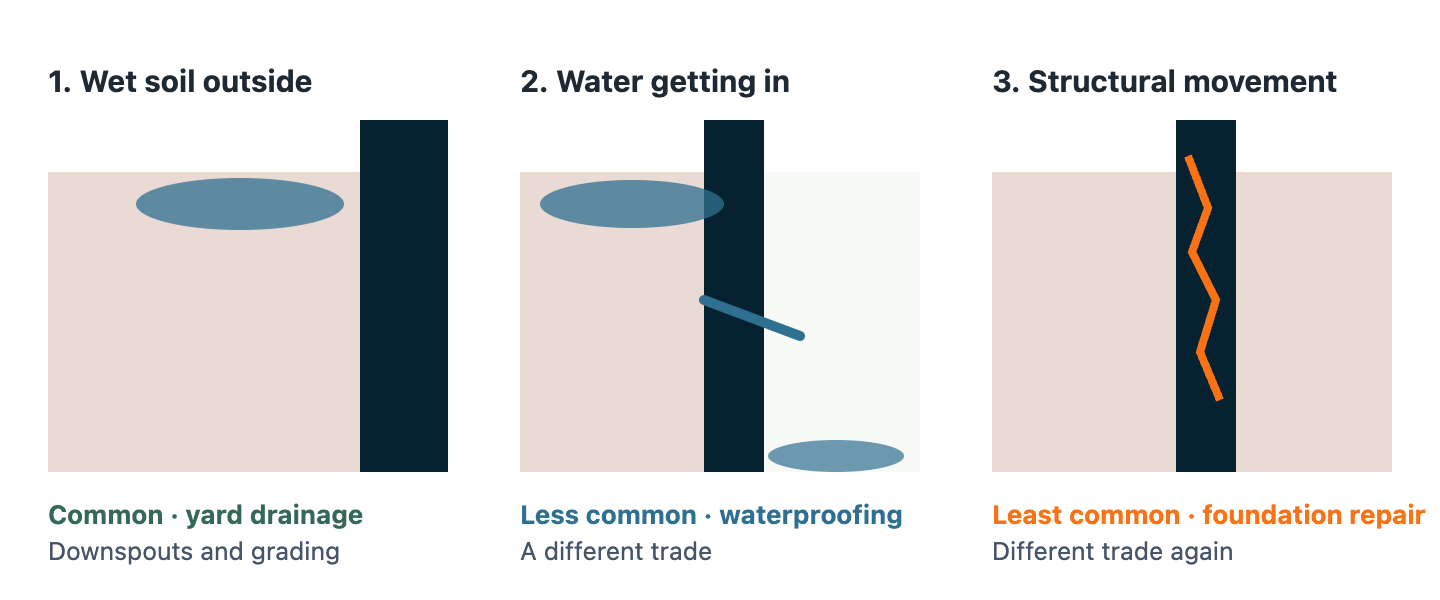
Wet soil outside the wall is a yard drainage problem. It is extremely common, it is usually caused by roof water and grading, and it is usually the cheapest thing on this page to fix.
Water getting through the wall — damp basement walls, water on a basement floor, a wet crawl space — is a waterproofing problem. Yard drainage reduces the load on the wall but is rarely the complete answer once water is actually coming through.
Structural movement — cracking, bowing, settlement, doors that have stopped closing — is a foundation problem. Persistent moisture can contribute to it over years, particularly in expansive clay soils, but pooling water beside the house does not mean movement is happening or will happen.
The reason this separation matters: the first problem is very common and the third is not, and the cost difference between them is enormous. It is worth knowing which conversation you are in before you have it.
What actually suggests something more than wet soil
Signs that put you beyond yard drainage:
- Water appearing inside — on a basement floor, at the wall-floor joint, or standing in a crawl space
- Cracks in foundation walls wider than about a quarter inch, or cracks that are visibly wider at one end
- Horizontal cracking or inward bowing of a basement wall
- Doors and windows that have recently begun sticking, or floors that have developed a noticeable slope
- Cracks that are measurably changing over months
Signs that generally do not, on their own:
- A puddle beside the house after heavy rain that clears within a day
- Damp soil against the wall in a wet season
- Fine hairline cracks in concrete or mortar that have not changed
- Efflorescence — the white powdery deposit — on masonry, which indicates moisture movement, not structural damage
If you are seeing items from the first list, the appropriate next step is an assessment from the relevant trade rather than yard work. If you are seeing only the second list, what you have is a drainage problem, and the rest of this page applies.
Fix the cheap things first
The order matters, because the first two steps solve a large share of cases and cost a fraction of what comes after.
1. Deal with roof water
This is the most common cause and the easiest to fix. A 2,000 square foot roof sheds roughly 1,250 gallons per inch of rain. Discharged at the base of the wall, that water saturates exactly the soil you least want saturated.
Get discharge at least 6 feet from the wall, ideally 10. Extensions, buried lines to a pop-up emitter, or a proper underground carrier all work. See downspout drainage problems for how far is far enough and where the water should end up.
2. Check and correct the grade
Ground should fall away from the house. The commonly cited target is about 6 inches of drop over the first 10 feet — roughly a 5% grade. Beyond that, a gentler slope is enough as long as water keeps moving.
Check it with a string line and a line level, as described in standing water in your yard. Yards frequently settle over the years into a slight slope toward the house without anyone noticing, particularly around backfilled areas near newer construction.
Where the grade is wrong, correcting it with soil is usually cheaper and more durable than installing drainage to manage the consequences. Keep soil several inches below siding, weep holes, and any wood.
3. Look at what's touching the wall
Landscaping beds built up against the foundation, edging that traps water, mulch piled high against siding, and impermeable plastic sheeting under decorative stone all hold moisture against the wall. These are cheap to correct and frequently overlooked.
4. Only then consider drainage
If roof water is handled, the grade falls away, and the ground beside the house still stays saturated, then subsurface drainage becomes reasonable. An exterior French drain intercepting water before it reaches the wall, or a swale further out, can help.
Be aware that deep excavation immediately against a foundation wall is a different job from a yard drain — more expensive, with more potential to cause problems if done badly. If a quote involves excavating along the foundation, that is worth a second opinion.
Unsure where you sit? Work through your yard's conditions.
A note on quotes
Because this symptom sits at the boundary between three trades, it attracts quotes of wildly different sizes for the same visible problem. A homeowner with a downspout discharging at the wall can reasonably receive a $200 suggestion and a $15,000 one for the same puddle.
Two questions separate them quickly:
"What did you observe that rules out downspouts and grading?" If nothing was measured and the downspouts were not checked, the diagnosis was not made on your property.
"What specifically indicates a structural problem?" A good answer names an observation — a crack width, a measured floor slope, a documented change. A vague answer about long-term risk is a sales position, not a finding.
For structural questions, an independent structural engineer works for you rather than for the company that would perform the repair, and typically costs a few hundred dollars.
Related pages
- Standing water in your yard
- Downspout drainage problems — usually the first fix
- Yard grading and levelling
- French drains for yards
- Roof Runoff Calculator — size the water coming off your roof
- Who to call for yard drainage
FAQs
How far should water drain away from a house?
Aim for ground that falls away from the wall by about 6 inches over the first 10 feet — roughly a 5% grade. Downspout discharge should be further still: 6 feet as a minimum, 10 or more where the yard allows. What matters more than any single number is that water keeps moving once it gets there rather than pooling at the end of the run.
Is water pooling near the foundation an emergency?
Rarely. A puddle after heavy rain that clears within a day is a drainage issue worth fixing, not an emergency. What warrants prompt attention is water appearing inside, a wall bowing or cracking horizontally, or cracks that are visibly widening. Those indicate something beyond yard drainage and are worth assessing quickly.
Will water next to my foundation crack it?
Not directly or quickly. The mechanism people are describing is slower: repeated wetting and drying of expansive clay soils causes them to swell and shrink, which over years can contribute to movement. Persistent saturation also raises hydrostatic pressure against walls. Both are real, both are reasons to fix drainage, and neither means a puddle after a storm is damaging your house this month.
What slope do I need around my house?
The commonly used figure is 6 inches of fall in the first 10 feet, roughly a 5% grade. Some references use 2 to 3 inches per 10 feet further out in the yard, which is a gentler slope for a different purpose. Both can be true: steeper immediately against the house, gentler once water is clear of it. Check with a string line and line level rather than by eye.
How do I stop water from pooling around the foundation?
In most yards the fix is ordinary and inexpensive: extend the downspouts so roof water discharges several feet out instead of at the wall, then correct the grade so the first few feet of soil slope away from the house rather than toward it. Those two steps stop the majority of water pooling around a foundation. Only when they are already right and the soil against the wall still stays saturated does a perimeter drain become worth considering — and that is a larger, separate job.
Do I need a French drain around my foundation?
Often not. If roof water is discharging at the wall or the grade falls toward the house, fix those first — they cause most cases and cost far less. A perimeter drain becomes reasonable when those are already correct and the soil beside the wall still stays saturated. Note that deep excavation against a foundation is a different job from a yard drain, and should be quoted and considered as such.
Should I put gravel or plastic against the foundation?
Decorative gravel over plastic sheeting is a common and generally unhelpful combination — the plastic traps water where you least want it and prevents the soil beneath from drying. If you want gravel for appearance, keep the ground beneath it graded away from the wall and avoid impermeable membranes directly against the foundation.
Who should I call about water near my foundation?
It depends which of the three problems you have. For wet soil outside the wall, a drainage or landscape contractor. For water coming through into a basement or crawl space, a waterproofing specialist. For cracking, bowing, or movement, an independent structural engineer first — before a repair company, so the assessment comes from someone with no stake in the recommendation.
Sources consulted
- JES Foundation Repair — drainage around foundations
- Alpha Foundations — foundation drainage tips
- LawnLove — keeping groundwater away from the house
- Vodaland — stopping water pooling near foundations
By Under Your Home Team · Last reviewed 2026-09-18