How to Install a French Drain in Your Yard: Step by Step
To install a French drain in a yard, confirm a lower outlet and at least 1% fall first, then call 811. Dig a trench about 12 inches wide and 18 inches deep, line it with filter fabric, lay gravel and 4-inch perforated pipe with holes down, cover with gravel, wrap the fabric, and test with a hose before backfilling.
Is a French drain the right fix?
A French drain collects water from ground that stays saturated and carries it to a lower outlet. It is the right tool for some wet yards and the wrong one for others, so check the match before you dig:
- The ground stays soggy for days, but water doesn't sit on top. A French drain fits. Is a French drain right for your yard? walks through the diagnosis.
- Water pools on the surface in one low spot. A catch basin usually works better.
- Water sheets across the lawn from uphill. A swale is cheaper. On a hillside, a drain run across the slope to intercept water is a curtain drain.
- Water is coming into the basement. See the note at the end of this page.
Three measurements before you buy anything
Most French drains that fail were dug properly and planned badly: the outlet turned out higher than the trench, or the fall wasn't there. Ten minutes of measuring prevents both.
1. Where the water will leave
Choose the outlet first. It can be a spot on a slope where the pipe comes out of the ground ("daylights"), a pop-up emitter, or a dry well. Wherever it is, it has to be lower than the bottom of the trench at its deepest end, on your own property, and pointed away from the house, a neighbour and the sidewalk.
2. How much fall the route has
Drive a stake where the drain starts and another at the outlet. Tie a string between them, hang a line level on it and adjust until it reads level. The difference between the string-to-ground measurements at the two stakes is your fall.
A gravity French drain needs at least 1% fall: ⅛ inch per foot, or 1¼ inches every 10 feet. Some guides round that to "an inch every 10 feet", but an inch in 10 feet is 0.83%, below the minimum those same guides quote. If the ground gives you less than 1%, the trench has to make up the difference by getting deeper, which the depth table below shows. The yard slope calculator does the arithmetic, and how much slope you need for drainage explains the method in more detail.
3. Whether the soil drains
A one-hour drainage test shows how quickly water leaves the ground. A French drain still works in slow clay; it just collects more slowly. The result matters most if your outlet is a dry well, because a dry well depends on the soil absorbing water.
| What you found | Go ahead? |
|---|---|
| Outlet lower than the trench end, and 1% fall or more | Yes. Build it as described below |
| An outlet exists, but fall is under 1% | Yes, if the trench can get deep enough at the outlet end. Check the depth table |
| Nowhere lower than the trench | Not as a gravity drain. See how to drain a flat yard |
| Water seeps into a test hole on its own | High water table. A drain can help, but the outlet must be lower still |
Tools and materials for a 100-foot drain
Tools: stakes, string and a line level, tape measure, marking paint, a trenching shovel or a rented walk-behind trencher, a 4-foot level, wheelbarrow, hand tamper, utility knife, and tarps for the soil you dig out.
Materials: 4-inch perforated pipe, non-woven filter fabric, clean washed angular stone about ¾ inch (#57 stone, not pea gravel), a capped cleanout riser, outlet fittings, and topsoil and sod if you cap the trench with turf.
These quantities for a 100-foot run come from the same calculations as the French drain gravel calculator:
| Trench (width × depth) | Stone | 50-lb bags | Pipe | Fabric | Soil to move | Turf cap | Materials (planning) |
|---|---|---|---|---|---|---|---|
| 8 × 12 in, stone to the surface | 2.4 yd³ · 3.3 tons | 128 | 105 ft · 11 sticks | 420 ft² · 4-ft roll | 3.1 yd³ | — | $270–$510 |
| 6 × 18 in (trencher), turf cap | 2.0 yd³ · 2.8 tons | 110 | 105 ft · 11 sticks | 630 ft² · 6-ft roll | 3.5 yd³ | 0.6 yd³ topsoil + 55 ft² sod | $330–$600 |
| 12 × 18 in, turf cap | 4.4 yd³ · 6.2 tons | 238 | 105 ft · 11 sticks | 630 ft² · 6-ft roll | 6.9 yd³ | 1.2 yd³ topsoil + 110 ft² sod | $490–$840 |
| 12 × 24 in, turf cap | 6.4 yd³ · 9.0 tons | 348 | 105 ft · 11 sticks | 630 ft² · 6-ft roll | 9.3 yd³ | 1.2 yd³ topsoil + 110 ft² sod | $590–$980 |
Stone is figured at 1.4 tons per cubic yard with 10% added for settling. A turf cap reserves the top 4 inches for topsoil and sod. "Soil to move" is loose volume: 7 cubic yards is several pickup loads, so decide where it goes before you start. Four-inch pipe handles most yard drains; the French drain sizing calculator tells you whether a long run or a big catchment needs 6-inch. Enter your own trench size in the gravel calculator for exact figures and prices.
How to install a French drain, step by step
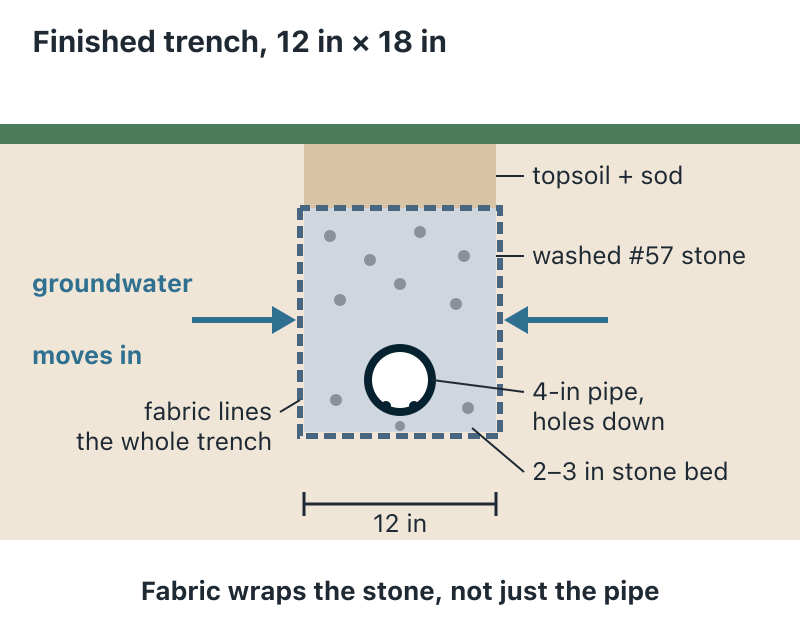
- Mark the route and the outlet. Paint a line from the wettest area to the outlet. Keep the trench a few feet from the house and out of tree root zones where you can.
- Call 811. Utility locating is free and required before digging in most states. Irrigation lines and low-voltage cable often sit at exactly French drain depth, so hand-dig near any marks.
- Stake and string the line. Set a stake every 10 feet with a level string along them, and mark the trench depth needed at each stake. The next section shows how to work those depths out.
- Cut the turf and dig. Roll the sod aside if you'll reuse it and pile soil on tarps. Dig to width (about 12 inches by hand, or the trencher's width) and to the depth marked at each stake.
- Check the fall every 10 feet. Measure from the string down to the trench bottom at each stake, and fix high and low spots now. A dip that holds an inch of water becomes a silt trap.
- Line the whole trench with fabric. Lay filter fabric across the bottom and up both sides, with enough left at the top to fold over later. The fabric wraps the stone, not just the pipe.
- Lay a stone bed. Spread 2 to 3 inches of stone along the bottom, keeping the fall you set.
- Lay the pipe with the holes down, and add a cleanout. Holes facing down let water into the pipe as soon as it reaches the bottom of the trench. Fit a capped vertical cleanout at the upstream end so the line can be flushed later.
- Cover with stone. Fill around and over the pipe to about 4 inches below grade if you're capping with turf, or to the surface if you're leaving gravel exposed.
- Test it. Run the hose test described below before anything is buried.
- Fold the fabric and restore the surface. Fold the fabric over the stone, add topsoil and reset the sod. Don't pack heavy clay back over the top, because it can seal the drain from surface water.
- Finish the outlet. Let the pipe daylight onto a stable planted or rock-lined spot, or connect it to a pop-up emitter or dry well. Put a critter guard on an open pipe end.
How deep the trench gets along the run
The trench bottom has to fall 1% the whole way, whatever the ground surface does. On sloping ground the trench can stay at a steady depth. On flat ground it gets deeper as it goes, and the outlet has to be lower still.
This is a 60-foot run starting 18 inches deep, with the bottom falling ⅛ inch per foot:
| Distance from the start | Flat ground | Ground falls 3 in over the run | Ground falls 7½ in over the run |
|---|---|---|---|
| 0 ft | 18 in | 18 in | 18 in |
| 10 ft | 19¼ in | 18¾ in | 18 in |
| 20 ft | 20½ in | 19½ in | 18 in |
| 30 ft | 21¾ in | 20¼ in | 18 in |
| 40 ft | 23 in | 21 in | 18 in |
| 50 ft | 24¼ in | 21¾ in | 18 in |
| 60 ft | 25½ in | 22½ in | 18 in |
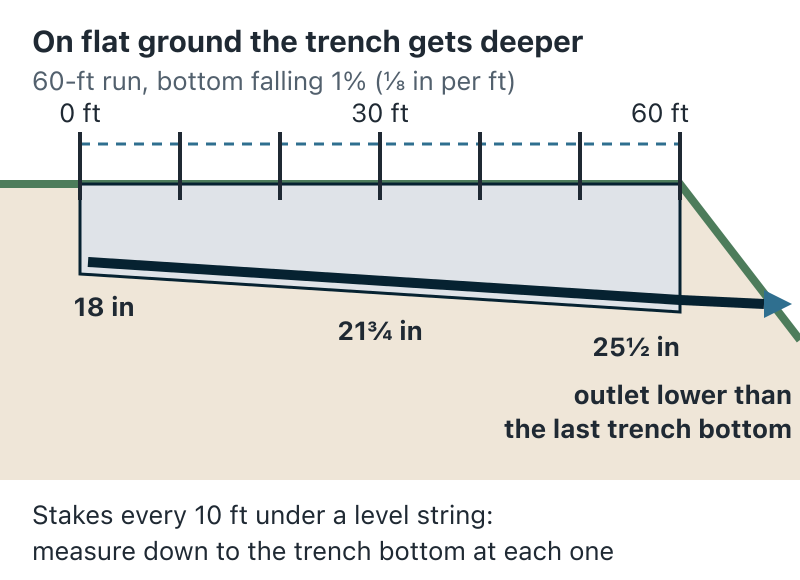
Two things follow. First, on flat ground a long drain gets deep quickly: the same trench would be about 30½ inches deep at 100 feet, which means more digging and more stone. Second, the outlet has to sit below the trench bottom at the last stake, 25½ inches down in the flat example. A lawn that "slopes a bit toward the back" isn't enough on its own. If the outlet can't go that low, shorten the run, start shallower, or look at the flat-yard options.
How deep to start depends on where the water sits. Most yard drains end up 18 to 24 inches deep; a shallow run intercepting a hillside seep can work at about a foot.
Test it before you backfill
A drain that passes this test before it's buried rarely surprises you later:
- Run a hose into the cleanout at full flow for 5 to 10 minutes. Water should reach the outlet within a few minutes and keep flowing steadily.
- Watch the open trench. Water standing in the stone at one spot marks a dip in the pipe. Lift and re-bed that section.
- Watch the start of the run. Water backing up at the cleanout instead of moving along means the fall is wrong or the outlet is blocked or too high.
- Lay a level on each 10-foot section of pipe as a last check before the stone goes over it.
- After the first real rain, check that the outlet runs and the trench line isn't staying soft.
Mistakes that show up a year later
| Mistake | What happens | How to avoid it |
|---|---|---|
| A dip (belly) in the pipe | Water sits, silt settles, and the line clogs from that point | Check the fall at every stake before stone goes in |
| Holes facing up | Water has to rise to the top of the pipe to get in, so the trench bottom stays wet | Holes down |
| Fabric only around the pipe (a sock) | Silt fills the stone instead, and the drain slows within a few seasons | Line the whole trench |
| Pea gravel or stone with fines | Packs tight, leaves less room for water, and silts faster | Washed angular #57 stone |
| No cleanout | Nothing to flush, so a small blockage means digging up the line | A capped riser at the upstream end |
| Outlet higher than assumed | The drain fills and backs up | Measure the outlet before digging |
| Heavy clay packed back on top | Surface water can't reach the stone | Topsoil and sod, or stone to the surface |
| Connected to a sewer or septic line | Usually against code, and it can overload the system | Daylight, a pop-up emitter or a dry well |
These are the same failure points covered in French drain maintenance: most of a drain's lifespan is decided the day it's built.
Dig by hand or rent a trencher?
Hand-digging 100 feet of 12 × 18-inch trench moves about 7 cubic yards of soil. That's a hard weekend or more for two people, and harder in clay or roots. A walk-behind trencher, commonly rented by the day, cuts a narrower trench (often 6 inches) much faster, and the narrower trench needs less than half the stone. Trenchers struggle with rocks and roots, though, and can't follow tight curves.
Dig during a dry spell, when the soil is workable rather than frozen or waterlogged. But watch where water collects in the wet season first, so the trench goes where the problem actually is.
On a slope, run the drain across the slope to intercept water rather than straight down it. That layout is a curtain drain, and it's built exactly like this.
What it costs: doing it yourself or hiring it out
| Route | Planning range |
|---|---|
| DIY, 100 feet, materials only | About $270–$980, depending on trench size and whether you cap it with turf |
| Hired, yard French drain | Roughly $10–$35 per linear foot installed, about $1,000–$3,500 for 100 feet |
Planning estimates, not quotes. The outlet, site access, restoring paving, and hauling away soil move the number most, and the yard French drain cost guide prices each one. The yard drainage cost calculator prices the whole job. If you get quotes, how to compare drainage quotes shows what each should spell out.
Related pages
- Is a French drain right for your yard? — when it works and when it doesn't
- Curtain drains — the same build, run across a slope
- How to drain a flat yard — when there's no lower outlet
- French drain maintenance — keeping it working for decades
- French drain gravel calculator — materials for your trench size
- How much slope you need for drainage
FAQs
Can you install a French drain yourself?
Yes, for a yard drain with a clear outlet and at least 1% fall. The skills are simple: measuring, digging, and laying pipe to a steady slope. The hard part is moving several cubic yards of soil. Get utilities marked first, and bring in help if the run is long or deep, the ground is rocky, or you aren't sure where the outlet can go.
How deep should a French drain be?
For yard water, usually 18 to 24 inches deep, and about a foot for a shallow drain intercepting a hillside seep. It isn't a fixed number, though: the trench has to keep 1% fall all the way to an outlet, so on flat ground it gets deeper toward the end. Set the depth by where the water sits and where it can leave.
Does a French drain have to go downhill?
Yes. A gravity French drain needs at least 1% fall, about ⅛ inch per foot, from its start to its outlet. With less, water lingers in the pipe and silt settles. If there's nowhere lower for the water to go, use storage or a pump instead, as described in how to drain a flat yard.
Where should you not put a French drain?
Over buried utilities, through a septic drain field, in tree root zones, and anywhere the water only pools on the surface, where a catch basin or regrading does the job better. Don't dig one along a route with no outlet lower than the trench, and don't rely on a yard drain to stop water already coming into a basement.
Can I tie a French drain into my sewer line?
Usually not. Most local codes prohibit sending groundwater or stormwater into a sanitary sewer or a septic system, because it can overload them. Discharge to daylight, a pop-up emitter or a dry well instead, and check local rules before connecting to any storm drain.
How much gravel do I need for a 100-foot French drain?
About 4.4 cubic yards, roughly 6 tons, for a 12 × 18-inch trench capped with turf. A narrow 6-inch trencher cut or a shallow 8 × 12-inch trench needs 2 to 2.5 cubic yards. Those figures include 10% for settling. The French drain gravel calculator works it out for your own dimensions.
What is the best time of year to install a French drain?
Dig during a dry spell, when the soil is workable rather than frozen or waterlogged. But watch where water collects during the wet season first, so the drain goes where the problem really is. In much of the country, late summer and early autumn suit both.
How long does it take to install a French drain?
A short, hand-dug run of 20 to 30 feet is often a weekend project. A 100-foot drain dug by hand can take several days of heavy work. With a rented trencher the digging may take hours rather than days, leaving the stone, pipe and surface restoration.
Sources consulted
- NDS — French Drain Installation Guide
- Commercial Industrial Supply — How to Install a French Drain
- Lenz Enterprises — Seven Steps to Building a French Drain
- Compact Power Rents — How to Install a French Drain in 10 Easy Steps
- Easy Digging — Determine the Proper Depth and Slope for a French Drain
- Cardona Construction — How Deep Should a French Drain Be?
By Under Your Home Team · Last reviewed 2026-09-15