French Drain Maintenance: What It Needs, and How Long It Lasts
French drains are sold as a permanent fix and treated as a fit-and-forget one. They are neither. A drain is a pipe surrounded by stone, buried in soil that is constantly trying to migrate into it, and how long it resists that is mostly a function of how it was built.
This page is about keeping a working drain working. If yours has already stopped flowing, start with diagnosing a clogged yard drain instead — finding the blockage is a different job from preventing one.
What maintenance actually involves
Less than people expect, and it takes an hour a year.
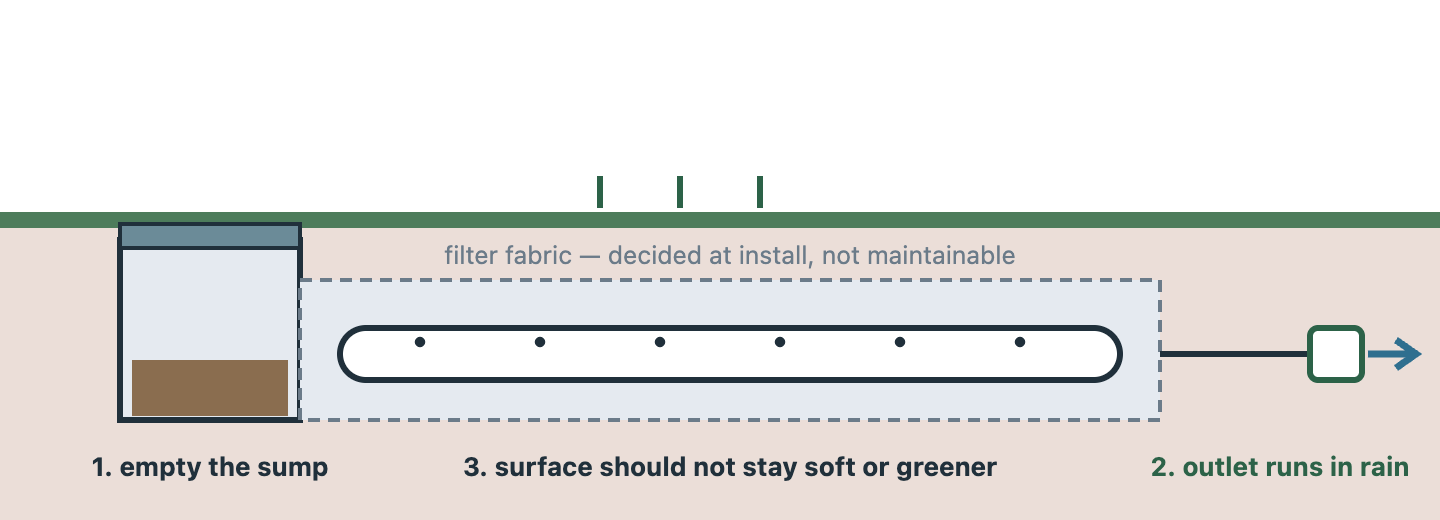
- Look at the outlet after heavy rain. This is the single most useful check. Water should be running out of the discharge point during and shortly after a storm. If the ground is soaked and the outlet is dry, the drain is not doing its job — and you now know that in autumn rather than in the middle of a February flood.
- Clear the outlet. Leaves, silt, a rodent nest, or grass grown over the end. A blocked outlet backs the whole line up and is the easiest thing on this list to fix.
- Lift and clean any catch basin lids. The sump in a catch basin exists to collect silt so the pipe does not. That only works if somebody empties it.
- Check the surface above the run. A line of grass that stays greener, or a soft strip that squelches underfoot, suggests water is sitting in the trench rather than moving along it.
- Flush it every one to two years. A garden hose into the cleanout or upstream end, run for several minutes, moves light silt before it consolidates. Under trees or in silty soil, make it annual.
What actually kills a French drain
Almost none of it is neglect. The decisions that set a drain's lifespan were made on the day it went in.
| Cause | What happens | Fixable later? |
|---|---|---|
| No filter fabric | Fine soil washes into the stone voids and fills them | No — the drain is rebuilt, not cleaned |
| Fabric wrapped around the pipe only | Silt fills the stone instead, same outcome one step later | No |
| The wrong stone | Rounded or fines-heavy gravel packs tight and loses void space | No |
| Too little fall | Water moves slowly, silt settles out of it and consolidates | Sometimes, by re-laying at grade |
| Roots | Fine roots enter perforations and mat inside the pipe | Often, by cutting or jetting |
| Roof water piped in | Adds silt and volume far beyond what the drain was sized for | Yes, by separating the lines |
| No cleanout | Nothing can be flushed, so small problems become total ones | Only by adding one |
That table is really an argument about installation. If you are having a drain built, the things worth insisting on are fabric lining the whole trench, clean angular stone, at least 1% fall, and a cleanout at the upstream end. None adds much to the price, and together they are most of the difference between a drain that lasts decades and one that disappoints in five years.
Tool
Was the drain ever big enough?
A drain that has always struggled in heavy rain may not be blocked at all — it may be undersized or too flat for the water reaching it. Enter the catchment and the slope to see whether the pipe was ever going to keep up.
How to flush one
For a drain that is slow rather than dead:
- Find the upstream access. A cleanout riser, a catch basin, or the inlet end. If there is none, this is the moment you discover why cleanouts matter.
- Run a hose in for several minutes and watch the outlet. Water arriving quickly and running clear means the line is open. Water arriving late, or brown, means silt is moving.
- Repeat until it runs clear. Light sediment often clears in one session.
- If the water does not arrive at all, stop flushing. You are not dealing with silt but with a blockage, a collapse, or a disconnection, and more water will not help.
A drain snake handles roots and packed debris. Hydro jetting — high-pressure water, typically a professional service — is the most effective option for a heavily silted line, with one caveat worth knowing: pressure that clears a solid sewer pipe can damage thin corrugated drainage pipe or blow apart a joint. Anyone jetting a French drain should know what pipe they are working in.
How long should it last
A drain built properly, in reasonable soil, with fabric and fall and an accessible cleanout, can run for decades with the light annual attention above. A drain built without fabric can silt measurably within a few seasons.
The honest signal that a drain is finished rather than blocked: it flushes clear and still does not drain. That means the water is no longer moving through the stone around the pipe — the voids are full of soil — and no amount of cleaning the pipe changes that. At that point the choice is rebuilding the run or choosing a different approach for the water, and it is worth revisiting whether a French drain was the right answer to begin with. If the problem is a large volume arriving fast rather than saturated ground, it probably was not.
Related pages
- Installing a yard French drain — how the decisions above get made
- Clogged yard drain — diagnosing a drain that has already stopped
- Catch basins — the silt trap that protects the pipe
- Compare every yard drainage option — whether a French drain suits the problem at all
- French drain vs. dry well — the other common storage approach
FAQs
Do French drains require maintenance?
Yes, though not much of it. Inspect once a year, keep the outlet clear, empty any catch basin sumps, and flush the line every one to two years — more often under trees or in silty soil. The most valuable single habit is looking at the outlet during heavy rain: if the ground is saturated and nothing is running out, you have found a problem months before it becomes a flood.
How often should a French drain be cleaned?
Flush every one to two years as a default, annually where there are trees nearby or the soil is silty. Inspect yearly regardless, since most failures announce themselves at the outlet long before the pipe is fully blocked. If flow noticeably slows between storms, bring the next flush forward rather than waiting for the schedule.
How do you flush a French drain?
Put a garden hose into the upstream cleanout, catch basin, or inlet end, run it for several minutes, and watch the outlet. Water arriving quickly and clear means the line is open; arriving late or brown means silt is on the move, so repeat until it runs clear. If water never arrives at the outlet at all, stop — that is a blockage, collapse or disconnection rather than sediment, and flushing will not resolve it.
How long does a French drain last?
A properly built drain — filter fabric lining the full trench, clean angular stone, at least 1% fall, and an accessible cleanout — can run for decades with light annual attention. One built without fabric can silt up measurably within a few seasons, because there is nothing stopping fine soil migrating into the voids the drain depends on. Lifespan is set at installation far more than by maintenance.
What clogs a French drain?
Fine soil is the main culprit, entering the stone when filter fabric was omitted or wrapped only around the pipe. After that: roots matting inside the perforations, silt settling out where there is too little fall for water to carry it along, and roof water piped into a drain never sized for that volume or that sediment load. Leaves and debris at an unprotected outlet cause a surprising share of complete blockages.
Can a clogged French drain be saved?
Often, if the blockage is in the pipe. Snaking clears roots and packed debris, and hydro jetting clears heavy silt, though whoever jets it should know what pipe they are working in because pressure suited to a sewer line can damage thin corrugated drainage pipe. What cannot be recovered is a trench whose stone voids have filled with soil — if the line flushes clear and the ground still does not drain, the drain is finished rather than blocked.
How much does French drain cleaning cost?
Flushing one yourself costs the water. Professional cleaning of a yard drain, including snaking or jetting, commonly runs a few hundred dollars depending on length, access and how consolidated the silt is — treat that as a planning range rather than a quote. Weigh it against rebuilding: if a drain needs clearing every year, the money is often better spent correcting whatever is putting sediment into it.
Sources consulted
- Angi — French drain maintenance and cleaning
- Cinch Home Services — how to clean and maintain a French drain
- NC State Extension — preventative home maintenance
By Under Your Home Team · Last reviewed 2026-09-05