French Drains for Yard Drainage: When They Work and When They Don't
A French drain is a gravel-filled trench with a perforated pipe that collects water from saturated soil and carries it to a lower discharge point. It works best for ground that stays soggy, on a yard with at least 1% fall. For water sitting on the surface, a catch basin or regrading usually solves the problem better.
How a French drain actually works
A French drain is a trench — usually 18 to 24 inches deep and 9 to 12 inches wide — lined with permeable fabric, part-filled with washed gravel, fitted with a perforated pipe, then covered with more gravel and backfilled. Water in the surrounding soil moves sideways through the gravel, enters the pipe through its holes, and runs downhill to a discharge point.
Two details do most of the work, and both are easy to get wrong.
The pipe is not a gutter. It doesn't catch water falling on it from above. It collects water that has already soaked into the ground and reached the gravel. That is the single most important thing to understand about French drains, and it decides whether one will help you at all.
The perforations face down. It looks backwards, and it is the detail most often reversed on DIY installs. Holes down means water enters the pipe as soon as it reaches the bottom of the gravel envelope, so the drain starts working at the lowest possible water level. Holes up means water has to rise the full diameter of the pipe before any of it drains.
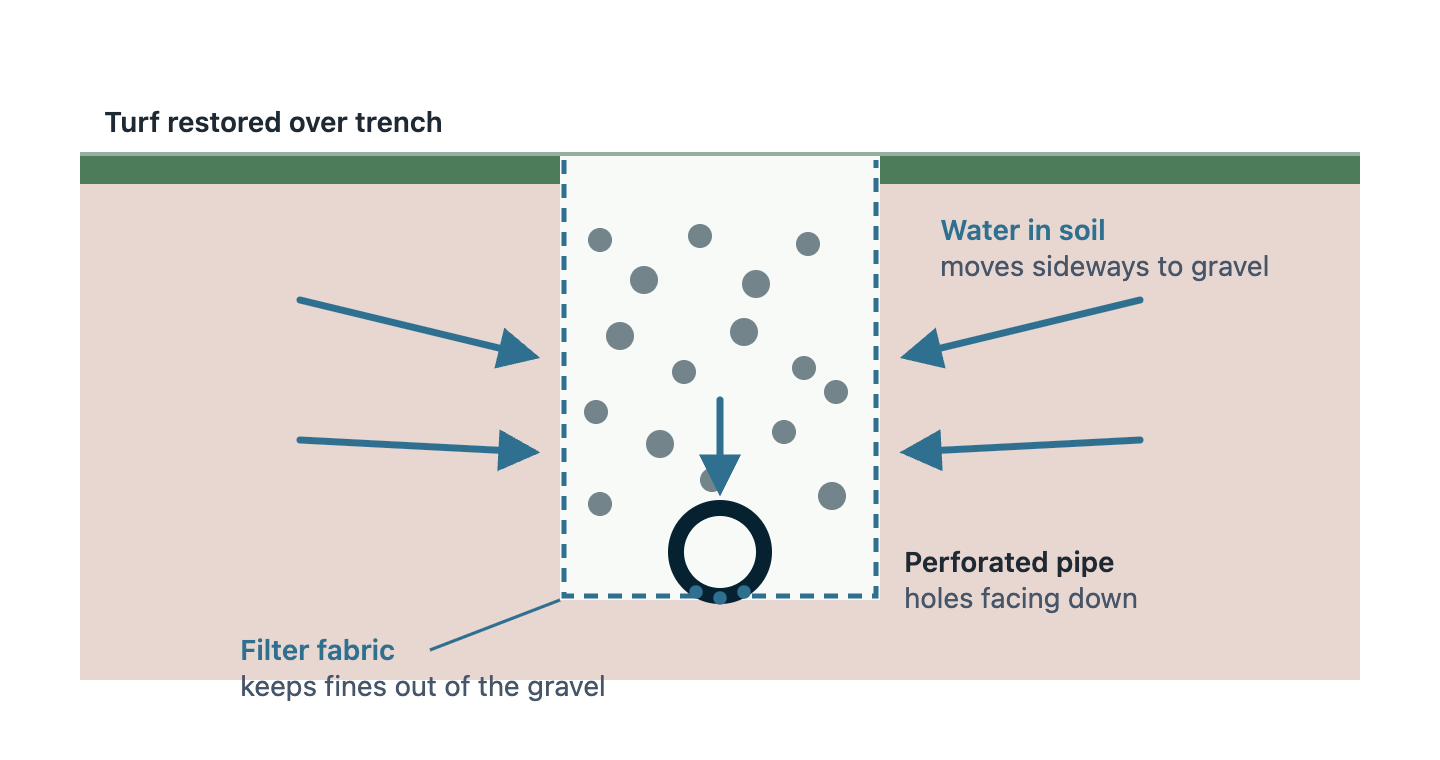
The discharge point matters as much as the trench. A French drain does not make water disappear — it moves it somewhere else. That somewhere has to be lower than the pipe and somewhere the water is genuinely welcome: a daylight outlet on a slope, a dry well, or a storm connection where local rules allow it. A drain that ends in a spot with nowhere to go simply relocates the puddle.
Surface water or saturated soil? This decides everything
You will find flatly contradictory advice on whether a French drain fixes standing water. Some sources call standing water the ideal French drain application. Others say the opposite — that standing water is precisely the case where you should use a catch basin instead.
Both are describing something real. The confusion comes from the phrase "standing water," which people use for two completely different problems.
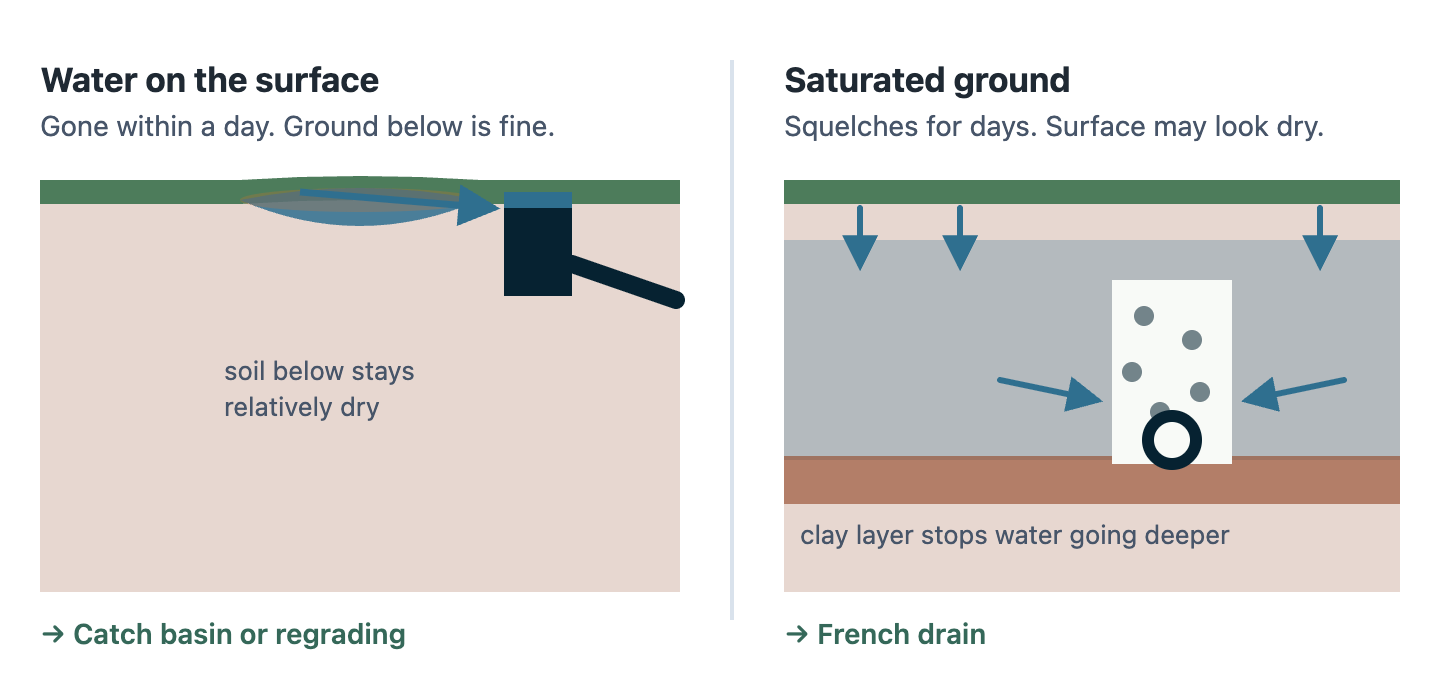
Water sitting on top of the ground is a surface problem. Rain fell faster than the ground could absorb it, or it ran downhill into a low spot and stopped there. The soil underneath may be perfectly capable of draining — the water simply has no path to anywhere lower. This is a collection and routing problem.
Ground that stays saturated is a subsurface problem. The water has soaked in, but it has nowhere to go once it's there — because a clay layer stops it, the water table is high, or water is moving through the soil from uphill. The surface may look dry a day after rain while the ground below stays wet enough to squelch underfoot for a week.
A French drain works on the second problem. Its pipe sits well below the surface and collects water out of the soil column. It is not designed to capture a puddle sitting on the lawn above it — that water has to soak down through the ground first, which in the soils that usually cause pooling is exactly what isn't happening.
The test that tells them apart
Wait for a normal soaking rain, then check the same spot twice.
A few hours after the rain stops. Is there visible water on the surface? Note where it is and roughly how deep.
Two to three days later. Walk the same spot. Push a screwdriver or a garden trowel into the soil.
- Surface water gone, ground firm underfoot, tool goes in with normal resistance — you have a surface problem. Water needed somewhere to go, and it eventually evaporated or soaked away. A catch basin at the low point or regrading to give the water a route out will usually fix it, and a French drain would be an expensive way to solve the wrong thing.
- Surface may be dry, but the ground squelches, the tool slides in with almost no resistance, and the hole starts to fill — you have saturated soil. This is what a French drain is for.
- Both, at different times of year, or both at once — you may need both, and the order matters. Deal with the surface routing first, then see what's left.
If you are looking at standing water that sits on the surface long after the rain has stopped, work through that page before spending money on a trench.
Will a French drain work in your yard?
The honest answer depends less on the drain than on your yard. This table covers the conditions homeowners most often ask about.
| Your situation | French drain? | Usually the better first move |
|---|---|---|
| Lawn stays soggy for days after rain | Good fit | French drain, once you've confirmed the outlet has somewhere lower to go |
| Water pools on the surface, gone in a day | Poor fit | Catch basin at the low point, or regrading |
| A single low spot collecting water | Poor fit | Catch basin, or fill and regrade the depression |
| Yard slopes noticeably | Good fit | Slope gives you a gravity outlet — usually the easiest install |
| Yard is flat | Difficult | See below — you need to create fall, add a pump, or use a different fix |
| Heavy clay soil | Partial fit | Helps, but drains slowly. Pair with surface routing; manage expectations |
| High water table | Poor fit | Gravity drainage can't beat the water table. Needs a pumped system |
| Constant seep or spring, wet even in dry weather | Good fit | An interceptor drain uphill of the wet area, cut across the flow |
| Water arriving from an uphill neighbour | Good fit | An interceptor along the property line — but check local drainage rules first |
| Wet strip along a driveway or patio edge | Poor fit | A channel drain at the hardscape edge collects surface flow far better |
If your yard is flat
This is the most common disqualifier, and it deserves a direct answer rather than "consult a professional."
A French drain moves water by gravity. Without fall, water sits in the pipe instead of running out of it, and a pipe full of standing water silts up and stops working. You have three real options:
- Create fall over distance. You may have less than you think — see the slope check below. A long run to a far corner of the property can find a foot of drop that isn't obvious by eye.
- Add a pump. The drain feeds a sump basin and a pump lifts the water to a discharge point. This works, but it adds a powered component that needs maintenance and fails during outages — which is often exactly when you need it.
- Use a different approach. On genuinely flat ground, regrading to create a shallow swale, or surface collection into a dry well, is frequently cheaper and more reliable than forcing a French drain to work.
How to choose between those from two quick measurements — your fall to an outlet and how fast your soil drains — is covered in how to drain a flat yard.
The 10-minute slope check
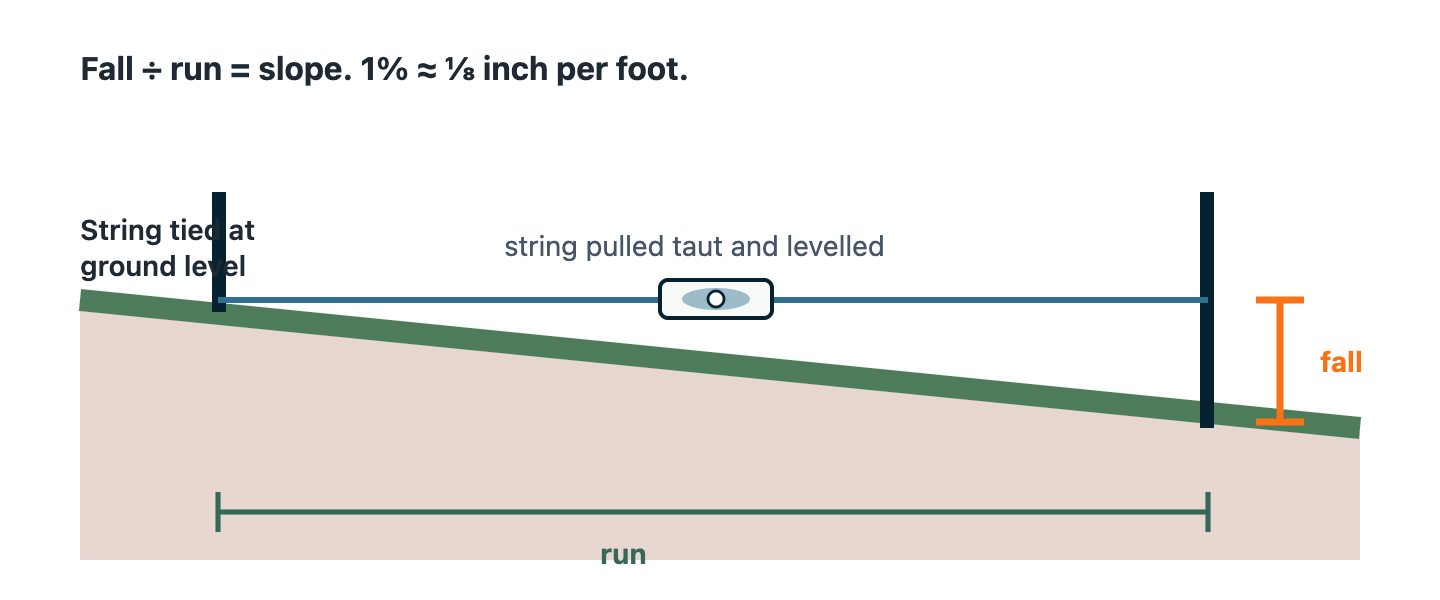
Every guide states that a French drain needs about 1% fall — roughly ⅛ inch of drop for every foot of run. Almost none tell you how to find out whether you have it. You can settle this yourself in ten minutes with a wooden stake at each end, a length of string, a line level, and a tape measure.
- Put a stake where the drain would start (the wet area) and another where you want the water to end up.
- Tie the string to the uphill stake at ground level.
- Run it to the downhill stake, pull it taut, and slide it up or down until the line level reads level.
- Measure from the string down to the ground at the downhill stake. That measurement is your total fall.
- Measure the distance between the stakes.
Divide the fall by the run. Thirty feet of run needs about 3½ inches of fall to reach 1% — roughly ⅛ inch for every foot.
Under 1% — a gravity French drain is unlikely to work as intended. Look at the flat yard options above. Around 1 to 2% — workable, but the install has to be precise. Worth having someone who does this regularly set the grade. Over 2% — you have comfortable fall. A French drain is straightforward here, and the main question becomes where the water goes at the bottom.
When a French drain is the wrong answer
French drains get specified for problems they cannot solve, and the drain then gets blamed for failing at a job it was never suited to. Industry guidance is blunt about the cause: the most common reason these systems disappoint is misdiagnosis before anyone picks up a shovel — poor grading, compacted soil, or a gutter problem treated as if it were a groundwater problem.
Five cases where something else should come first:
The water is coming off your roof. A house sheds a surprising volume — around 1,250 gallons from a 2,000 square foot roof in an inch of rain. If downspouts discharge beside the house, you are pouring a bathtub every few minutes into the soil you are trying to dry out. Extending or burying the downspouts is far cheaper and often ends the problem.
The ground slopes toward the house. No drain compensates for grade running the wrong way. Regrading addresses the cause; a French drain manages a symptom you have chosen to keep.
The soil is compacted, not waterlogged. Construction traffic and heavy clay produce ground that sheds water like pavement. Core aeration and organic amendment restore infiltration for a fraction of the cost of a trench.
It's one isolated low spot. A single depression collecting rain is a grading problem. Fill it, or collect it with a basin. A drain run to a low spot mainly gives the puddle a more expensive place to sit.
Water is getting into a basement. Once water is inside the structure, yard drainage is no longer the whole answer — interior systems, sump pairing, and wall treatment are a different discipline with different economics. Yard work may still be worth doing to reduce the load, but it should not be the only thing you do.
Before committing, it's worth comparing every yard drainage option side by side, or working through your yard's conditions step by step.
Depth, width and materials
Depth is set by the water, not by a rule of thumb. Eighteen to twenty-four inches is typical for a yard drain because that is usually deep enough to sit below the saturated zone in a lawn. A shallow interceptor cutting across a hillside seep may only need nine to twelve inches. What matters is that the pipe sits below the water you are trying to remove, and that it still has fall to its outlet at that depth.
Width is generally nine to twelve inches — enough to get a meaningful gravel envelope around the pipe. The gravel is not filler; it is the part of the system that actually collects water. A wider envelope gathers from a wider area.
Pipe should be perforated and rigid rather than thin corrugated tubing where you can manage it. Corrugated pipe is cheaper and easier to lay, but its ridged interior catches sediment and it deforms under load.
Gravel must be washed and angular, ¾ inch or similar. Rounded pea gravel packs tightly and leaves less void space. Anything with fines in it will silt up the voids and choke the drain within a few seasons.
Filter fabric wraps the gravel — not the pipe. It keeps soil particles out of the gravel while letting water through. Skipping it is the most common reason a drain that worked beautifully in year one is useless by year five.
To turn these dimensions into quantities — how many cubic yards and tons of stone, how much pipe and fabric, and the soil you will dig out — the French drain gravel and materials calculator gives a shopping list from your trench size, and checks whether the run has enough fall to reach an outlet.
What installation involves
A typical yard installation runs: mark the route and confirm the outlet, call 811 for utility locating, cut and remove turf, excavate to grade, check fall along the whole run, line with fabric, bed gravel, lay pipe with perforations down, cover with gravel, fold the fabric over, backfill, and restore the surface.
Two things go wrong more than anything else. The fall is not checked along the whole run, so the pipe develops a belly that holds water. And the outlet turns out to be higher than assumed, so the system backs up from the far end.
The full build, including measuring the outlet and fall before you dig, how deep the trench gets along the run, a 100-foot materials list and a hose test before backfilling, is in how to install a French drain in your yard.
What it costs
For yard work, expect roughly $10 to $35 per linear foot installed, which puts most residential runs somewhere between $1,500 and $6,000 depending on length, depth, access, and how much lawn or hardscape has to be restored. The yard French drain cost guide breaks that down by length, site conditions, and the outlet and restoration lines quotes often leave out.
These are planning ranges, not quotes. Prices move with soil conditions, how far the outlet sits from the wet area, whether machinery can reach the route, and local labour rates. Interior basement systems are a different product at a different price — commonly $40 to $85 per foot — so a quote in that range for yard work is worth questioning.
What moves the number most: length of run, depth, whether the outlet needs a dry well or pump, hand-digging versus machine access, and restoration of turf, beds, or paving.
Questions to ask before you hire
| Ask | What a good answer sounds like |
|---|---|
| How did you decide it's a subsurface problem? | A specific observation about your yard — soil, timing, where water shows up — not "this is what we install" |
| Where exactly does the water discharge? | A named point, lower than the pipe, that they have looked at |
| What's the fall from start to outlet? | An actual measurement, not "it'll be fine" |
| What pipe, gravel and fabric? | Perforated rigid pipe, washed angular stone, fabric around the gravel |
| What does restoration include? | Explicit — turf, beds, and paving stated separately |
| What happens in the heaviest storms? | An honest limit, not a guarantee that it handles everything |
Vague answers to the first and third questions are the ones worth acting on. A contractor who has not measured the fall has not designed the system.
Related pages
- Standing water in your yard — start here if water sits on the surface
- Catch basins — the usual answer for surface collection
- Compare every yard drainage option
- When your yard floods after rain
- Runoff arriving from a neighbour's yard
Tool
4-inch or 6-inch? Size the pipe before you dig
Enter the roof, paving, and lawn that drain toward the trench and the slope you can get, and the calculator checks the flow against the real capacity of both pipe sizes — then hands off to the materials calculator for stone and pipe quantities.
Afterwards
What the drain needs once it is in
An hour a year keeps a drain working: check the outlet during rain, empty the basin sumps, and flush the line every year or two. Most of what shortens a drain's life, though, was decided the day it was built.
FAQs
How deep should a French drain be in a yard?
Most yard French drains sit 18 to 24 inches deep, which is usually below the saturated zone in a lawn. Shallow interceptor drains cutting across a hillside seep can work at 9 to 12 inches. Depth should be set by where the water actually is and whether the pipe still has fall to its outlet at that depth — not by a standard number. The installation guide shows how that depth changes along the run.
Do French drains work in flat yards?
Not reliably in their standard form, because they rely on gravity. Without about 1% fall, water sits in the pipe and the system silts up. On flat ground you have three options: find fall over a longer run, add a sump and pump to lift the water, or use a different approach such as a shallow swale or surface collection into a dry well.
Does a French drain work on a hillside or a sloped yard?
Yes, and a slope is usually the easy case rather than the hard one — the fall that a flat yard has to manufacture is already there. The catch is that on a hillside you are often solving a different problem: instead of draining a soggy patch, you are intercepting water moving downhill before it reaches the house, patio, or low corner. That means running the drain across the slope near the top of the area you want to protect, not straight down the fall line. A drain laid down the hill just carries water faster to the bottom, which is usually where the problem already is. Two things to watch on a steep grade: the pipe can run fast enough to scour and pull soil in at the joints, and the discharge point has to be somewhere the concentrated flow will not cut a channel or dump onto a neighbour's ground.
Will a French drain fix standing water?
It depends which kind. If water sits on the surface and is gone within a day, that is a surface routing problem and a catch basin or regrading usually solves it better. If the ground stays saturated and squelches for days, that is what a French drain is designed for. The 24-hour and 3-day check described above tells you which you have.
Do French drains work in clay soil?
They help, but more slowly. Clay releases water reluctantly, so a drain in clay collects from a narrower area than the same drain in sandy soil. It is often worth pairing with surface routing rather than relying on the drain alone, and worth setting expectations that the ground will still be damp longer than a free-draining yard.
Can you put a French drain under a lawn?
Yes — most yard French drains are under lawn. The trench is backfilled and the turf restored over it, and once established the line is usually invisible. Keep the gravel envelope and fabric intact right up near the surface, and avoid capping the trench with topsoil so dense that water cannot reach the gravel.
Why do French drains stop working?
The most common causes are silt filling the gravel voids where filter fabric was omitted or wrapped only around the pipe, a belly in the pipe from uneven fall, root intrusion, a crushed or disconnected section, or an outlet that has become blocked or buried. Which one it is decides whether the drain can be cleaned or has to be rebuilt — see clogged yard drain for how to tell them apart.
Do you need a permit for a French drain?
Often not for simple residential yard work, but this varies by municipality and by what you are connecting to. Discharging into a storm system, working near a wetland or easement, or disturbing larger areas can all trigger requirements. Check with your local stormwater or building department before you dig, and call 811 for utility locating regardless — that part is not optional.
Sources consulted
- NDS — What Is a French Drain
- French Drain Man — When to Use a French Drain vs Yard Drain with Catch Basin
- LawnLove — What Is a French Drain
- Ware Landscaping — Common French Drain Mistakes
By Under Your Home Team · Last reviewed 2026-08-09