What Is a Perc Test? How It Works, Costs and What Failing Means
A perc test measures how fast water soaks into soil, in minutes per inch, to decide whether land can support a septic drain field. A licensed evaluator digs test holes to drain-field depth, saturates them and times the water drop. Many states now judge sites by soil evaluation instead, so ask your county health department which test applies.
What a perc test measures
A percolation test, usually shortened to "perc" or "perk" test, measures how quickly water soaks into soil. The result is given in minutes per inch: how long the water level in a test hole takes to drop one inch. The lower the number, the faster the soil drains.
That matters because a septic drain field treats wastewater by letting it trickle through soil. Soil that is too slow can't absorb the flow, so effluent backs up or surfaces, the pattern described in septic drain field failure. Soil that is too fast lets wastewater reach groundwater before the soil has had a chance to treat it. A perc test checks that the soil sits between those two.
You'll usually run into one when buying land without a sewer connection, applying for a permit to build, or replacing a failed septic system.
Perc test, soil evaluation or DIY test: which one is yours?
Three different things get called a perc test, and they aren't interchangeable.
| Septic perc test | Soil and site evaluation | DIY drainage test | |
|---|---|---|---|
| Who does it | A licensed evaluator, soil scientist or health department, depending on the state | Health department staff or a licensed soil scientist | You |
| How | Holes dug to drain-field depth, often 24–30 inches, soaked, then the water drop is timed | Pits or borings examined layer by layer for texture, structure, signs of seasonal wetness and dense layers | A 12-inch hole, pre-soaked, then a one-hour drop |
| What it measures | Minutes per inch at drain-field depth | Whether the soil profile can treat wastewater through the wettest months | How fast one spot in the yard drains |
| What it can decide | A septic permit, where the state uses it | A septic permit, where the state uses it | Which yard drainage fixes can work. Nothing about septic |
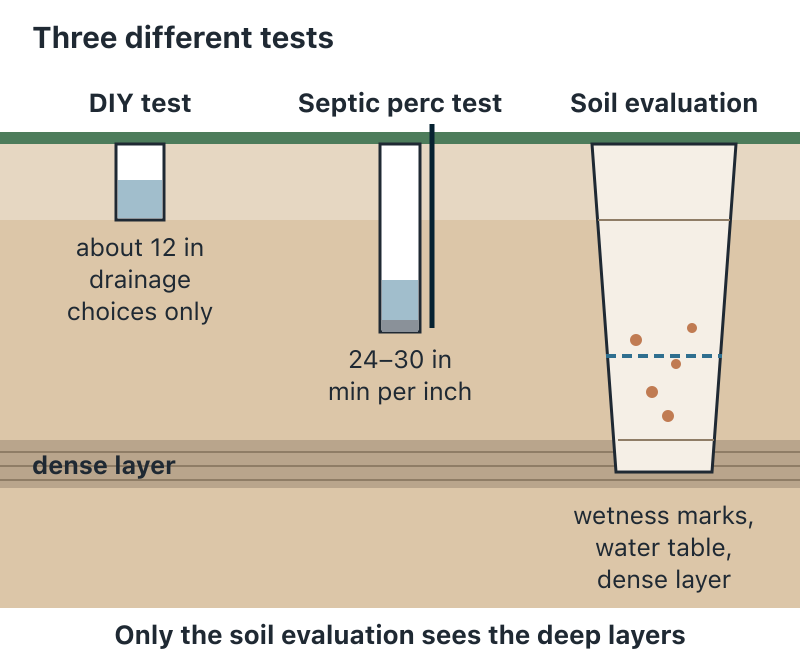
Many states have moved beyond the perc test. A timed hole shows how fast water drains on the day of the test. It can't show where water sits during the wettest months, or reveal a dense layer a few feet down. So several states judge septic sites mainly by reading the soil profile instead. North Carolina is one. Under its on-site wastewater rules (15A NCAC 18E), county environmental health staff or a Licensed Soil Scientist evaluate the soil and site. The county then issues an Improvement Permit, which names the system type and bedroom count, or a letter saying the site is unsuitable. Some counties still call that visit a "perk test", as Onslow County's soil evaluation page does.
The practical first step anywhere is the same: call the county health department and ask which evaluation it requires, who may do it, and what the lot needs ready beforehand, such as marked corners, a site plan or cleared access.
How a perc test is done
Procedures vary by state. This is the method University of Nebraska–Lincoln Extension describes, and it's typical of states that still use a perc test:
- Dig at least three holes, 4 to 8 inches across, spread over the proposed drain field and dug to the depth the trenches would be, often 24 to 30 inches.
- Roughen the sides and bottom to undo the smearing a shovel leaves, and add about 2 inches of fine gravel to protect the bottom.
- Presoak. Keep about 12 inches of water in each hole for at least four hours, preferably overnight. Heavy clay can need 12 hours or more. Sandy soil that drains twice in under 10 minutes needs no presoak.
- Measure the drop. Set the water about 6 inches above the gravel and record how far it falls over 30 minutes, or over 10-minute intervals in fast sand.
- Work out the rate. Minutes elapsed divided by inches dropped gives minutes per inch. Average the holes, unless their rates differ by more than 20 minutes per inch, in which case the design uses the slowest hole.
What the result means, and why the numbers online disagree
Search for a "passing" perc rate and you'll find different answers, because each one describes a particular state's rules or one company's rule of thumb:
| Source | Too fast | Acceptable | Slow, or needs a different system |
|---|---|---|---|
| University of Nebraska–Lincoln Extension (Nebraska) | Faster than 5 min/in | 5–60 min/in | Slower than 60 min/in |
| Texas Septic Guide (Texas rules) | Faster than 5 min/in | 5–30 min/in conventional; 30–60 with a larger field | 60–120 an alternative design is likely; over 120 a mound, drip or other alternative |
| A septic contractor's guide (WR Environmental) | Not stated | 1–30 min/in described as ideal | Not stated |
Two things hold almost everywhere. Too fast fails too: gravelly or very sandy soil can pass wastewater so quickly that it isn't treated. And the rate isn't the whole verdict: a site can perc well and still be turned down for a high seasonal water table, shallow rock, a steep slope or setback distances. For typical rates by soil texture, see soil infiltration rates. Heavy clay is the most common reason for a slow result.
Can a DIY drainage test predict the result?
Only roughly. Both tests time a falling water level, and the units convert: minutes per inch = 60 ÷ inches per hour. A yard that drops 1 inch an hour is 60 minutes per inch; 2 inches an hour is 30. The soil drainage rate calculator shows both numbers from a DIY drainage test.
A backyard result still can't stand in for a septic evaluation, for four reasons:
- Depth. The DIY hole is about a foot deep. Drain-field soil is judged 2 to 3 feet down or more, often in a different layer entirely.
- Presoak. A quick wetting isn't the four hours to overnight a formal test uses, so slow soils can read faster than they are.
- Season. A test in a dry week says nothing about the water table in the wettest month, which is exactly what a soil evaluation looks for.
- Hidden layers. A dense clay or rock layer below the hole, invisible from the surface, can rule a site out.
Use the DIY test for yard drainage decisions. For septic, treat it as a hint, never a prediction.
Who does it, how long it takes and how long it's valid
- Who does it: depending on the state, a licensed soil scientist, a licensed site evaluator or septic designer, or health department staff. A homeowner's own test isn't accepted for a permit.
- How long it takes: the field work usually takes from part of a day to two days including the presoak, and a report commonly follows within days. Booking a county or private evaluator can add weeks in busy seasons.
- How long it's valid: it varies by jurisdiction, and two to five years is commonly cited. What matters is the expiry date on the permit, and whether the site or the rules have changed since.
What a perc test costs
| Published figure | Planning range |
|---|---|
| Standard perc test in Texas (Texas Septic Guide) | $250–$450; a full site evaluation $400–$800 |
| Perc test in Florida (Land Perc) | $750–$1,900 typical; $300–$3,000 full range |
| By lot size (WR Environmental) | About $150–$250 for a quarter acre, $600–$900 for an acre |
Planning estimates drawn from published guides, not quotes. The price goes up with an excavator for deep pits or rocky ground, extra holes on a large or varied lot, a private soil scientist instead of county staff, county permit and application fees, and retests. Where county health department staff do the evaluation, the application fee can be most of the cost.
If the land fails
A failed test means a conventional drain field isn't approved where and how the site was tested. The reason it failed decides what might still work:
| Why it failed | What may still be possible |
|---|---|
| Soil too slow (dense clay) | Testing another part of the lot; a larger field where the rules allow it; drip distribution or an aerobic treatment unit; an engineered design |
| Soil too fast (gravel or coarse sand) | Deeper trenches or a soil liner, as Nebraska Extension suggests; a sand filter; an aerobic treatment unit |
| High seasonal water table | A mound system; chambers or drip lines at shallow depth; a sand filter; an aerobic treatment unit |
| Shallow rock or a dense layer | A mound system; drip distribution |
| Nothing on the lot works | A sewer connection if a line is within reach; otherwise the lot may not be buildable as planned |
The system types come from the EPA's guide to septic systems, which matches each to the site conditions it's designed for. Which ones your state approves is a local decision, and alternatives typically cost several times a conventional system. One Texas guide puts them at $8,000 to $30,000, a sense of scale rather than a local price. If the test ran during an unusually wet spell, ask about retesting in another season or another part of the lot first.
On a property that already has a septic system, a drain field that stays wet may be saturated rather than failed. See saturated drain field for how to tell the difference.
Buying land? Ask these first
- Which evaluation does the county require here: a perc test, a soil evaluation, or both?
- Is there an existing permit for this lot, and when does it expire? An Improvement Permit or its local equivalent is worth far more than an old test result.
- What system and bedroom count was the site approved for? A permit for a two-bedroom conventional system doesn't cover a four-bedroom house.
- Who pays for the evaluation, and is the purchase contingent on the lot passing? This is negotiable, and buyers commonly make it a contingency.
- If an alternative system would be needed, what would it cost to install and maintain, and is the land still worth the price with that added?
Related pages
- How to test soil drainage at home — the free DIY version for yard drainage decisions
- Soil drainage rate calculator — inches per hour and minutes per inch from your own test
- Soil infiltration rates by soil type
- Septic drain field failure — signs an existing field is failing
- Saturated drain field — wet after rain, or failing?
- Clay soil and drainage
FAQs
How much does a perc test cost?
Published guides range from about $250 for a basic test in Texas to a typical $750 to $1,900 in Florida, with complex sites reaching about $3,000. An excavator, extra holes, a private soil scientist and county permit fees all raise the price. Where county staff do the evaluation, the application fee may cover most of it. Treat these as planning figures, not quotes.
Can I do a perc test myself?
You can do a DIY drainage test, and it's useful for choosing yard drainage fixes, but it isn't accepted for a septic permit. Permit evaluations are done at drain-field depth, to state procedures, by a licensed evaluator, a soil scientist or health department staff.
What does it mean if land fails a perc test?
It means a conventional drain field isn't approved on that site as tested. Depending on why it failed (soil too slow, soil too fast, a high water table or shallow rock), a retest elsewhere on the lot, a larger field, or an alternative system such as a mound, drip lines or an aerobic treatment unit may still be permitted.
Can you build on land that fails a perc test?
Sometimes. If the county approves an alternative septic system, or a sewer connection is available, yes. If neither is possible, the lot may not be buildable as planned. Ask the county what it would approve before you buy.
How long does a perc test take?
The field work usually takes from part of a day to two days including the presoak, with a report following within days. Getting a county or private evaluator scheduled can add weeks in busy seasons.
How long is a perc test good for?
It depends on the jurisdiction; two to five years is commonly cited. Check the expiry date on the permit itself, and whether the rules or the site have changed since the test.
Who performs a perc test?
Depending on the state, a licensed soil scientist, a licensed site evaluator or septic designer, or environmental health staff at the county health department. In North Carolina, the soil and site evaluation is done by the county health department or a Licensed Soil Scientist.
Who pays for a perc test when buying land?
It's negotiable. Buyers often pay and make the purchase contingent on the result; in some markets sellers provide a recent test or permit to make land easier to sell. Agree on it in writing before you sign the contract.
Sources consulted
- UNL Extension — Conducting a Soil Percolation Test (G1472)
- NC DHHS — On-Site Water Protection Branch
- Onslow County, NC — Soil Evaluations
- JG Soil Consulting — Why Perc Tests Don't Exist in NC Anymore
- US EPA — Types of Septic Systems
- Texas Septic Guide — Perc Test in Texas
- Land Perc — Perc Test for Septic System
- WR Environmental — Understanding Perc Tests
- Superior Sewer Solutions — What to Do If Your Land Fails a Perc Test
By Under Your Home Team · Last reviewed 2026-09-15