Saturated Drain Field: Waterlogged After Rain, or Actually Failed?
Heavy rain can saturate the soil around a drain field and stop it absorbing for a day or two, and a healthy system usually recovers on its own once the ground drains. The test is timing: if the ground over the field is still wet or puddling 24 to 48 hours after the rain stops, the field is surfacing rather than simply soaked, and that is failure rather than weather.
Rain does not cause failure, but it exposes it
A drain field works by letting treated wastewater soak into the soil around it. That only works while the soil has somewhere to put it. After sustained heavy rain the surrounding ground is already holding as much water as it can, the water table rises, and for a while the field has nowhere to discharge to.
That is a real effect and it happens to systems that are in perfectly good condition. It is also why a wet patch over the drain field during a storm is weak evidence on its own — almost everything looks saturated in those conditions.
What separates a soaked field from a failed one is what happens next. A healthy field starts absorbing again as the surrounding soil drains, usually within a day. A field that has lost its capacity has nowhere to send water regardless of the weather, so it stays wet.
The 24 to 48 hour rule
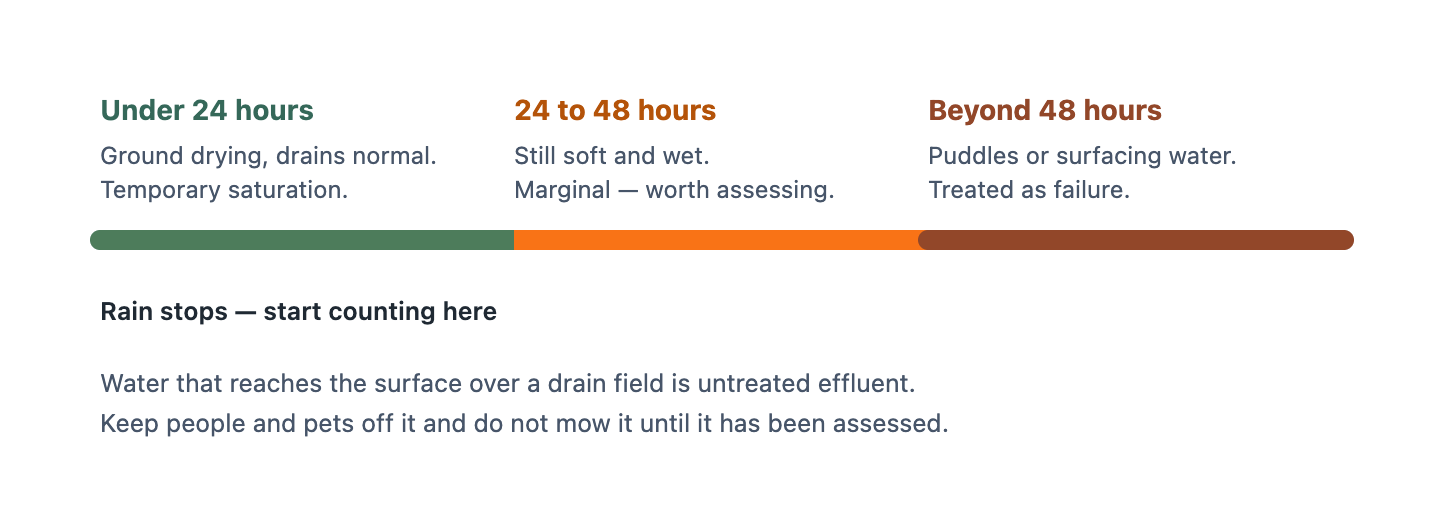
Start counting when the rain stops, not when it started. Then watch three things together:
- The ground over the field. Firm and drying within a day is the healthy pattern. Still spongy after two days is not.
- The drains inside. If sinks and toilets returned to normal speed as the ground dried, the system recovered. If they are still slow, the field is not accepting water.
- Whether water reaches the surface. Puddling or a wet sheen over the field 24 to 48 hours after rain stops is called surfacing, and it is the clearest single sign that the field has lost capacity.
One important qualifier: a system that backs up every time it rains heavily has told you something even if it recovers each time. Repeated rain-triggered backups usually mean the field is already marginal and the weather is only exposing it.
When it is wet with no rain to blame
A drain field that stays wet in dry weather is not a saturation question at all. That points to the field itself, to water arriving from somewhere other than the sky, or to more water entering the system than it was sized for.
Common contributors worth ruling out before assuming the worst:
- Surface water being directed onto the field. Downspouts discharging nearby, a graded slope that sheds toward the field, or a new patio or driveway pushing runoff that way. This is the one you may be able to correct yourself, and it is covered in yard grading and leveling and swales and berms.
- A high seasonal water table, which leaves less soil depth available for absorption.
- More water going in than before — a new appliance, more people in the house, or a running toilet quietly adding hundreds of gallons a day.
- Compaction over the field from vehicles, trailers, or stored equipment, which reduces the soil's ability to absorb.
If none of those apply and the ground stays wet, treat it as a field problem rather than a weather one and read septic drain field failure.
What not to do while it is saturated
Waiting is genuinely the right action for the first day or two, but a few things make matters worse:
- Do not add water. Postpone laundry, long showers, and anything that sends a surge into a system that currently has nowhere to put it.
- Do not drive or park on it. Saturated soil compacts far more easily than dry soil, and compaction over a drain field is difficult to undo.
- Do not have the tank pumped as a reflex. Pumping an overloaded tank while the ground is saturated can allow a tank to shift or float in some conditions, and it does not fix a field that cannot absorb. It may still be the right call — but as a decision after assessment, not before it.
- Do not treat surfacing water as ordinary puddle water. It is untreated effluent. Keep people and pets away from it.
Where this hands off
This page covers what you can see on the surface of your own yard. Septic system design, soil and percolation testing for a replacement, tank work, pumping, and permitting are a different trade with licensing requirements that vary by county, and this site does not cover them. If the answer here is that the field has failed rather than flooded, the next questions are what caused it and what replacement involves.
How long should a drain field stay wet after heavy rain?
A working drain field in reasonable soil generally starts absorbing again within about a day of the rain stopping, and the ground over it firms up as the surrounding soil drains. Ground that is still soft and wet after two days, and especially standing water or puddling over the field, suggests the field is not recovering on its own.
Can heavy rain flood a drain field that is working?
Yes. Sustained rain saturates the soil around the field and raises the water table, and while that lasts the field has nowhere to discharge into. That can cause slow drains or a backup in a system that is otherwise in good condition. The distinguishing feature is that it recovers once the ground drains, rather than staying wet.
Is a saturated drain field the same as a failed drain field?
Not necessarily, and the difference matters because one costs nothing and the other can cost thousands. Saturation is a temporary soil condition caused by weather. Failure means the field has lost its ability to absorb regardless of the weather. Timing separates them: recovery within a day or two points to saturation, while water that persists or reaches the surface after 24 to 48 hours points to failure.
Why is my leach field always wet even without rain?
Persistent wetness in dry weather is not a saturation problem. Look first for water being delivered to the field from elsewhere — downspouts discharging nearby, ground that slopes toward it, or new hard surfaces shedding runoff that way. Beyond that, a high seasonal water table, more household water going in than the field was sized for, or compaction over the field can all keep it wet. If none of those explain it, the field itself is the likely issue.
Can I do anything while the drain field is saturated?
Mostly you reduce the load and wait. Postpone laundry and long showers so less water enters a system that cannot currently discharge, keep vehicles and equipment off the saturated ground because it compacts easily when wet, and keep people and pets away from any water that has reached the surface. Resist pumping the tank as an automatic first move — it does not restore a field that cannot absorb, and it is better decided after an assessment.
Does surface water from the yard make a drain field worse?
It can. A drain field is sized to absorb what the household sends it, not that plus roof runoff and slope drainage. Downspouts discharging near the field, ground graded toward it, or a new patio or driveway redirecting runoff all add water the field was never meant to handle. Correcting that is ordinary yard drainage work and is often the cheapest thing available.
Sources consulted
- US EPA — septic systems and how soil absorption works
- NC State Extension — septic systems and their maintenance
- Washington State Department of Health — signs of septic system failure
By Under Your Home Team · Last reviewed 2026-08-30