Does Gravel Help Yard Drainage? The Dig-a-Hole Myth, Explained
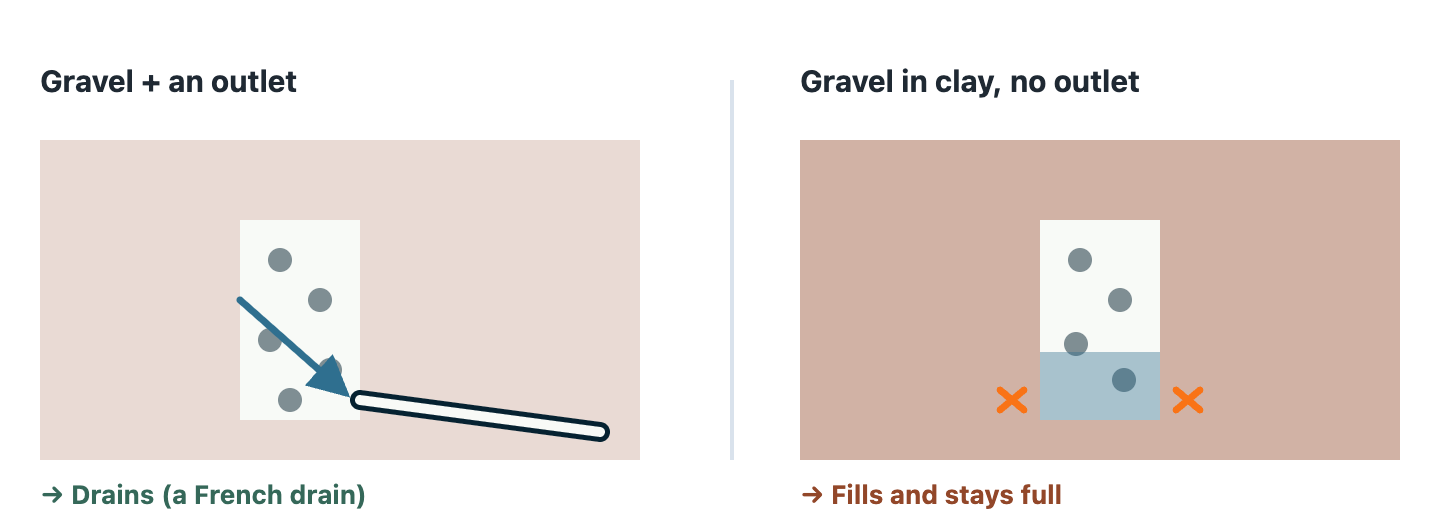
Gravel drains water through itself far better than soil — but it's a conduit, not a destination. Water still has to reach somewhere lower or soil that absorbs it. That's why a gravel-filled trench to an outlet works, and a gravel-filled hole in clay just becomes a hole full of wet gravel.
Yes, gravel drains — but that's only half the story
Gravel is genuinely good at one thing: water passes through the gaps between the stones far faster than through soil. That's real, and it's why gravel is in nearly every drainage system. So when people ask "does gravel help drainage," the honest answer is yes — as a way to move water.
The half that gets missed is where the water goes next. Gravel doesn't make water disappear. It gives water an easy path, but the water still has to arrive somewhere it can leave — a lower outlet, or soil that will absorb it. Miss that, and you've built a very well-draining container for water that has nowhere to drain to.
Can I dig a hole and fill it with gravel for drainage?
This is one of the most-asked drainage questions, and the answer is a clear it depends — because a gravel-filled hole is a dry well, whether you call it that or not. A dry well works by letting water soak from the gravel into the soil around it.
So the hole only drains if the surrounding soil absorbs water:
- In sandy or well-draining soil, a gravel-filled hole genuinely helps — water fills the gravel and then soaks away into the ground.
- In the heavy clay that causes most drainage problems, it fails. Water fills the gravel, the clay refuses to take it, and you've built a hole full of wet gravel that overflows in the next storm.
Before digging one, do the one-hour perc test: fill a hole with water and time the drop. Under about half an inch an hour, skip the gravel hole — the soil won't empty it.
Do rocks on the surface help?
Spreading rock or gravel on top of a wet area is a different thing entirely, and it's mostly cosmetic. It covers mud so the spot looks tidier and is easier to walk on, but the ground underneath is exactly as wet as before — the rock hasn't given the water anywhere to go. Rocks help drainage when they're part of a graded channel that carries water somewhere (a dry creek bed), not when they're a layer dumped on a soggy patch.
Gravel vs sand: which drains better?
They do opposite jobs, and mixing them up is a common mistake:
- Gravel has large gaps between the stones, so water races through it. It's the material for moving water — trenches, drains, dry wells.
- Sand has tiny pore spaces, so water passes slowly. Its value is as a filter, not a drain — a thin sand layer over gravel can stop fine soil washing into the stone.
For drainage, gravel wins decisively. And the tempting idea of adding sand to clay to help it drain almost always backfires — sand fills the few pores clay has and can set up something closer to weak concrete. Use gravel to move water and organic matter to improve clay, never sand mixed into clay. See clay soil and drainage.
This short shows exactly why the sand-into-clay "hack" backfires — the sand plugs the few pores clay has and sets up something closer to weak concrete.
The one rule that ties it together
Gravel is a tool for moving water, not a place for water to end. Every time gravel actually fixes drainage, it's because it channels water to a real destination:
- In a French drain, gravel surrounds a pipe that carries water to a lower outlet.
- In a dry well, gravel holds water while draining soil absorbs it.
- In a dry creek bed, stone channels surface water along a graded path.
Ask of any gravel plan: where does the water go once it's in the gravel? If the answer is "nowhere lower, and the soil won't absorb it," the gravel won't save it.
Related pages
- French drains for yards — gravel doing its real job
- Dry wells — what a gravel-filled hole actually is
- How to test your soil's drainage
- Clay soil and drainage
- The cheapest ways to fix yard drainage
FAQs
Does gravel help with drainage?
Yes, as a way to move water — water passes through the gaps between gravel far faster than through soil, which is why it's in nearly every drainage system. But gravel is a conduit, not a destination: the water still has to reach a lower outlet or soil that absorbs it. Gravel with nowhere for the water to go just becomes a well-draining container that fills and stays full.
Can I dig a hole and fill it with gravel for drainage?
Only if the surrounding soil absorbs water — because a gravel-filled hole is a dry well. In sandy or well-draining soil it works. In the heavy clay that causes most drainage problems, it fails: water fills the gravel, the clay won't take it, and it overflows. Run a one-hour perc test first — under about half an inch of drop an hour, don't dig the gravel hole.
Do rocks help with drainage in a yard?
Rocks spread on top of a wet spot are mostly cosmetic — they cover the mud but the ground stays just as wet, because the water still has nowhere to go. Rocks help drainage only when they're part of a graded channel that carries water to a lower point, like a dry creek bed, or a gravel envelope that feeds a drain. On their own, dumped on a soggy patch, they don't drain.
What is better for drainage, sand or gravel?
Gravel, clearly. Its large gaps let water move fast, making it the material for drains, dry wells, and trenches. Sand has tiny pores and drains slowly — its real use is as a filter layer over gravel to keep fine soil out. And adding sand to clay to improve drainage usually backfires, filling the clay's few pores and setting up something like weak concrete.
Why does my gravel drainage still hold water?
Almost always because the water has nowhere to go once it's in the gravel — no outlet lower than the gravel, and surrounding soil (usually clay) that won't absorb it. Gravel drains through itself but can't create a destination. The fix is to give it one: a pipe to a lower outlet, or confirming the soil can actually soak the water away.
Do I need filter fabric with gravel?
For a drain or dry well meant to last, yes. Filter fabric around the gravel keeps fine soil from washing into the gaps and clogging them, which is the most common reason gravel drainage stops working after a few seasons. Wrap the fabric around the gravel envelope, not just the pipe, and use washed angular stone rather than rounded pea gravel.
Sources consulted
- The Pool and Lawn — sand or gravel for drainage
- Hello Gravel — sand vs gravel guide
- Douglasville Landscape Design — how gravel and sand affect drainage
By Under Your Home Team · Last reviewed 2026-08-09