How Much Slope Do You Need for Drainage?
Near the house, aim for about 6 inches of fall over the first 10 feet — roughly a 5% grade. Out in the yard, 1% is enough to move water — about ⅛ inch per foot, or 1¼ inches per 10 feet. Drains and swales need at least that 1%. Measure with a string line and level, because "flat" rarely is.
The numbers, and where each applies
Slope for drainage isn't one number — it changes with where you are on the lot, because the job changes. Close to the house you want water pushed away decisively; out in the yard you just want it to keep moving.
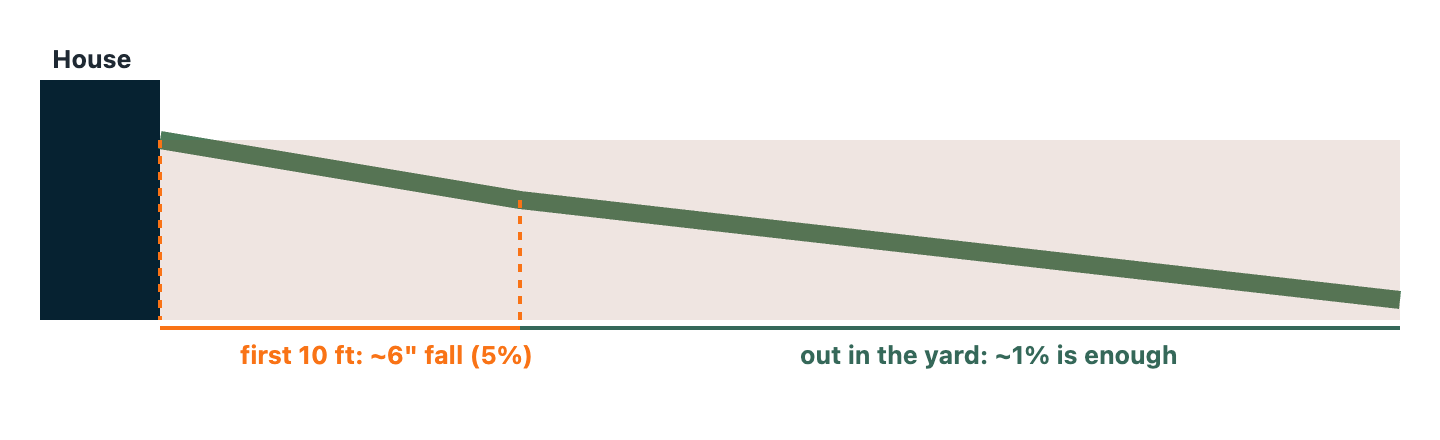
Right next to the house — about 6 inches over 10 feet (a 5% grade). This is the standard for grading around a foundation, and it exists to get roof and surface water decisively away from the wall. Steeper is fine here; gentler risks water lingering against the foundation.
Out in the yard — about 1%, or ⅛ inch per foot (1¼ inches per 10 feet). Once water is clear of the house, it only needs enough fall to keep moving toward a lower point. One percent is the practical minimum for water to flow across a surface without stalling.
Drains and swales — 1% minimum. A French drain, a catch basin outlet pipe, or a swale all need at least that 1% fall along their run. Below it, water sits in the pipe or channel, silts up, and stops working. More is better where you can get it.
What "1% slope" actually means
Percent slope is just fall divided by distance. 1% means the ground drops 1 unit for every 100 it runs — which works out to 1 foot of drop per 100 feet, or about ⅛ inch of drop per foot (1¼ inches per 10 feet). A 2% grade is twice that; 5% (the near-house target) is exactly 6 inches over 10 feet.
A note on a common rule of thumb: you'll often hear "1% is an inch per 10 feet." It's close and easy to remember, but strictly an inch per 10 feet is 0.8% — a shade under 1%. For the yard that difference is within a string line's accuracy; near the house, use the exact 6 inches per 10 feet.
You don't need to think in percentages if you don't want to. "About an inch and a quarter per 10 feet" is the number for the yard, and "six inches of drop in the first ten feet" for the foundation.
How to measure your slope
Yards that look flat usually aren't, and yards assumed to drain away sometimes slope back toward the house. Ten minutes with simple tools settles it.
- Drive a stake at the top of the run (the house, or the wet area) and another 10 feet away.
- Tie a string to the uphill stake at ground level.
- Run it to the downhill stake, pull it taut, and slide it until a line level on the string reads level.
- Measure from the string down to the ground at the downhill stake. That gap is your fall over 10 feet.
Divide fall by run for the percentage. Six inches over 10 feet is 5%; one inch over 10 feet is about 0.8%, and 1¼ inches over 10 feet is about 1%. A slope calculator turns the measurement into a percentage for you.
If you don't have enough
Falling short of these numbers is common, especially away from the house. Your options:
- Find fall over a longer run. You often have more than you think — a string line across 30 or 40 feet toward a far corner can reveal a foot of drop that's invisible by eye.
- Regrade to create fall where it's wrong or missing — see yard grading and levelling.
- On genuinely flat ground with no outlet, gravity drainage won't work, and the answer shifts to storage (a dry well or rain garden) or a pump. Confirm with a measurement before assuming your yard is truly flat.
Related pages
- Yard Slope Calculator — turn a measurement into a slope percentage
- Water pooling near the foundation — where the near-house grade matters most
- Yard grading and levelling
- How yard drainage works
- How to test your soil's drainage
FAQs
How much slope does a yard need to drain?
About 6 inches of fall over the first 10 feet right next to the house — roughly 5% — to push water away from the foundation, then around 1% (⅛ inch per foot, or 1¼ inches per 10 feet) out in the yard to keep it moving toward a lower point. Drains and swales need at least 1% along their length or they stall and silt up.
What is the minimum slope for a French drain?
About 1% — ⅛ inch of fall per foot, or 1¼ inches per 10 feet — is the practical minimum. Below that, water sits in the pipe instead of flowing out, and a pipe holding standing water silts up and stops working. More fall is better where the site allows, since it moves sediment through rather than letting it settle.
How do I measure the slope of my yard?
Drive a stake at each end of the run, tie a string at ground level on the uphill stake, level it with a line level, and measure from the string down to the ground at the downhill stake. That drop, divided by the distance between stakes, is your slope. Six inches over 10 feet is 5%; about 1¼ inches over 10 feet is 1%.
What does 1% slope mean?
It means the ground drops 1 unit for every 100 it runs — which equals 1 foot per 100 feet, or about ⅛ inch of drop per foot (1¼ inches per 10 feet). It's the practical minimum fall for water to move across a surface or through a drain without stalling. A 2% slope is twice as steep; 5% is 6 inches over 10 feet.
How much should the ground slope away from a house?
The widely used target is 6 inches of fall in the first 10 feet — about a 5% grade — so water is pushed decisively away from the foundation. Keep soil several inches below siding and weep holes as you build the grade. Beyond that first 10 feet, a gentler slope of around 1% is enough to keep water moving.
What if my yard is completely flat?
First confirm it — measure with a string line, because most "flat" yards have more fall than they appear to, especially over a long run to a far corner. If it's genuinely flat with no lower outlet, gravity drainage won't work, and the answer becomes storage (a dry well or rain garden, soil permitting) or a pumped system rather than a drain to daylight.
Sources consulted
- Pretty Purple Door — yard grading 101
- NDS — drainage slope guidance
- This Old House — grading around a foundation
By Under Your Home Team · Last reviewed 2026-09-21