Rain Gardens: A Drainage Fix That Has to Drain (Not Hold) Water
A rain garden is a shallow planted depression that catches runoff and lets it soak in — and the key word is soak. It must drain within 24 to 48 hours or it becomes a mosquito pond, so it only works in soil that drains. Test your soil, size it at 20 to 30 percent of the area feeding it, and plant for wet-then-dry.
The mistake in the name
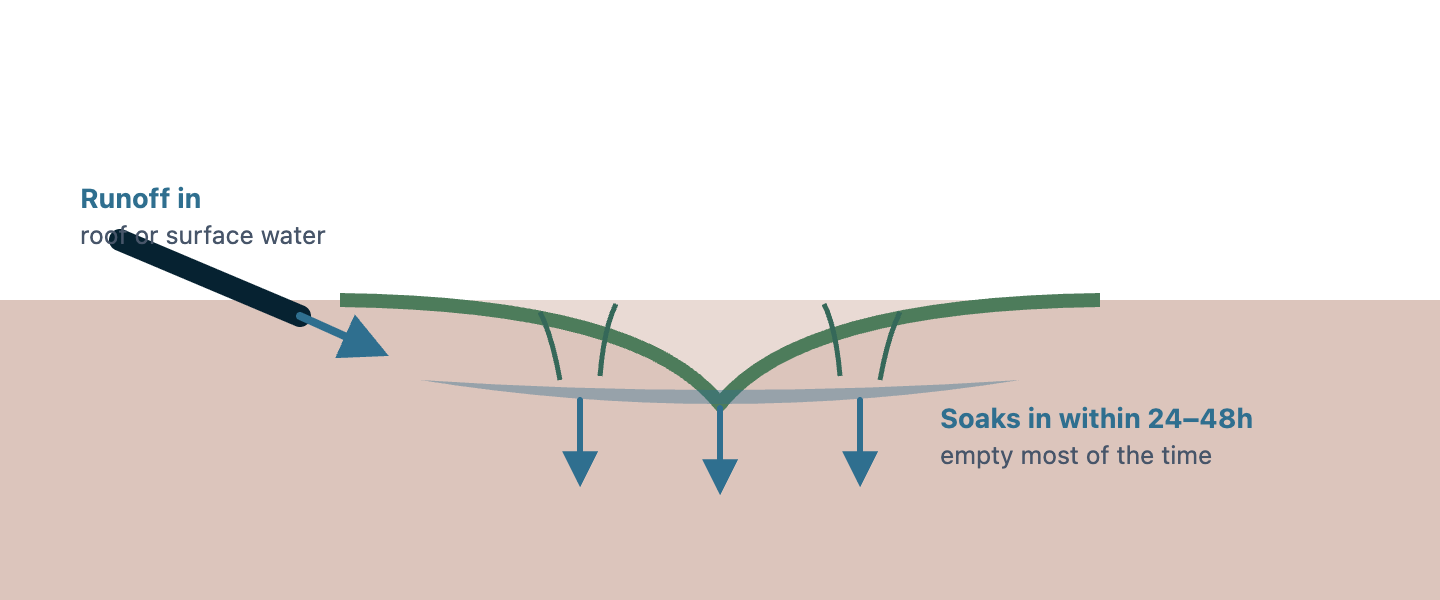
"Rain garden" sounds like a place to keep water. It isn't. A rain garden is a place to get rid of water, gracefully — a shallow, planted depression that collects a surge of runoff and lets it percolate into the ground within a day or two. The plants and the pretty are real, but the job is infiltration.
Getting this backwards is the single most common rain garden failure. A depression that holds water for days is not a rain garden — it is a pond you didn't mean to build, and standing water for more than about 48 hours starts breeding mosquitoes. A working rain garden is empty most of the time.
First question: will your soil drain it?
Like a dry well, a rain garden lives or dies on whether the ground beneath it can absorb water fast enough. And as with dry wells, this is where clay defeats good intentions — the soil that causes drainage problems is often the soil a rain garden can't empty into.
Test before you dig, with the same method as the perc test:
- Dig a hole about a foot wide and two feet deep where the rain garden would go.
- Fill it with water and let it drain fully.
- Fill it again and check that it empties within 24 to 36 hours.
If it drains in that window, the site works. If water is still sitting after a day and a half, the soil is too tight — amend it heavily with compost and sand, choose a different spot, or use a solution that moves water elsewhere instead of relying on it soaking in, such as a swale to a lower outlet. Work through your conditions if you're unsure.
Sizing — the 20 to 30 percent rule
Size it
How big does your rain garden need to be?
Enter the roof, paving and lawn that will drain to it, pick a ponding depth, and get the area, the dig list, and — the part that matters — whether your soil will empty it within 24 to 48 hours or leave you with a pond.
A rain garden has to be big enough to hold the surge from whatever drains into it. The working guideline is 20 to 30 percent of the area feeding it.
Runoff from a 1,000 square foot roof is typically handled by a rain garden of around 300 square feet. Undersize it and it overtops in every real storm; the overflow then has to go somewhere planned, not toward the house.
Depth is modest — a ponding zone usually 4 to 8 inches deep, so it fills and empties rather than holding a reservoir.
Placement
- At least 10 feet from the foundation, and never uphill of the house — you are concentrating water, and it must soak away from the structure, not toward it.
- Where runoff already arrives or can be led — below a downspout, at the end of a swale or dry creek bed, at the bottom of a gentle slope.
- Not over a septic field, well, or utilities, and clear of large tree roots.
- With a planned overflow — a low point in the rim that sends excess to a safe place when a storm exceeds the garden's capacity.
Plants that tolerate wet, then dry
The planting has to survive both states: briefly flooded, then normal or dry for weeks. Deep-rooted native perennials, sedges, and shrubs suited to your region do this best, and their roots keep the soil open so it keeps draining. Group the most water-tolerant species in the centre where it ponds, and the drought-tolerant ones on the rim. A regional native-plant list or your local extension service is the right source, since suitable species vary widely by area.
What it costs
| Scope | Rough planning range |
|---|---|
| DIY rain garden, small | $100 – $700 (mostly plants and soil amendment) |
| Professional, typical residential | $1,000 – $3,000 |
| Large or heavily planted | $3,000 – $7,000+ |
Planning estimates, not quotes. Size, soil amendment, and planting density drive the cost. A rain garden is one of the few drainage fixes that adds habitat and curb appeal while it works, which is part of its appeal — but only if the soil lets it drain.
Related pages
- Dry wells — the same soil-drainage requirement, buried instead of planted
- Dry creek beds — a natural way to lead water into a rain garden
- Downspout drainage problems — a common water source
- Standing water in your yard
- Compare every yard drainage option
FAQs
Is a rain garden the same as a pond?
No — it is nearly the opposite. A pond holds water; a rain garden gets rid of it. A properly built rain garden is empty most of the time, filling during a storm and draining within 24 to 48 hours. If yours holds water longer than that, the soil is too tight for the site, and it will breed mosquitoes rather than function as intended.
How do I know if my soil is right for a rain garden?
Dig a hole about a foot wide and two feet deep, fill it with water, let it drain, then fill it again and confirm it empties within 24 to 36 hours. If it does, the site works. If water lingers past a day and a half, the soil drains too slowly — you'll need heavy amendment, a different spot, or a solution that moves water away rather than soaking it in.
How big should a rain garden be?
About 20 to 30 percent of the area draining into it. Runoff from a 1,000 square foot roof is typically handled by a rain garden of roughly 300 square feet, with a ponding depth of 4 to 8 inches. Undersizing means it overtops in ordinary storms, so plan an overflow to a safe place either way.
What is the difference between a rain garden and a dry well?
Both store a surge and let it soak into the soil, and both need soil that drains. The difference is form: a dry well is a buried chamber out of sight, while a rain garden is an open planted depression that adds habitat and curb appeal. Choose a dry well where you want the storage hidden, a rain garden where you want it to be a visible feature.
What plants go in a rain garden?
Deep-rooted native perennials, sedges, and shrubs that tolerate being briefly flooded and then dry for weeks. Put the most water-tolerant species in the centre where it ponds and drought-tolerant ones on the rim. Because suitable plants vary by region, use a local native- plant list or your county extension service rather than a generic one.
Will a rain garden breed mosquitoes?
Not if it drains within 24 to 48 hours, which is the whole design target — mosquito larvae need roughly a week of standing water to mature. A rain garden that holds water longer than two days isn't draining properly, usually because the soil is too tight for the site. That's a sign to amend the soil or reconsider the location, not a reason to avoid rain gardens.
How far from the house should a rain garden be?
At least 10 feet from the foundation, and never uphill of it. You are deliberately concentrating runoff, so it must soak into the ground away from the structure, not toward it. Keep it clear of septic fields, wells, and utilities as well, and include an overflow that directs excess water somewhere safe in a large storm.
Sources consulted
- Brooklyn Botanic Garden — creating a rain garden
- Groundwater Foundation — all about rain gardens
- Old Farmer's Almanac — rain gardens 8 things to know
- Penn State Extension — introduction to rain gardens
By Under Your Home Team · Last reviewed 2026-08-09