Gutter Drainage: Where the Water Should Go Once It Leaves the Gutter
Gutter water should end up somewhere lower than the house that can take it: ground that keeps falling away, a planted bed or rain garden, a buried line to daylight or a pop-up emitter, or a dry well. Get it at least 5–10 feet from the foundation, never onto a neighbour's lot or sidewalk, and check local rules first.
A gutter's job ends at the downspout. Drainage is what happens to the water next, and that is decided one downspout at a time: the corner by the driveway and the corner by the fence rarely want the same answer. For the argument about distance, see how far downspouts should drain from the house. This page is about the destination.
What each part is called
- Gutter: the trough along the roof edge.
- Downspout (or leader): the vertical pipe that brings the water down.
- Elbow and adapter: the bend at the bottom, and the fitting that joins a downspout to round drain pipe.
- Extension or drain pipe: what most people mean by a "gutter drain". It's an extension if it runs above ground and a downspout drain line if it's buried.
- End-point: where the water is released, such as a splash block, emitter, bed, basin or dry well.
If water overflows the gutter itself, the question is whether there are enough downspouts, which the downspout calculator can check for you.
Where the water can go: the options compared
The figures in the fourth column are for one typical downspout serving about 500 square feet of roof in a 1-inch storm, which sheds roughly 300 gallons. Costs are planning ranges per downspout, not quotes.
| Destination | What it does with the water | Planning cost (DIY / installed) | What one storm asks of it | Wrong choice when… |
|---|---|---|---|---|
| Splash block | Slows and spreads it at the wall | Part of the extension range | 300 gallons landing within 2 ft of the foundation | The ground within a few feet doesn't fall steeply away |
| Above-ground extension | Carries it 4–10 ft onto the lawn | $10–$30 / $40–$100 | Releases the full 300 gallons wherever the pipe ends | It ends in a flat spot, or gets moved for mowing and not put back |
| Rain barrel (+ overflow) | Stores the first few dozen gallons | Low; not in our cost model | A 50-gallon barrel is full after about ⅙ inch of rain | Its overflow isn't routed like a downspout of its own |
| Planted bed or rain garden sized for roof water | Soaks it into the ground | $100–$700 / $1,000–$3,000 | A receiving bed of at least 50 sq ft; a true rain garden 100–150 sq ft | The soil doesn't drain, or the bed sits within 10 ft of a basement wall |
| Buried line to daylight | Carries it underground to a lower bank or ditch | About $80–$200 / $400–$1,200 | Moves all 300 gallons; the outlet has to take them | There's nowhere lower on your lot to come out |
| Buried line to a pop-up drain emitter | Releases it at lawn level far from the house | $80–$200 / $400–$1,200 | The same 300 gallons, surfacing at one point | The emitter sits in a flat spot or heavy clay |
| Buried line to a catch basin or a dry well | Collects it, then stores it or pipes it on | Basin $150–$400 / $600–$2,000; dry well $150–$800 / $1,500–$3,500 | A dry well has to hold the surge while the soil takes it in | The soil won't absorb water, or the water table is high |
| Storm connection | Hands it to the municipal system | Varies; often a permit | The city's system takes it | Your city prohibits it, or you haven't asked |
The table is an order of preference as much as a list. Ground that already falls away needs only an extension. Everything below that row costs more and adds something that can clog, so reach for it only when the simpler answer has nowhere to go. The buried rows share one method, covered in burying a downspout line. Longer runs add roughly $2–$3.50 per foot in DIY materials or $8–$15 per foot installed.
One house, four downspouts
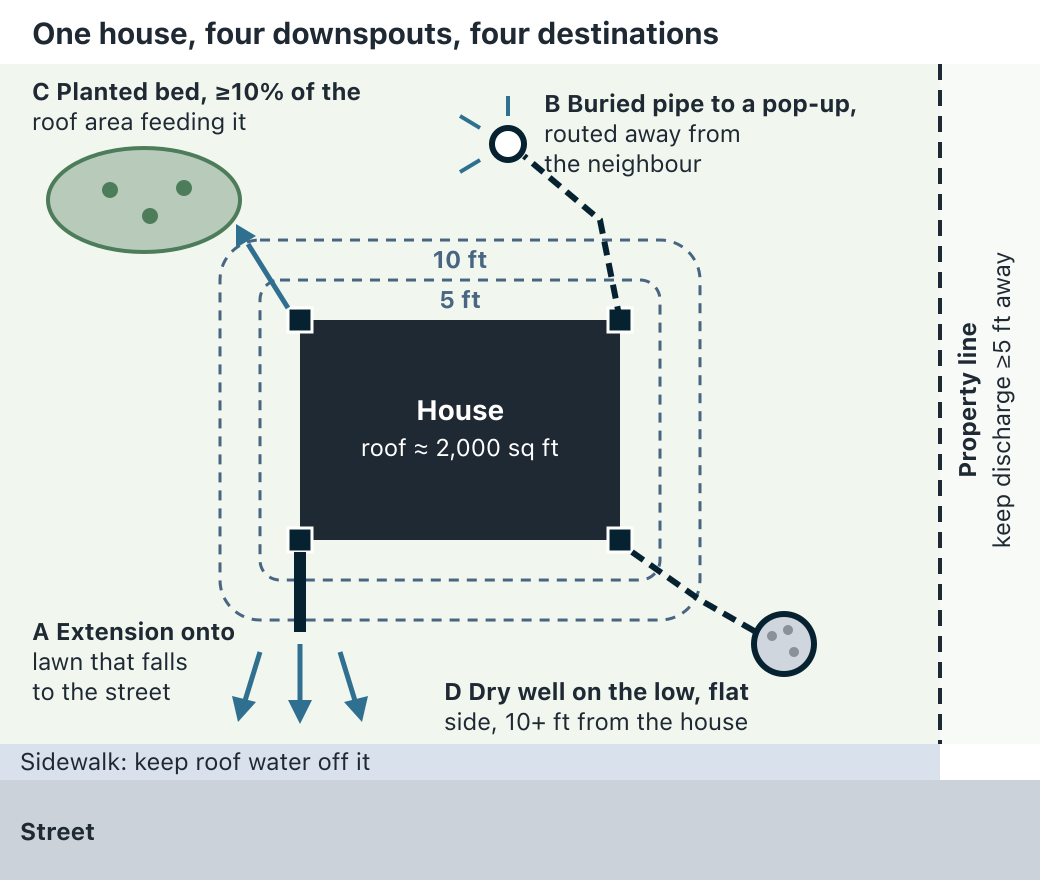
A, front corner: the lawn falls toward the street, so an extension that reaches past the 10-foot ring does the job. It's the cheapest answer, and it's right here because the ground beyond the pipe keeps falling.
B, the side by the fence: an extension would dump water toward the neighbour. The line goes underground and turns away from the property line, surfacing at a pop-up in the back lawn.
C, back corner by the garden: the water feeds a planted bed. A bed at least 10% of the roof area draining to it can take an ordinary storm, which is the sizing rule Portland uses.
D, the low, flat side: there's no lower ground to reach, so the water goes into storage. A dry well well clear of the house holds the surge while the soil takes it in.
How much water each destination has to handle
These figures come from the same calculation as our roof-runoff calculator: 0.623 gallons per square foot per inch of rain, times 0.95 because a roof sheds almost all of it.
- The whole roof. A 2,000 sq ft roof sheds about 1,200 gallons in a 1-inch storm, or about 300 gallons at each of four downspouts. A 2-inch storm doubles that, to about 2,350 gallons, or 590 per downspout.
- Rain barrels. A 500 sq ft roof section sheds about 300 gallons per inch of rain, so a 50-gallon barrel is full after roughly 0.17 inch, about a sixth of an inch. In any real storm most of the water goes through the overflow, which is why the overflow needs a proper destination.
- Receiving beds. At the 10% rule, that same 500 sq ft section needs a planted receiving area of at least 50 sq ft. A bowl-shaped rain garden, which holds water for a while, is usually sized larger, at 20–30% of the area feeding it.
Splash blocks disappoint for the same reason. Three hundred gallons in an hour is more than the 2 feet of soil beside a foundation can take.
Tool
What does your own roof shed?
Enter your roof footprint, a storm size and your number of downspouts to see the gallons arriving at each one. That's the number each destination on this page has to handle.
The rules that limit where it can go
There is no single national rule for gutter drainage. There are a few layers that commonly apply, and your city's version is the one that counts.
The building code. The International Residential Code, section R801.3, requires that where expansive or collapsible soils exist, roof water must be discharged at least 5 feet from the foundation or into an approved drainage system. Many local codes adopt some form of it.
A worked example of local setbacks. Portland, Oregon publishes one of the clearest sets of rules for disconnected downspouts:
| Keep discharge at least… | Distance |
|---|---|
| From a basement foundation | 6 ft |
| From a crawl-space or slab foundation | 2 ft |
| From your neighbour's property line | 5 ft |
| From buildings on the adjacent property | 10 ft |
| From a public sidewalk | 3 ft |
| From a retaining wall | 10 ft |
| On slopes steeper than 10% | Don't disconnect at all |
Neighbours and sidewalks. Many municipal codes bar downspouts from discharging across a public sidewalk or onto an adjoining property. Bellwood, Illinois is one example, and it also says downspouts must not damage adjacent property. Concentrated water onto a neighbour's lot is also the classic start of a dispute; see runoff onto a neighbour's yard.
Septic systems and slopes. Keep roof water well away from a septic tank and drain field, since extra water can overload them. On steep ground, water released at the surface can destabilise the slope, which is why Portland prohibits disconnection above 10%.
Storm sewers. Some cities let a downspout run to the curb or a storm drain, some require a permit, and many prohibit it. Tying roof water into a sanitary sewer is almost always prohibited.
Above-ground options: extensions, splash blocks, barrels
Extensions. They come hinged (flip up for mowing), flexible or accordion, roll-out, and rigid. They do work, provided the ground beyond the end keeps falling away. They usually fail for ordinary reasons: the extension gets moved for the mower and not put back, it's crushed, or it ends in a flat patch that ponds. Before burying anything, a temporary extension along the route you plan to use is the cheapest test there is.
Splash blocks slow the water and spread it out, but they don't move it anywhere. They're enough only where the ground falls steeply away within a few feet.
Rain barrels and diverters store a small first flush, useful for the garden. The overflow carries everything else, so it needs routing like a downspout of its own. Building America guidance puts it at least 5 feet from the house. A rain chain replaces the downspout but still needs somewhere to send the water at its base.
To judge whether the ground falls enough, see how much fall a drain line needs.
Buried options: when to go underground
Bury the line when the water has to travel more than about 10 feet, when an extension would cross a path or mowing line, or when it has to turn away from a neighbour. The spec that matters:
- Solid 4-inch pipe, not perforated. This line carries water away; it doesn't collect it.
- Continuous fall of at least 1%, about ⅛ inch per foot, with no dips.
- A cleanout or accessible joint, so the line can be flushed.
Then choose the end-point. Use daylight if the lot drops away somewhere, a pop-up emitter if the lawn falls gently, or piping a downspout into a catch basin when you're collecting surface water at the same spot. Where nothing on the lot is lower, use a dry well, and size a dry well for the roof area that feeds it.
Where gutter water should not go
- Into a French drain. A French drain takes water from soil slowly, but a downspout delivers a surge in minutes. The drain gets overwhelmed and silts up.
- Into a spot that already ponds. You're adding water to the problem.
- Upslope of the house. It comes straight back.
- Onto a neighbour's lot, a driveway or a sidewalk. Beyond the legal issue, water on paving freezes in winter.
- Over a septic tank or drain field.
- Within about 10 feet of a retaining wall, where saturated backfill adds pressure.
Related pages
- Downspout drainage problems: distance, and what goes wrong
- Underground downspout drainage: pipe, depth and fall
- Pop-up drain emitters: how they work and how they fail
- Downspout to catch basin
- Dry wells and rain gardens
- Cheapest drainage fixes: where an extension is the whole answer
- Downspout calculator: check you have enough downspouts
FAQs
What is a gutter drain called?
Usually a downspout extension if it runs above ground, or a downspout drain line (an underground downspout) if it's buried. The fitting that joins the downspout to round pipe is a downspout adapter. The end of the line is a splash block, a pop-up emitter, a catch basin or a dry well.
What are the rules for gutter drainage?
There's no single national rule. The International Residential Code (R801.3) requires roof water to be discharged at least 5 feet from the foundation, or into an approved drainage system, where expansive or collapsible soils exist. Many towns bar discharge onto a neighbour's lot or across a sidewalk, and some restrict storm-sewer connections. Check with your city. This isn't legal advice.
What is the best drainage system for gutters?
There's no single best. It's the one that ends lower than the house and can absorb the storm. If the ground already falls away, an extension is usually enough. If the water has to travel or turn away from a neighbour, a buried solid line to daylight or a pop-up emitter commonly works, and a dry well suits lots with nowhere lower to go.
How far should gutter water drain from the house?
Five to 10 feet is the common range, and buried lines often run further. Where the water lands matters more than the number: 6 feet onto ground that keeps falling beats 20 feet into a flat spot. Downspout drainage problems covers the distance question in detail.
Do downspout extenders really work?
Yes, when the ground beyond the end keeps falling away from the house. They usually fail because they get moved for mowing and not put back, get crushed, or end in a flat spot where water sits. A hinged or rigid extension and a destination that drains solve most of that.
What pipe should I use for gutter drainage?
Solid 4-inch pipe, not perforated, because the line is carrying water away rather than collecting it. Smooth-wall PVC generally outlasts thin corrugated tubing, which crushes and traps sediment in its ridges. Underground downspout drainage covers pipe choice and fall.
Can gutters drain into the street or storm drain?
Sometimes, but it's often regulated and in some places prohibited. A curb outlet or a connection to a storm drain may need a permit, and connecting to a sanitary sewer is almost always prohibited. Ask your city's stormwater or public works department before running a line to the street.
Sources consulted
By Under Your Home Team · Last reviewed 2026-09-21