Underground Downspout Drainage: Depth, Pipe, Slope and Outlets
A surface extension is the cheapest fix for a downspout dumping at the wall, and for a lot of houses it is the right one. Burying the line is what you do when the extension is in the way of mowing, when the water has to travel further than a splash block can send it, or when there is nowhere on the surface for it to go without crossing a path.
The mistake is treating it as a trenching job. It is a fall job. Get the fall right and almost any reasonable pipe works; get it wrong and the best pipe in the world holds water.
Project planner
Planning to bury one?
Enter your run length and the ground drop to the outlet. The planner checks whether the line will drain, gives the trench depth at each end and a shopping list, then walks you through the job in nine steps.
The video walks through the whole job in section: the pipe mistake, why depth should come from the fall to your outlet, and the four places a buried line can actually end.

Solid pipe, not perforated
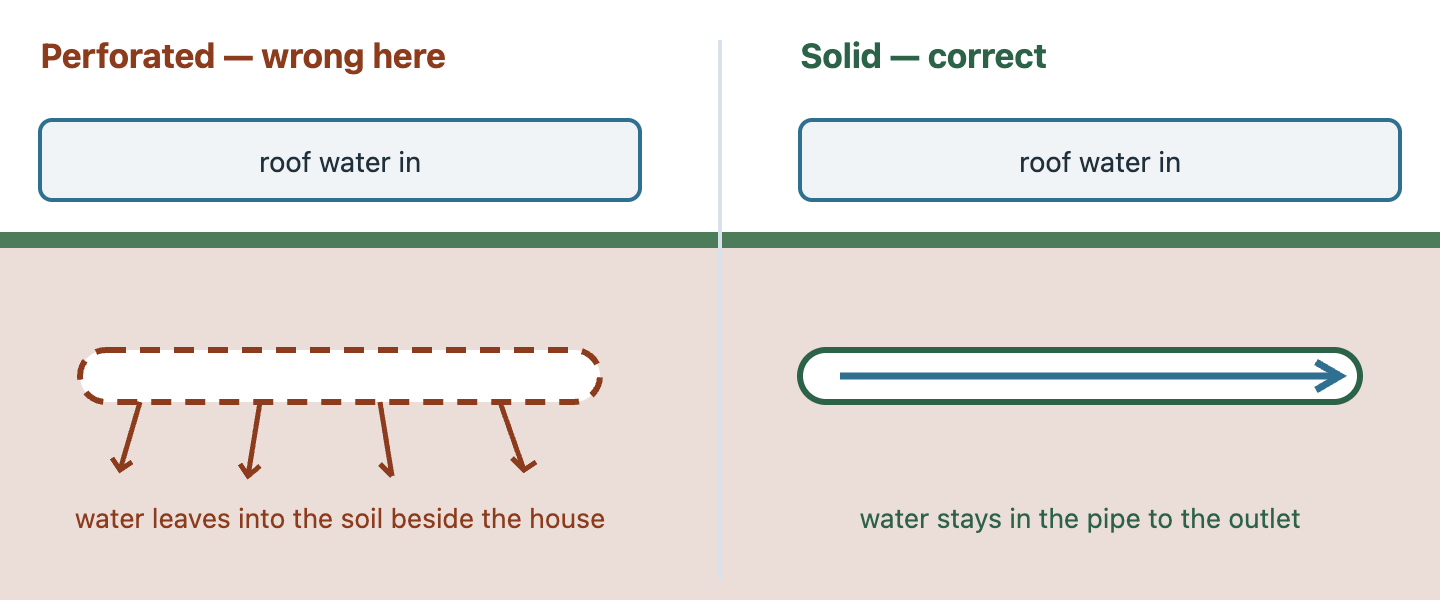
This is the error that ruins more buried downspout lines than anything else, and it happens because the aisle at the store puts both pipes side by side.
A French drain uses perforated pipe wrapped in fabric, because its job is to collect water out of wet soil. A downspout line uses solid pipe, because its job is to carry water past soil you are trying to keep dry. Bury perforated pipe from a downspout and you have built a device that takes several hundred gallons off the roof and injects it into the ground along the side of your house — which is usually the exact problem you were trying to solve.
Smooth-wall or corrugated? Rigid Schedule 40 PVC has a smooth interior, so it carries more water per inch of diameter, silts up more slowly, and can be snaked or jetted when it does. Corrugated HDPE is cheaper, bends around obstacles without fittings, and is genuinely harder to clean because the ribs trap sediment. For a run you never want to dig up again, smooth pipe is worth the difference.
Depth is the wrong question
The usual answer is 12 to 18 inches, and that is fine as a starting point. In North Carolina frost is not the constraint it is further north, so you are not burying deep to protect the pipe — you are burying deep enough to mow over and not catch a spade.
Here is what nobody mentions. At a 1% slope you drop one inch for every eight feet of run. Start the pipe 18 inches down instead of 12, and you have spent six extra inches of fall before you have moved a foot — about 48 feet of run you no longer have. On a flat lot, that difference decides whether the line can daylight at all.
So the sequence is backwards from how most people do it: find the outlet first, measure the fall you actually have to it, and let that set the depth at the house. Shallow and sloped beats deep and flat every time.
Tool
Measure the fall before you dig
Enter the drop between the downspout and where you want the water to come out, and the calculator tells you the grade and whether it clears the 1% minimum. That single number decides the whole design.
Slope, size and the outlet
| Decision | What to use | Why |
|---|---|---|
| Slope | 1% minimum — 1 in per 8 ft, or 1/8 in per foot | The IRC minimum for drainage. Below it, water sits and silt settles out. |
| Depth at the house | 12–18 in, or as shallow as the fall allows | Deep enough to mow over; every extra inch spends fall. |
| Pipe | Solid 4 in; smooth-wall PVC where you can | 4 in suits a single downspout comfortably. Solid, never perforated. |
| Connection | 6×4 reducer at the downspout | Lets the downspout drop straight in without a restriction at the top. |
| Distance from the wall | 5 ft minimum to any discharge; 10 ft to a catchment | Closer and you are re-wetting the soil you just drained. |
Where the line ends is the part people leave until last, and it is the part that decides whether the system works in five years. There are only four honest options:
- Daylight on a slope. The best outcome: the pipe surfaces somewhere lower, nothing mechanical, nothing to maintain. Needs real fall.
- A pop-up emitter. For flat lots where the pipe cannot surface. Works, with a specific failure mode worth understanding first.
- A dry well. Storage instead of discharge, if the soil can actually accept the water — which in clay it often cannot.
- A catch basin in the run. Not an endpoint, but a place for silt to settle and a lid you can lift to inspect the line.
What is not an option is ending the pipe underground with nothing at the end. A buried line that terminates in soil is a very expensive way to build a small, hidden pond.
How much water is actually in there
One downspout on a 2,000 square foot roof delivers roughly 300 gallons in a one-inch storm. That is the figure that should size the pipe and choose the outlet, and it is why a splash block on flat clay was never going to be enough.
Tool
How many gallons arrive at this downspout?
Enter the roof area and a storm size to see the total and the per-downspout share. If the number surprises you, that is the point — it is the volume the buried line has to move every time it rains hard.
Finding and clearing a line you inherited
Buried downspout drains are one of the most common things a homeowner discovers only when it fails, usually because water is suddenly backing up at the downspout in a storm.
To find one: start where the downspout enters the ground and probe along the likely route toward the lowest part of the property. Look for a pop-up emitter lid in the lawn, a grate, or a pipe stub on a bank. On an older house, check whether the line was ever connected to a storm sewer, because in some places that connection is no longer permitted.
To clear one: a garden hose flushes light silt; a drain snake handles roots and packed debris in smooth pipe. Corrugated pipe resists both, which is the practical argument for smooth wall. If the line will not clear, it may be crushed or disconnected rather than blocked — see clogged yard drains for how to tell the difference before you dig.
Related pages
- Downspout drainage problems — how far the water needs to go before you decide to bury anything
- Connecting a downspout to a catch basin — the most common buried arrangement
- Pop-up drain emitters — the outlet for flat lots, and how it fails
- Dry wells — storage when there is nowhere to discharge
- Clogged yard drain — diagnosing a line that has stopped flowing
FAQs
How deep should an underground downspout drain be?
Twelve to eighteen inches is typical, and in most of North Carolina frost is not the reason — you are burying deep enough to mow over and not catch with a spade. Treat depth as the output rather than the input: work out how much fall you have to the outlet first, because at a 1% slope every extra inch of depth at the house costs you about eight feet of run. Shallow and properly sloped beats deep and flat.
What size pipe should I use for a buried downspout?
Four inch solid pipe handles a single downspout comfortably, including the roughly 300 gallons a 2,000 square foot roof sends to one outlet in a one-inch storm. Step up to 6 inch where several downspouts join one line, where the run is long and flat, or where the pipe also has to take surface water from a catch basin. Use a 6×4 reducer where the downspout meets the pipe so the top of the run is not the restriction.
Should buried downspout pipe be perforated?
No. Perforated pipe is for French drains, where the job is to collect water out of wet soil. A downspout line is doing the opposite: carrying clean roof water past ground you want to keep dry. Burying perforated pipe from a downspout releases several hundred gallons per storm into the soil beside the house, which is usually the problem you were trying to fix. Use solid, non-perforated pipe for the whole run.
How much slope does a buried downspout line need?
At least 1%, which is one inch of fall for every eight feet of run, or 1/8 inch per foot — the IRC minimum for drainage. More is better where you have it. Below 1% the water moves slowly enough for silt to settle out of it, and a line that silts up cannot be flushed clean by the next storm because the next storm moves just as slowly.
Where should an underground downspout drain end?
Somewhere it can genuinely discharge: daylight on a slope, a pop-up emitter on a flat lot, a dry well if the soil will accept the water, or a storm connection where local rules allow one. Keep any discharge at least five feet from the foundation, and ten feet if it is a catchment that holds water. A pipe that simply stops underground with nothing at the end will back up, and it is the most common fault in inherited buried lines.
How do I find a buried downspout drain?
Start at the base of the downspout where it enters the ground and work toward the lowest part of the property, which is the direction any sensible installer would have run it. Look for a pop-up emitter lid in the lawn, a grate, or a pipe stub on a bank or ditch. A thin probe rod along the likely route will find a shallow pipe. If nothing surfaces, the line may end at a dry well or an old storm connection.
How do I clear a clogged underground downspout drain?
Flush from the downspout end with a garden hose first; light silt often moves. A drain snake clears roots and packed debris, and works far better in smooth-wall PVC than in corrugated pipe, whose ribs both trap sediment and catch the snake. If it will not clear, the pipe may be crushed, separated at a joint, or ending in soil rather than at an outlet, and none of those is fixed by flushing.
Sources consulted
- IRC — 1/8 inch per foot minimum drainage slope
- Building America Solution Center — gutters and downspouts
- NC State Extension — gutter management and moisture control
By Under Your Home Team · Last reviewed 2026-10-07