Water Runoff From a Neighbour's Yard: What You Can Do About It
Water that has always flowed downhill onto your lot is treated very differently from water a neighbour has collected and redirected. Establishing which you have decides both the drainage fix and any conversation that follows. Either way, you can intercept water at your own boundary — and documenting the flow first is worth more than any single fix.
Before anything else: is this natural flow or redirected flow?
Everything about this problem — the fix, the cost, who pays, and what conversations are worth having — hinges on one distinction, and it is the thing most guidance skips.
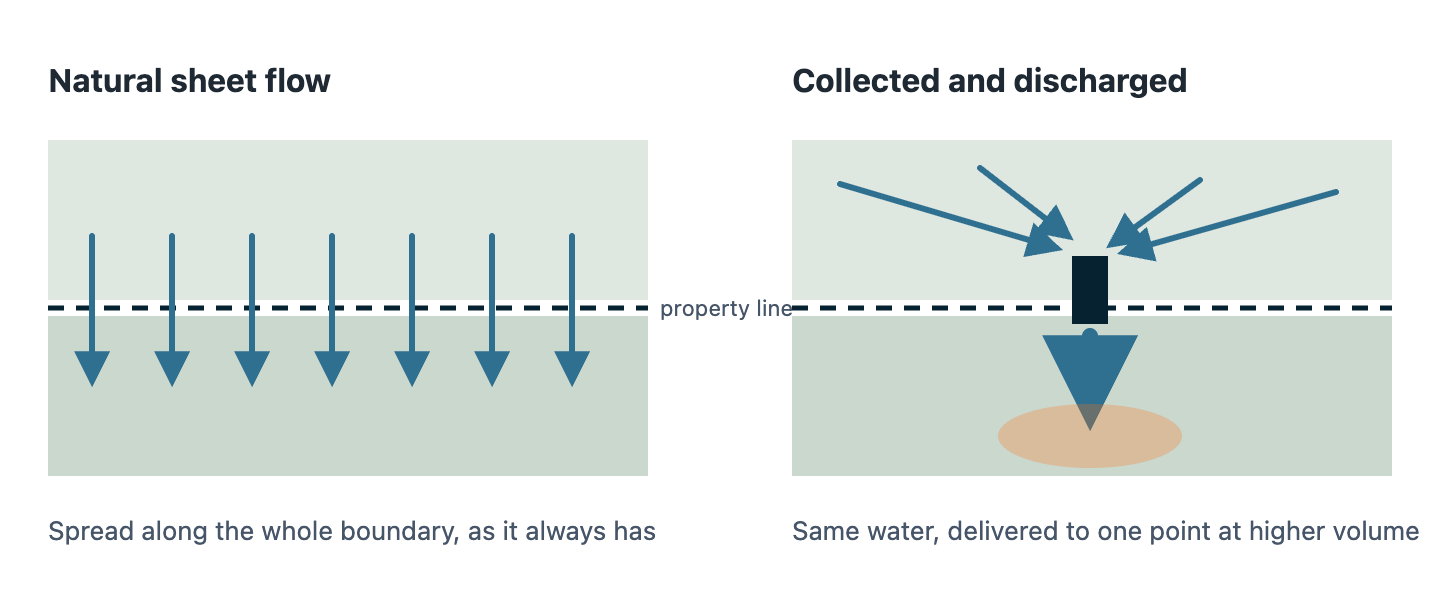
Natural flow is water doing what the land has always made it do. Your lot sits lower, so water crosses onto it as a broad sheet spread along the boundary. Unwelcome, but it is the land's normal behaviour and generally nobody's fault.
Collected and redirected flow is water that has been gathered — by a pipe, a French drain outlet, a regraded surface, a new patio, a swale cut toward you — and delivered to one point on your boundary at greater volume, speed, or concentration than before.
The practical test: has anything changed, and does the water arrive at a point or along a line? A pipe end, an emitter, an obvious channel, or flooding that started after your neighbour did work all point to redirection. Water that has arrived across the whole boundary for as long as you have lived there is natural flow.
How the law generally treats this
This is genuinely a legal question rather than a drainage one, and it varies substantially between states. This section describes the general landscape so you know what to ask about — it is not legal advice, and this site is not qualified to give any. Speak to a local attorney before acting.
Broadly, US states follow one of three approaches:
The common enemy rule. Surface water is treated as a shared problem, and landowners may generally protect their own property without liability for effects on neighbours. Under a strict version, water arriving on your land is largely your problem regardless of where it came from. Many states have softened this over time.
The civil law rule. Landowners must not alter the natural flow of water in ways that harm neighbouring property. This is more protective of the downhill owner.
The reasonable use rule. Courts weigh whether what the neighbour did was reasonable in the circumstances, considering the benefit to them against the harm to you.
Even in common-enemy states, the position often changes when water has been artificially collected and concentrated. The distinction that recurs is between water following its natural course and water gathered through some artificial means and discharged onto a neighbour in increased volume, velocity, or concentration.
Which rule applies where you live, and how it has been interpreted, is exactly the kind of thing to ask a local attorney. It is also why the documentation below matters.
What to document, starting now
If there is any chance this becomes a dispute, evidence gathered during rain is worth far more than a description afterwards. Almost nobody does this, and it is the single most useful thing on this page.
- Video during rain, showing where water enters your property and how much. Point at a fixed reference — a fence post, a step — so volume is judgeable.
- Dated photographs of standing water, erosion channels, and damage. Repeat them across several storms so the pattern is visible rather than a single bad day.
- Photographs of the source if visible from your property or a public vantage — a pipe outlet, a regraded slope, a new patio edge.
- A written note of when it started, and what changed around then. "It began the spring after they redid the back garden" is materially more useful than "it's been bad recently."
- Any correspondence, in writing. A polite message noting the problem creates a dated record that the neighbour was aware of it.
- Repair costs and receipts for anything you have already spent.
Consistent records across several storms are much harder to dismiss than one dramatic photograph.
Fixes on your own side of the line
You do not need anyone's cooperation for these, and on a modest slope they are often enough. All work by intercepting water before it spreads across the areas you care about.
A swale along the boundary. A shallow, gently graded, vegetated channel that catches sheet flow and carries it around your yard to a lower outlet. Usually the most effective option for broad natural flow, and it looks like landscaping rather than infrastructure. See swales and berms.
A berm. A raised earth ridge that redirects flow. Often paired with a swale — the material dug out of the channel forms the ridge beside it.
An interceptor French drain. A drain cut across the flow near the top of your property, collecting water moving through the soil before it reaches the wet area. This suits a slow seep better than a storm surge. See French drains for yards.
A channel drain where water arrives over a hard surface such as a shared driveway.
Planting and soil improvement to slow flow and increase absorption. Modest on its own, but it reduces erosion and complements the rest.
One important caution. Blocking or redirecting water can shift the problem onto someone else — including back toward your neighbour or onto a third property — and that can create liability for you where none existed. A berm that dams water against an uphill neighbour is a genuinely risky thing to build without advice. Design fixes to carry water through and past your property rather than to dam it.
Work through your yard's conditions if you are not sure which applies.
Raising it with your neighbour
Most of these situations resolve without lawyers, and the sequence matters.
- Establish the facts first. Know whether the flow is natural or redirected, and have your documentation. Going in without this tends to produce an argument rather than a fix.
- Assume it was unintentional. Redirected drainage is usually a side effect of work someone did for another reason. Most people genuinely do not realise where their downspout or drain outlet sends water.
- Lead with the observation, not the accusation. Showing a video of water arriving is more persuasive than an assertion about responsibility.
- Propose something specific. "Could the outlet be extended to the ditch?" is easier to agree to than "you need to fix this."
- Follow up in writing, even after a friendly conversation. A short message summarising what was agreed is not hostile, and it creates a record.
- Check whether an HOA or municipality is involved. In managed communities, drainage between lots may fall under association rules, and in some developments the association is responsible for stormwater infrastructure entirely. A municipal stormwater department may also have a view if the work required a permit.
If it does not resolve, a local attorney can tell you which rule your state follows and whether what happened crosses the line. That conversation is far more productive with a folder of dated evidence behind it.
Related pages
- When your yard floods after rain
- Standing water in your yard
- Swales and berms
- French drains for yards
FAQs
Can my neighbour legally drain water onto my property?
It depends on your state and on whether the water is following its natural course or has been collected and redirected. Some states treat surface water as a shared problem and give the uphill owner considerable latitude; others prohibit altering natural flow to a neighbour's detriment; others apply a reasonableness test. Water artificially gathered and discharged in concentrated form is treated less favourably almost everywhere. This is a legal question — ask a local attorney rather than relying on general guidance.
What is the difference between natural flow and redirected water?
Natural flow crosses the boundary as a broad sheet, spread along its length, doing what the land's shape has always made it do. Redirected flow has been gathered by a pipe, drain, regraded surface, or channel and delivered to one point at greater volume or speed. Ask whether the water arrives at a point or along a line, and whether the problem began after someone did work.
My neighbour installed a French drain and now my yard floods — what can I do?
Document it first: video during rain showing the outlet discharging and the water arriving, across several storms. This is the clearest example of collected and concentrated discharge, which is the situation most likely to be treated as the neighbour's responsibility. Raise it directly first — outlet placement is often thoughtless rather than deliberate and can be extended cheaply. If that fails, take your documentation to a local attorney.
Can I build a berm to block water from my neighbour?
Sometimes, but proceed carefully. Damming water so it backs up onto an uphill property can create liability for you where none existed, and in some jurisdictions obstructing natural flow is itself actionable. A swale that carries water through and past your property is generally safer than a barrier that stops it. Worth getting advice before building anything substantial along a boundary.
What should I document before raising it with my neighbour?
Video during actual rain showing where water enters and roughly how much, with a fixed reference for scale. Dated photographs across several storms. Photographs of the source if visible. A written note of when the problem started and what changed around then. Receipts for any damage. Records spanning multiple storms are far more persuasive than one dramatic image.
Does an HOA handle drainage disputes?
Sometimes. In many developments the homeowners association holds responsibility for stormwater infrastructure and its maintenance, and association rules may govern what owners can alter on their lots. If you are in a managed community, check the covenants and raise it with the association before treating it as a purely private matter — they may already be responsible for the system involved.
Who pays to fix drainage between two properties?
There is no general rule. Where flow is natural, the downhill owner usually bears the cost of managing water on their own land. Where a neighbour has collected and redirected water, responsibility may sit with them, depending on state law. Many cases settle with shared cost because that is faster and cheaper than establishing who is right. A local attorney can tell you what leverage you actually have.
Sources consulted
- NDS — how to keep a neighbour's runoff from flooding your yard
- HomeServe — water drainage law overview
- King Law Offices — neighbour drainage disputes
- Timoney Knox LLP — stormwater and liability
By Under Your Home Team · Last reviewed 2026-08-09