Patio and Hardscape Drainage: Water On the Slab vs Water Off It
Patio drainage problems come in two forms. Water pooling on the surface means the slab has no fall or has settled. Water pouring off the edge into the lawn means the slab drains fine but has nowhere to send it. The first needs a drain cut into or beside the surface; the second needs somewhere for the water to go.
Two problems that look similar and aren't
Almost every patio drainage complaint is one of these, and they need opposite responses.
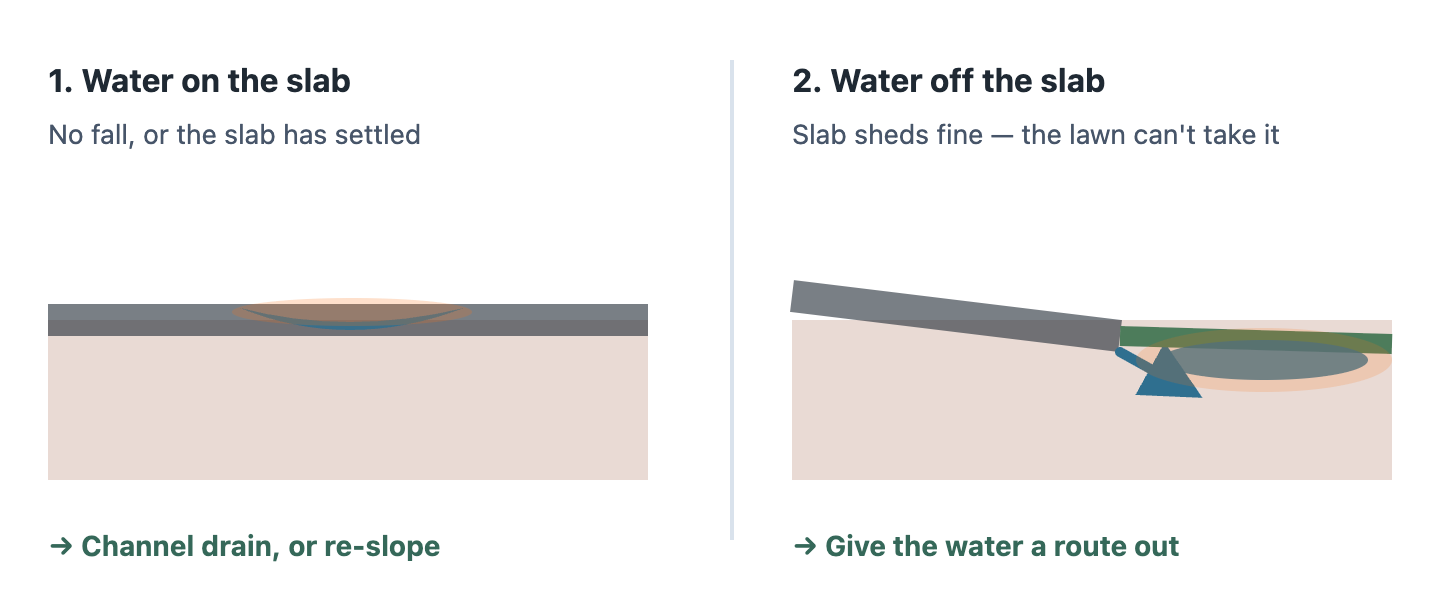
Water sitting on the slab means the surface has insufficient fall, or it once had fall and a section has settled. Cutting a drain into the surface, or adding one at the low edge and re-sloping toward it, is the fix.
Water running off the slab and pooling beside it means the patio is doing its job. A 600 square foot patio sheds around 370 gallons per inch of rain, and it delivers all of it to whichever edge is lowest. If that edge is lawn, the lawn gets 370 gallons in an hour. The patio isn't the problem — the destination is.
How to tell: stand at the patio during rain, or run a hose across it. Water that collects in the middle and stays is problem one. Water that runs cleanly off and then sits in the grass is problem two.
Getting this wrong is expensive. Cutting a channel drain into a slab that already drains properly costs several thousand dollars and does not fix the wet lawn beside it.
Fixing water on the slab
How much fall should there be?
The general target for paved surfaces is around 1 to 2% fall — roughly ¼ inch per foot — running away from the house toward somewhere water can go. That is enough to shed water without being noticeable underfoot or unstable for furniture.
Check with a level and a straightedge, or a string line. Patios frequently have fall in the wrong direction, or a dip where a section has settled over a soft spot in the base.
Channel drains
A channel drain — also called a trench drain or slot drain — is a long, narrow grated channel that collects water along a line rather than at a point. This is what makes it the right tool for hardscape: water on a slab arrives spread across an edge, not gathered in one spot.
Where they go:
- Along the low edge of a patio or driveway
- Across a driveway apron, to stop water reaching a garage
- Between a patio and the house, where the slab falls the wrong way
- Across the middle of a large slab that falls toward its centre
Channel drains need more precise work than a catch basin — a longer cut, consistent elevation along the whole run, and a clean transition into the surrounding surface. On an existing slab that means saw-cutting and reinstatement, which is why retrofits cost considerably more than installing during construction.
Other options on existing slabs
- Cut a shallow channel into the concrete and fill it with decorative stone. Cheaper than a proper drain, works for modest volumes, and reads as a design feature.
- A catch basin at one low corner, if water does gather at a single point rather than along an edge. See catch basins.
- Lift and re-lay pavers. On a paver patio, resetting a settled area to correct fall is often cheaper than any drain and fixes the cause.
- Mud-jacking or slab lifting where a concrete section has settled — restores fall without replacement.
Fixing water off the slab
This is the more common problem and much the cheaper one, because it happens in soil rather than concrete.
- Work out the volume. Measure the paved area and multiply by 0.62 gallons per square foot per inch of rain. Knowing you are dealing with a few hundred gallons per storm changes what looks adequate.
- Check where the roof water goes too. Patio edges frequently receive both slab runoff and a downspout. Separating them is often the entire fix — see downspout drainage problems.
- Give the water a route. A shallow swale leading away, a gravel edge strip that spreads the flow, or a catch basin at the low corner piped to a lower point.
- Add storage if there's nowhere lower. A dry well beside the patio accepts the surge and releases it slowly.
- Consider planting. A bed of water-tolerant plants along the receiving edge handles moderate runoff and looks intentional rather than remedial.
What it costs
| Work | Rough planning range |
|---|---|
| Channel drain, installed during new construction | $30–$80 per linear foot |
| Channel drain retrofit into existing concrete | $70–$150+ per linear foot |
| Cut-and-fill decorative stone channel | $20–$45 per linear foot |
| Catch basin at a patio corner | $600–$2,000 |
| Lifting and re-laying settled pavers | $6–$15 per square foot |
| Concrete slab lifting | $600–$2,000 per section |
Planning estimates, not quotes. Retrofits into existing concrete carry a large premium because of saw-cutting, removal, and reinstating a surface that matches. If you are having hardscape built or replaced, adding drainage at that point costs a fraction of adding it later — worth raising with the contractor even if water is not currently a problem.
What goes wrong
Grate set proud of the surface. A channel drain sitting even slightly high sheds water around itself. This is the single most common retrofit failure.
No fall in the channel itself. The channel has to slope toward its outlet. Level channels hold water and silt up.
Discharging into a French drain. A French drain collects slowly from soil; hardscape delivers a surge. Keep hardscape runoff in solid pipe to its own outlet.
No maintenance access. Channel drains fill with grit and leaf litter. Removable grates and a cleanout at the outlet end are what keep them serviceable — a blocked channel drain behaves exactly like no drain.
Discharging onto a neighbour's property. Concentrating hardscape runoff and delivering it over a boundary is a genuinely risky thing to do — see runoff from a neighbour's yard.
Related pages
- Catch basins — point collection rather than line collection
- Downspout drainage problems
- Compare every yard drainage option
- Standing water in your yard
Related
Same drain, different surface
A driveway sheds more water than a patio and usually aims it at the garage. The channel drain is the same product; the sizing, the load rating on the grate, and the gravel-driveway case are not.
FAQs
How much slope does a patio need to drain?
Around 1 to 2% — roughly ¼ inch per foot — falling away from the house. That sheds water reliably while staying comfortable underfoot and level enough for furniture. Check with a straightedge and level rather than by eye; patios often have fall in the wrong direction or a settled dip that is invisible until it rains.
Can you add a drain to an existing concrete patio?
Yes, by saw-cutting a channel and installing a drain, but it costs considerably more than including one during construction — commonly $70 to $150 per linear foot versus $30 to $80. Before committing, confirm the water is actually pooling on the slab. If the patio sheds water fine and the problem is where it lands, the fix is in the soil and much cheaper.
What is the difference between a channel drain and a trench drain?
In residential use the terms are used interchangeably for a long, narrow grated drain that collects along a line. Trench drain sometimes implies a larger, heavier commercial unit and channel drain a lighter residential one, but there is no firm dividing line. What matters is capacity and load rating — a driveway drain needs to carry vehicle weight, a patio drain does not.
Why does my patio pool water in the middle?
Either it was built without adequate fall, or the base beneath that area has settled. Water finds the dip regardless of how the rest of the slab slopes. On pavers, lifting and re-laying the settled section corrects the cause. On concrete, slab lifting can restore fall, or a drain can be cut at the low point to work with the dip rather than against it.
How much does patio drainage cost?
It depends entirely on which problem you have. Giving runoff somewhere to go in the surrounding soil — a swale, a gravel strip, a basin — commonly runs a few hundred to a couple of thousand dollars. Cutting a channel drain into existing concrete typically runs $70 to $150 per linear foot, so a 20-foot run lands between $1,400 and $3,000. Planning estimates, not quotes.
Do permeable pavers solve patio drainage?
They help by letting water pass through the surface into a stone base beneath rather than running off. They work well where the underlying soil percolates reasonably and the base is built for it. In heavy clay the base fills and the surface behaves much like solid paving, so they are not a universal answer — and retrofitting them means rebuilding the patio.
Where should patio drainage water go?
Somewhere lower that can accept it: a slope that daylights, a dry well, a rain garden, or a storm connection where local rules permit. It should not go against a foundation, into an area that already holds water, or over a property boundary. Decide the destination before choosing the drain — the outlet determines what will actually work.
Sources consulted
- Concrete Network — concrete patio drainage solutions
- Slot Drain Systems — concrete patio drainage considerations
- The Garden Scene — catch basin vs channel drain
- Pavestone — preventing water pooling on patios
By Under Your Home Team · Last reviewed 2026-08-09