Driveway Drainage: Stopping Water Before It Reaches the Garage
A driveway is the most efficient water collector on most properties. It absorbs nothing, covers several hundred square feet, and on a large share of houses it slopes gently down toward the building — because that is where the car needs to end up.
At roughly 0.62 gallons per square foot per inch of rain, a 600 square foot driveway delivers about 370 gallons in a one-inch storm, all of it arriving at the bottom end within a few minutes. If the bottom end is a garage door, that is the whole problem in one sentence.
First: is it the driveway, or is it uphill?
Worth thirty seconds before anyone quotes you for cutting concrete. Stand outside during rain, or run a hose at the top of the drive, and watch where the water actually enters.
- Sheet flow down the drive itself. The driveway is the catchment. A channel drain across the low end is the right fix.
- Water crossing onto the drive from the lawn or a bank. The drive is a victim, not the cause. Intercept it before it arrives — a swale or regrading uphill is cheaper and less invasive than cutting the slab.
- Water arriving from the street or a neighbour. A different question again, with a legal dimension. See runoff from a neighbour's yard.
- Roof water discharging onto the drive. Fix the downspout first. Adding roof water to a driveway is a self-inflicted version of this problem.
Channel drains: what they are and how to size one
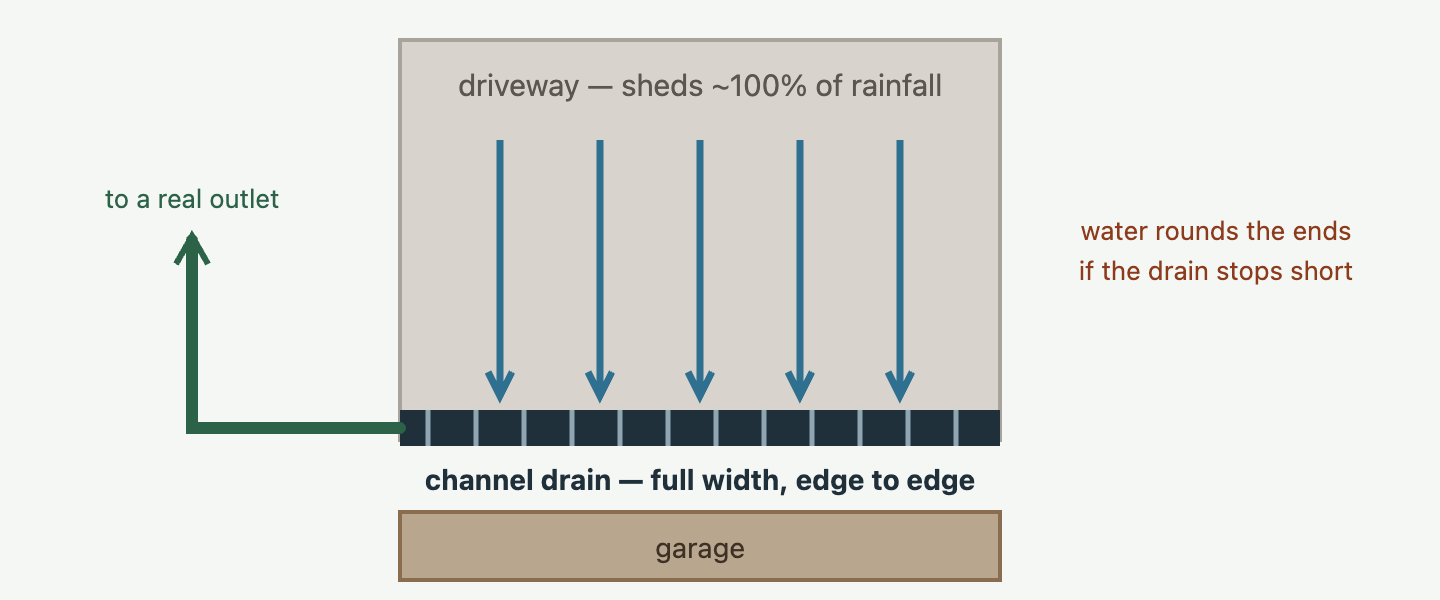
A channel drain — also sold as a trench drain or linear drain — is a narrow pre-formed channel with a removable grate, set flush into the paving so water crossing it falls in. It is the right tool where water arrives as sheet flow across a width, which is exactly how it behaves on a driveway. A single round grate at one spot cannot catch a sheet; a line across the flow can.
| Decision | Guidance | Why |
|---|---|---|
| Length | The full width of the drive, edge to edge | Water simply rounds a drain that stops short. |
| Channel width | 4 in for typical residential; 6–8 in for steep or wide drives | Wider channel carries more without overtopping. |
| Grate material | Plastic for foot traffic; ductile iron or galvanised steel where cars cross | A plastic grate under a wheel is a repair waiting to happen. |
| Load rating | Check the class matches vehicle traffic | Grates are load-rated; driveway duty is not the cheapest tier. |
| Outlet | Solid pipe to daylight, a dry well, or a storm connection | The drain only moves the problem to wherever the pipe ends. |
| Fall in the pipe | 1% minimum from the channel | Below that the outlet pipe silts and backs up into the channel. |
The failure people report most is not the drain filling up — it is water going around it. A channel that stops a foot short of each edge leaves two gaps that concentrate flow exactly where you did not want it. Full width, or it is decoration.
What it costs
Planning ranges for comparing quotes, not quotes themselves.
| Scope | Typical range | Notes |
|---|---|---|
| Channel drain, installed | $36–$120 per linear foot | Complex cuts and heavy grates push toward the top. |
| Typical driveway drain project | $400–$2,400 | Depends on width, grate, and how far the outlet is. |
| Materials only, DIY | $100–$500 | Channel sections run roughly $45–$100 per 6 ft. |
| Cutting and reinstating concrete | Adds meaningfully | Saw-cutting an existing slab is the expensive part. |
| Clearing a neglected drain later | $300–$600 | Cheaper than the alternative of not clearing it. |
The single biggest cost variable is whether the driveway already exists. Setting a channel during a new pour is straightforward; cutting a slot through cured concrete, bedding the channel, and reinstating the surface is a different job at a different price.
Tool
Where does the pipe from the drain actually go?
The channel is the easy half. Measure the fall from the drain outlet to where you intend the water to end up — if it does not clear 1%, the drain will fill faster than the pipe empties it, and the design needs rethinking before anyone cuts concrete.
Gravel driveways wash out for a different reason
On a gravel drive the problem is rarely a puddle at the bottom — it is the surface leaving with the water. Ruts form along the line of fastest flow, gravel collects at the low end, and each storm cuts the channel deeper.
Cutting a channel drain into gravel does not work well; there is nothing solid to bed it into and the stone migrates into it. The approaches that do work:
- Crown the surface so water sheds sideways to both edges rather than running the length of the drive. This is the fix, and it is a grading job.
- Cross-slope or a broad water bar at intervals on a long, steep drive, moving water off the running surface before it gains speed.
- A shallow swale alongside, taking the shed water away.
- Larger, angular stone on the surface layer, which locks together instead of rolling.
The common thread is the same as everywhere else on this site: move the water off early and in a controlled direction, rather than letting it accumulate and then trying to catch it.
Related pages
- Patio and hardscape drainage — the same physics on a patio, and when the fix is the slab rather than a drain
- Catch basins — for a low spot rather than a sheet of water
- Yard grading and levelling — the crown-and-shed approach
- Water pooling near the foundation — where driveway water usually ends up
- Yard erosion from runoff — what the same water does to soil
FAQs
How do I stop water running down my driveway into the garage?
Intercept it across the full width before it reaches the door, usually with a channel drain set flush at the low point and piped to a real outlet. Before committing, confirm the water is coming off the driveway itself rather than crossing onto it from uphill — if it is arriving from the lawn or a bank, a swale or regrading above the drive is cheaper and does not involve cutting concrete. Also check that no downspout is discharging onto the drive.
What is a channel drain and how does it work?
A channel drain, also called a trench or linear drain, is a narrow pre-formed channel with a removable grate, set flush into paving so water running across the surface falls into it. It suits sheet flow across a width, which is how water behaves on a driveway — a single round grate cannot intercept a sheet, but a line across its path can. The channel drains to a solid pipe that carries the water to a discharge point.
How much does a driveway channel drain cost?
As a planning range, roughly $36 to $120 per linear foot installed, with a typical driveway project landing between about $400 and $2,400. Materials alone for a DIY installation run about $100 to $500, with channel sections around $45 to $100 per six feet. The largest variable is whether the driveway already exists — saw-cutting and reinstating cured concrete costs considerably more than setting a channel during a new pour.
How wide should a driveway channel drain be?
A 4 inch channel handles most residential driveways. Step up to 6 or 8 inches on a steep drive, a wide one, or where the drain also takes water from an adjoining slope, because a narrow channel on a steep drive can be overtopped by fast-moving water before it has a chance to fall in. Length matters more than width: run it edge to edge, because water simply flows around a channel that stops short.
How do I stop a gravel driveway washing out?
Shed the water sideways instead of letting it run the length of the drive. Crowning the surface so it falls to both edges is the main fix, supported on long or steep drives by a cross-slope or water bar at intervals, and often a shallow swale alongside to take the shed water away. Larger angular stone on the surface locks together better than rounded gravel. Channel drains work poorly in gravel because there is nothing solid to bed them into.
Can I install a channel drain myself?
On a new pour or a gravel-set paver drive, it is within reach of a confident DIYer. Cutting a slot through an existing concrete slab is a different proposition: it needs a saw, an accurate bed for the channel, correct fall along its length, and a reinstated surface that does not crack at the join. The part most often underestimated is not the channel but the outlet pipe, which needs a genuine fall to somewhere the water can go.
Do I need a permit for driveway drainage?
Sometimes, and it depends less on the drain than on where the water ends up. Discharging to a storm sewer, altering a drainage easement, or changing runoff across a property line are the situations most likely to need approval or to create a dispute. A drain that keeps water on your own property and discharges to your own ground is usually the simplest case. Check with your local building or stormwater department before connecting to anything public.
Sources consulted
- Angi — channel drain installation guide and costs
- Rhode Island DEM — trench drains for sloping driveways
- HomeGuide — drainage system installation cost 2026
By Under Your Home Team · Last reviewed 2026-09-05