Standing Water in Your Yard: How to Find the Cause Before You Fix It
Water that clears within a few hours after heavy rain is normal. Water still standing after 24 hours points to a drainage problem, and after 48 hours it is almost certainly grading, compaction, or clay soil. How long it sits — and whether the ground stays wet underneath — tells you which of the six common causes you have.
How long is too long?
Most advice about standing water skips straight to solutions. But the single most useful piece of information you already have is how long the water sits, and it costs nothing to observe.
A yard with adequate grading and drainage should not hold standing water 48 hours after a heavy rain event. Working backwards from that gives you a rough ladder:
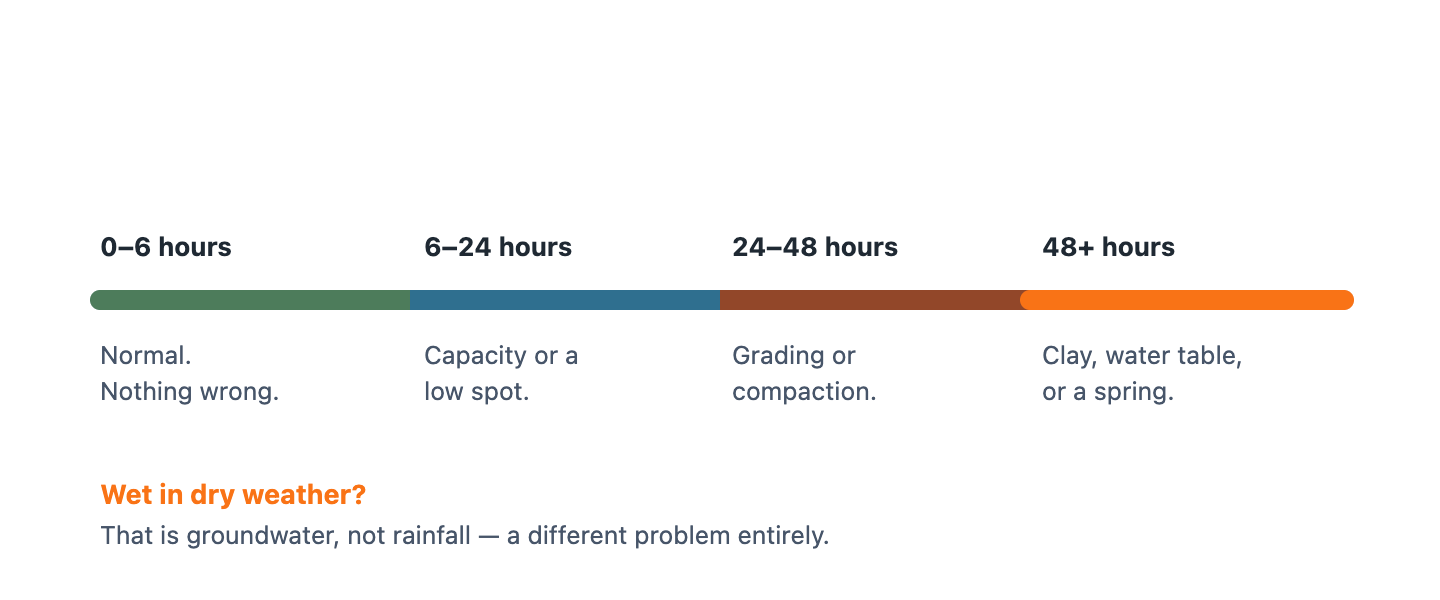
Two follow-up observations sharpen it further:
Does it happen after small rain, or only after storms? Pooling only in heavy storms is usually a capacity problem — more water arrived than the ground could take in that hour. Pooling after ordinary rain means the ground has very little capacity at all.
Is the ground still wet underneath after the surface dries? Push a screwdriver in two or three days later. Easy entry and a damp hole means the soil is saturated below, which is a different problem from a puddle sitting on top of ground that drains fine.
The six causes, and how to tell them apart
Almost every case of standing water comes down to one of six things, often two together. The table below is the fastest way to narrow it down.
| Cause | What points to it | How to confirm |
|---|---|---|
| Low spot / grading | Water always collects in the same place; the rest of the yard drains fine | String line and level across the area — see below |
| Compacted soil | Broad wet areas, hard ground, thin grass, often on newer builds or where vehicles parked | Screwdriver test: hard to push in when dry, water sits on top when wet |
| Clay soil | Whole yard drains slowly; ground cracks in summer, stays sticky in winter | Perc test — under 1 inch per hour indicates heavy clay |
| Roof runoff | Wet areas near the house, downspouts, or in a line leading away from one | Watch during rain. A 2,000 sq ft roof sheds ~1,250 gallons per inch |
| High water table | Wet in dry weather too; holes fill with water on their own | Dig a 12–18 inch hole in dry weather and leave it overnight |
| Water arriving from elsewhere | Wet area is uphill-facing or along a boundary; volume seems too large for your lot | Walk uphill during rain and watch where water enters |
Two or more of these together is common — clay soil that was also compacted during construction is close to the default condition in a lot of newer subdivisions.
Two tests you can do yourself
Both are worth doing before you spend money, and both take longer to read about than to perform.
The perc test — does your soil actually drain?
This is the test that recurs across drainage advice as the recommended first step, and almost nobody explains it properly.
- Dig a hole about 12 inches deep and 6 to 12 inches wide, in the problem area.
- Fill it with water and let it drain completely. This pre-soaks the soil so you measure real behaviour, not dry-soil absorption.
- Fill it again, and time how far the water level drops in an hour.
More than 4 inches per hour — free-draining soil. Your problem is almost certainly surface routing, not soil. 1 to 4 inches per hour — normal. Soil is not your main issue. Less than 1 inch per hour — poor drainage. Clay, compaction, or both. Barely moves overnight — the ground has effectively no capacity, and no surface fix will change that on its own.
The grade check — which way does the ground actually fall?
Yards that look flat frequently are not, and yards that look like they slope away from the house sometimes do the opposite.
Drive a stake at the wet spot and another 10 to 20 feet away where you would like water to go. Tie a string at ground level on the uphill stake, run it taut to the other, and level it with a line level. Measure from string to ground at the far stake. That gap is your fall.
Around the house, aim for roughly 6 inches of drop over the first 10 feet (about 5%). Out in the yard, about 1% — a bit over an inch per 10 feet — is enough to move water if the route is clear.
What to do first
Work in order of cost. A surprising share of standing water problems resolve at step one or two, and every step tells you more about what you are dealing with.
- Fix the roof runoff. If downspouts discharge within a few feet of the house, you are adding hundreds of gallons to the wettest part of your yard every storm. Extending or burying them is the cheapest meaningful change you can make. See downspout drainage problems.
- Clear anything already installed. Existing grates, basins, and outlets silt up quietly. If you have drains, check they still work before adding more — a clogged yard drain behaves exactly like no drain.
- Relieve compaction. Core aeration and topdressing with compost restores infiltration on compacted lawns for a fraction of the cost of excavation, though it takes a season or two to show.
- Fix the low spot. A shallow depression can be filled and regraded. This is often the whole answer where the rest of the yard drains normally.
- Add surface collection. Where water genuinely has nowhere to go, a catch basin at the low point piped to a lower outlet moves it out.
- Add subsurface drainage. If the ground itself stays saturated — not just the surface — a French drain is the tool for that. It is fifth on this list for a reason: it is the most expensive option and the one most often installed for problems it cannot solve.
Not sure which applies? Work through your yard's conditions step by step, or compare every option side by side.
When it isn't really your problem
Some standing water is not a defect in your yard at all.
Water arriving from uphill. If a neighbouring property, a road, or a development upslope concentrates water onto your lot, drainage work on your side manages a symptom. That has its own considerations — see runoff from a neighbour's yard.
Seasonal high water table. In low-lying ground, the water table can rise to within a foot of the surface for part of the year. Gravity drainage cannot lower a water table; it can only intercept water moving through soil above it.
A spring or seep. Water appearing in dry weather, often in the same spot on a slope, is groundwater surfacing. It can be intercepted, but not stopped.
Genuinely low-lying land. Some lots sit at the bottom of everything around them. Where the whole neighbourhood drains through your yard, the realistic goal is managing water across it rather than eliminating it.
A septic drain field, if the wet area sits over one. If your house is on septic and the soggy patch happens to be above the drain field, the cause may not be drainage at all — the field may be saturated after rain, or no longer absorbing. The timing test is the same one used above, and it is covered in saturated drain field and septic drain field failure. Water that reaches the surface over a drain field is untreated, so it is worth ruling out before you dig anything.
Recognising these early saves money. A drainage system installed against a rising water table will disappoint no matter how well it is built.
Related pages
- When your yard floods after rain — for volume, not just pooling
- Water pooling near the foundation
- Catch basins — the usual answer for surface water
- French drains for yards — for saturated ground
- Dry creek beds — a landscaped channel for surface runoff
- Compare every yard drainage option
- Who to call for yard drainage
FAQs
How long should water stand in a yard after rain?
A well-drained yard should clear standing water within a few hours, and should not hold it 48 hours after heavy rain. Puddles immediately after a storm are normal. Water lingering past a day indicates a drainage problem worth investigating; water still there after two days points to grading, compaction, or clay.
Is standing water in a yard dangerous?
The main practical concern is mosquitoes — it takes roughly a week for larvae to become adults, so water that sits for several days after every rain can become a persistent problem. Standing water also kills turf and most ornamental plants by starving roots of oxygen. Water repeatedly saturating soil against a house is worth addressing sooner, since that is a different issue from a puddle in the middle of the lawn.
Why does my yard hold water even when it hasn't rained?
Water present in dry weather is almost always groundwater rather than rainfall — a high seasonal water table, or a spring or seep surfacing. This behaves very differently from rain-driven pooling and needs a different approach: interception rather than collection. Dig a hole 12 to 18 inches deep in dry weather and leave it overnight. If it fills on its own, you are dealing with groundwater.
Will aerating my lawn fix standing water?
It helps genuinely compacted soil, and it is cheap enough to be worth trying first on a broad wet area with hard ground. It will not fix a low spot, a grading problem, or roof runoff discharging beside the house, because none of those are caused by compaction. Core aeration with compost topdressing, repeated over a couple of seasons, produces more lasting improvement than a single pass.
How do I know if I have clay soil?
Clay cracks when dry, stays sticky when wet, and can be rolled into a ribbon between your fingers. The reliable test is a perc test: fill a pre-soaked 12-inch hole and measure the drop over an hour. Under an inch per hour indicates heavy clay. Many state extension services, including North Carolina's, offer low-cost or free soil testing that gives you a proper answer.
Can I just fill in the low spot with soil?
Often yes, and it is the right first move where the rest of the yard drains normally and the depression is shallow. Use topsoil rather than heavy clay fill, build it up in layers rather than all at once, and confirm with a string line that water now has somewhere lower to go. Filling a low spot in a yard that drains poorly everywhere just relocates the puddle.
Does standing water mean I need a French drain?
Usually not. A French drain collects water from saturated soil, not water sitting on the surface. If your ground stays soggy for days and squelches underfoot, it may be the right tool. If the water sits on top and the ground below is fine, a catch basin or regrading addresses it far more directly and for less money.
Sources consulted
- McKee Homes — 48-hour drainage benchmark
- TLC Incorporated — why yards hold water after rain
- NC Cooperative Extension — soil testing programme
- Ware Landscaping — standing water causes
By Under Your Home Team · Last reviewed 2026-08-09