Drainage Swale for Yard Water: Sizing, Slope, Cost, and Berms
A swale is a shallow, gently sloping channel that carries surface water across your yard to a safe outlet; a berm is the low ridge often built beside it. Together they handle surface runoff for a fraction of a French drain's cost — and for water sheeting over the ground, they usually work better too.
The option homeowners skip — and shouldn't
Ask most people how to fix a wet yard and they say "French drain." It has become the default answer, and for a lot of problems it is the wrong one and the expensive one.
A swale does a job a French drain often cannot: it catches water moving across the surface and carries it somewhere safe before it pools. And the cost difference is not small. Swale work runs roughly $0.50 to $1 per square foot. French drain installation runs $10 or more per linear foot. For the very common problem of water sheeting downhill across a lawn, a swale can solve for a tenth of the price — while a French drain buried underneath collects almost none of that surface water.
If your problem is water you can see running or pooling on the ground, a swale belongs at the top of your list, not the bottom.
Swale, berm, or both
The two go together, so it helps to be clear on what each does.
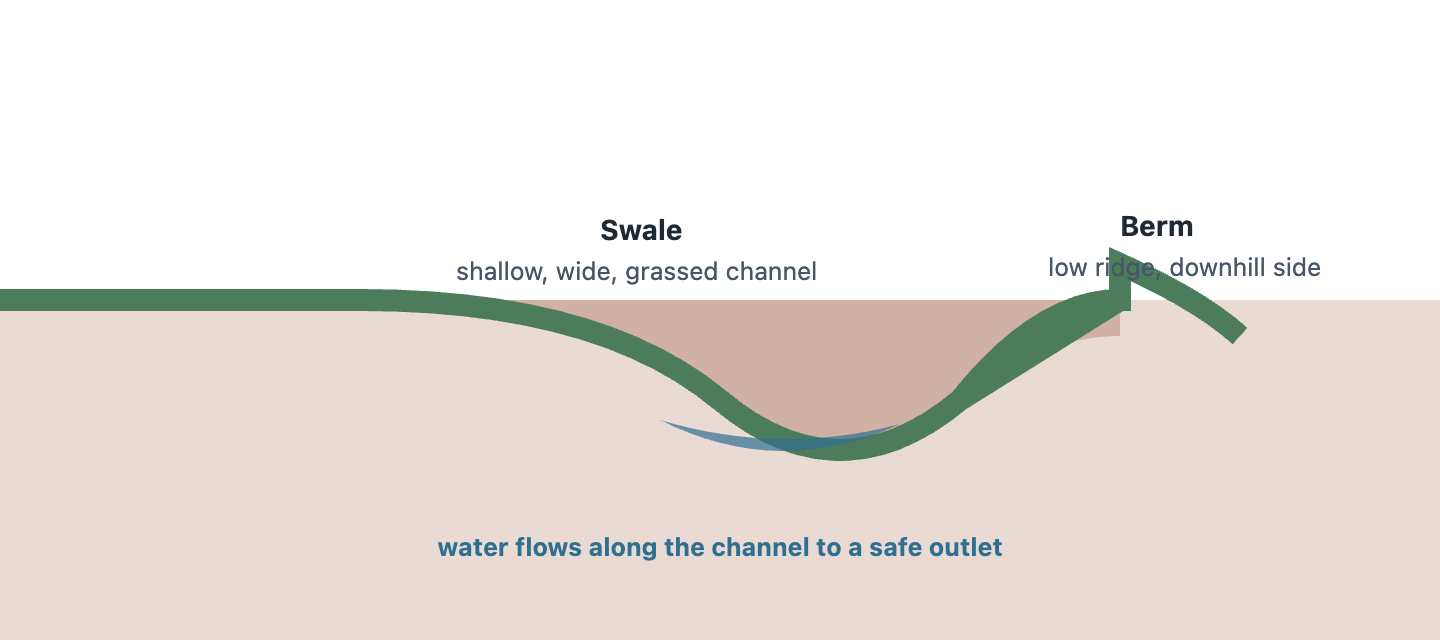
A swale is a shallow, broad, gently graded channel — usually grassed — that water flows along, not into. It is not a ditch. Done well it looks like a natural low sweep in the lawn and mows like the rest of the yard. Its whole job is to intercept surface water and guide it to a place it can leave or soak in.
A berm is a low mound of earth, often built on the downhill side of a swale from the very soil dug out to form it. It keeps water in the swale's path, or blocks and redirects flow coming from a direction you don't want. A berm without a swale can redirect; a swale with a berm can both carry and contain.
Together they are the standard tool for water arriving as a broad sheet — down a slope, off a neighbouring property, across an open lawn — because they work with the surface flow instead of hoping it soaks down to a buried pipe.
Watch the swale and berm walkthrough
This video shows how a drainage swale and berm work together: the swale carries surface water, and the berm helps keep that water moving along the planned route.
When a swale is the right call
Good fits:
- Water sheeting downhill across the yard
- Runoff arriving from an uphill neighbour or a road
- A broad wet area rather than one pinpoint low spot
- Directing roof and surface water toward a rain garden, dry well, or daylight outlet
- Anywhere you want drainage that looks like landscaping, not infrastructure
Poor fits:
- Saturated soil with nothing pooling on top — that is subsurface water, and a French drain is the tool.
- No fall at all — a swale still needs gentle slope to move water; on dead-flat ground it becomes a linear puddle.
- No room — swales need width. A narrow side yard may suit a channel drain or French drain better.
- Water at one small point — a catch basin is simpler.
Drainage swale design: size and slope
A drainage swale should be broad enough to carry water slowly, shallow enough to blend into the yard, and graded toward a real outlet. These are planning starting points, not engineered stormwater designs.
| Situation | Planning size | What to watch |
|---|---|---|
| Light lawn runoff | 1–2 feet wide, shallow depression | Keep it mowable and fully vegetated |
| Water sheeting across a slope | Several feet wide, 8–12 inches deep | Use a gentle, continuous route toward a lower outlet |
| Boundary or uphill runoff | Wider swale with a low berm on the downhill side | Carry water through, not onto a neighbour or back toward the house |
| Faster flow or erosion risk | Wider swale, stone lining, or dry creek bed | Grass may scour before it establishes |
| Dead-flat yard | Usually not a swale-only problem | Look at grading, a catch basin, rain garden, dry well, or pump-assisted plan |
For grade, a 1% to 2% fall along the swale is a useful homeowner target — about 1 to 2 inches of drop every 10 feet. Too little fall leaves a long puddle. Too much fall sends water fast enough to erode bare soil, young grass, mulch, or a weak outlet.
Side slopes matter too. A swale with gentle side slopes is easier to mow and less likely to collapse or scour. As a practical rule, the sides should flare gradually rather than drop like a trench.
Inlet and outlet planning
The inlet is where water first enters the swale: the uphill edge of a lawn, a downspout discharge point, a driveway edge, or the place where runoff from a neighbouring slope already arrives. Widen and stabilize the inlet so water spreads into the channel instead of cutting a new path around it.
The outlet is where the swale sends water. Decide this before digging. Good outlets can include:
- A rain garden or planted absorption area
- A dry well, if the soil drains well enough
- A daylight edge on a slope
- A ditch or approved stormwater route
- A catch basin or pipe system when surface routing needs to connect to drainage hardware
Do not use a swale to push water toward the house, into the street, or across a property line. If the only place it can go is another problem area, the swale is not finished — it is just moving the problem.
When to add a berm
A berm helps when water wants to keep sliding downhill past the swale. It belongs on the downhill side of the channel, shaped as a low, broad ridge rather than a wall. The soil dug from the swale often becomes the berm, which keeps the project efficient.
Use a berm when:
- Water sheets across a slope and needs to be intercepted
- Runoff arrives from uphill and needs to be carried along the boundary
- The swale needs a subtle lip to keep water in the channel during ordinary storms
Be careful with berms near property lines. A berm that simply blocks water can back it up against a neighbour, fence, driveway, or foundation. The safer pattern is collect and carry: the berm nudges water into the swale, and the swale gives it a safe route out.
How to build a drainage swale
A swale is one of the most achievable DIY drainage projects, but the grade is everything.
- Find the path and the outlet. Water has to end somewhere lower and welcome — a ditch, a rain garden, a dry well, a daylight edge. Establish that first.
- Call 811 before digging.
- Mark the route with the natural fall of the land, not straight across it. Swales curve.
- Excavate shallow and wide — commonly 8 to 18 inches deep and several feet wide, with gently sloping sides that a mower can climb. Wide and shallow beats narrow and deep.
- Build the berm from the spoil on the downhill side, firmed and shaped to blend in.
- Hold about a 1 to 2% grade along the channel toward the outlet — roughly 1 to 2 inches of fall per 10 feet. Check it with a string line and line level.
- Stabilise the surface — sod, seed, or plant it. Bare soil erodes; established roots hold the swale and slow the water. For faster flows, a lining of stone (a dry creek bed) protects the base.
- Test it in rain or with a hose before calling it done. Watch for water cutting around the inlet, ponding in the middle, or eroding the outlet.
The most common mistake is making a swale too narrow and too deep, so it reads as a ditch, scours, and is miserable to mow. Shallow and broad is the goal.
Mistakes that make swales fail
| Mistake | What happens | Better approach |
|---|---|---|
| No clear outlet | Water fills the swale and spills wherever it can | Pick the outlet before digging |
| Too flat | The swale becomes a long puddle | Hold a gentle fall toward the outlet |
| Too steep | Water scours the bottom and outlet | Widen the swale, add curves, or use stone/check protection |
| Too narrow and deep | It acts like a ditch and is hard to mow | Keep it wide, shallow, and gradual |
| Bare soil left exposed | The first storm erodes the channel | Seed, sod, or plant quickly |
| Berm used as a dam | Water backs up or diverts onto someone else | Use the berm to guide water into a safe channel |
| Wrong problem | Saturated soil stays wet even after the swale is built | Consider a French drain or other subsurface fix |
Maintenance
A swale is low-maintenance, not no-maintenance. Check it after the first few heavy rains and then a few times a year.
- Keep grass or plants established so roots hold the soil.
- Repair bare spots before the next storm.
- Remove sediment, leaves, or mulch that blocks the low path.
- Mow grassed swales high enough that the channel stays vegetated.
- Watch the inlet and outlet for erosion; those are the first places to fail.
- Keep woody roots and raised edging from blocking the flow path.
Swale vs other drainage fixes
| Fix | Best for | Not ideal when |
|---|---|---|
| Swale | Broad surface water moving across a yard | The yard has no fall or outlet |
| Berm | Nudging surface water into a planned channel | It would dam water against a property line or structure |
| Dry creek bed | A swale that needs stone protection or a finished look | You need the cheapest grassed solution |
| French drain | Water held in saturated soil below the surface | You can see water running across the lawn |
| Catch basin | One low spot where water collects | Water arrives as broad sheet flow |
Not sure this is the right fix?
Check whether your yard needs a swale, basin, French drain, or dry creek bed
A swale is best for visible surface runoff. If the water is trapped in one low spot or the soil stays soggy below the surface, a different fix may be a better first move.
What it costs
| Scope | Rough planning range |
|---|---|
| DIY swale, hand-dug and seeded | Materials only — often under $300 |
| DIY swale with sod or planting | Often $200 – $800 |
| Swale work, professional | $0.50 – $1.00 per square foot |
| Swale with a stone-lined channel | Higher, toward dry-creek-bed pricing |
| Regrading plus swale on a larger lot | $1,000 – $5,000 |
Planning estimates, not quotes. A swale is usually the least expensive installed drainage option per area covered, which is exactly why it deserves more attention than it gets.
Related pages
- Standing water in your yard
- Runoff from a neighbour's yard — swales are a key fix here
- French drains for yards — for subsurface water instead
- Yard grading and levelling
- Compare every yard drainage option
- Yard Slope Calculator — measure the fall for your swale
FAQs
What is a swale?
A swale is a shallow, broad, gently sloped channel, usually grassed, that carries surface runoff across a yard to a safe outlet. It differs from a ditch because its sides are gentle enough to mow, and from a French drain because it works on the surface instead of underground. A drainage swale is used to intercept water sheeting downhill, runoff arriving from a neighbour's yard, or roof water on its way to a rain garden or dry well.
What is the difference between a swale and a French drain?
A swale is a surface channel that carries water you can see flowing across the ground. A French drain is a buried pipe that collects water from within saturated soil. Swales handle surface runoff and cost far less — around 50 cents to a dollar per square foot versus $10 or more per linear foot for a French drain. They solve different problems, and are sometimes used together.
How deep should a drainage swale be?
Most residential swales are 8 to 18 inches deep and several feet wide, with gently sloping sides. Wide and shallow works better than narrow and deep — it moves more water, resists erosion, and stays mowable. What matters more than depth is a consistent gentle grade of about 1 to 2% along the channel toward a lower outlet.
How much does a swale cost?
Professional swale work commonly runs $0.50 to $1.00 per square foot, making it one of the cheapest installed drainage options. A simple hand-dug and seeded swale can cost only materials. Adding a stone-lined channel or combining it with regrading raises the price. These are planning ranges, not quotes.
What is a berm and do I need one with a swale?
A berm is a low earth ridge, often built from the soil dug out to form a swale and placed on its downhill side. It keeps water in the swale's path or blocks flow from an unwanted direction. Not every swale needs one — a swale cut into a slope may not — but the swale-plus- berm pairing is common because the excavated soil has to go somewhere useful anyway.
Will grass grow in a swale?
Yes — a grassed swale is the most common kind, and once established it mows like the rest of the lawn. The vegetation is doing real work: roots hold the soil against erosion and slow the water so more soaks in. Choose grass suited to occasionally wet conditions, and establish it quickly with sod or fast seed so the channel doesn't scour before roots take hold.
Can a swale handle heavy rain?
A properly sized swale handles ordinary storms well, and a stone-lined channel handles more. For extreme events, a swale is often paired with storage — leading to a rain garden or dry well — or sized wider to carry the peak. On a lot with genuinely large volumes, a swale may be one part of a system rather than the whole answer.
Do I need a permit to build a swale?
Often not for a simple regrading swale within your own lot, but it varies by municipality, and directing water toward a property line, a wetland, or a storm system can trigger requirements. Redirecting flow onto a neighbour can also create liability. Check locally before building anything substantial, and call 811 before digging.
Sources consulted
By Under Your Home Team · Last reviewed 2026-09-15