Septic Drain Field Failure: The Signs, and What They Mean
A drain field has failed when it can no longer absorb water into the surrounding soil. The reliable signs are effluent surfacing over the field, drains that stay slow after the ground has dried, and sewage odour outdoors. Bright green grass over the field is a much weaker sign than it is usually given credit for, and rain-triggered problems that clear up are saturation rather than failure.
What "failure" actually means
A drain field is not a container. It is a set of trenches that release treated wastewater into the soil, and the soil does the final work of absorbing and filtering it. Failure is what happens when that soil can no longer take water — either because the trench surfaces have sealed over, or because the soil itself has lost the structure that let it absorb.
That definition matters because it separates two things people often merge. A drain field can stop working temporarily because the ground around it is soaked, and recover. A failed field cannot absorb regardless of conditions. Same symptoms, completely different bill.
The signs, ranked by how much they actually tell you
Most lists give every sign equal weight. They are not equal.
Strong signs — these mean have it looked at
- Effluent surfacing over the field. Standing water, a wet sheen, or spongy ground over the trenches when it has not rained for two days. This is the clearest single indicator, and it is also a health hazard — the water is untreated.
- Drains still slow after the ground has dried. Slow drains during a wet spell are ambiguous. Slow drains in dry weather point at the field.
- Sewage odour outdoors near the field. Indoor odours often have plumbing explanations, such as a dry trap or a venting problem. Outdoor odour over the field is harder to explain away.
- Backups that are getting more frequent. A system that used to cope with heavy rain and now backs up every time is telling you it is marginal, even between events.
Weak signs — worth noting, not worth panicking over
- Bright green grass over the field. This gets repeated everywhere, and on its own it is poor evidence. Grass over a drain field is often greener simply because it sits above moisture and nutrients — that can be a normally functioning system. It becomes meaningful when it appears with wet ground or odour, or when it is a sudden change rather than a long-standing pattern.
- A single backup during a storm. Ambiguous by itself. See saturated drain field for how timing separates weather from failure.
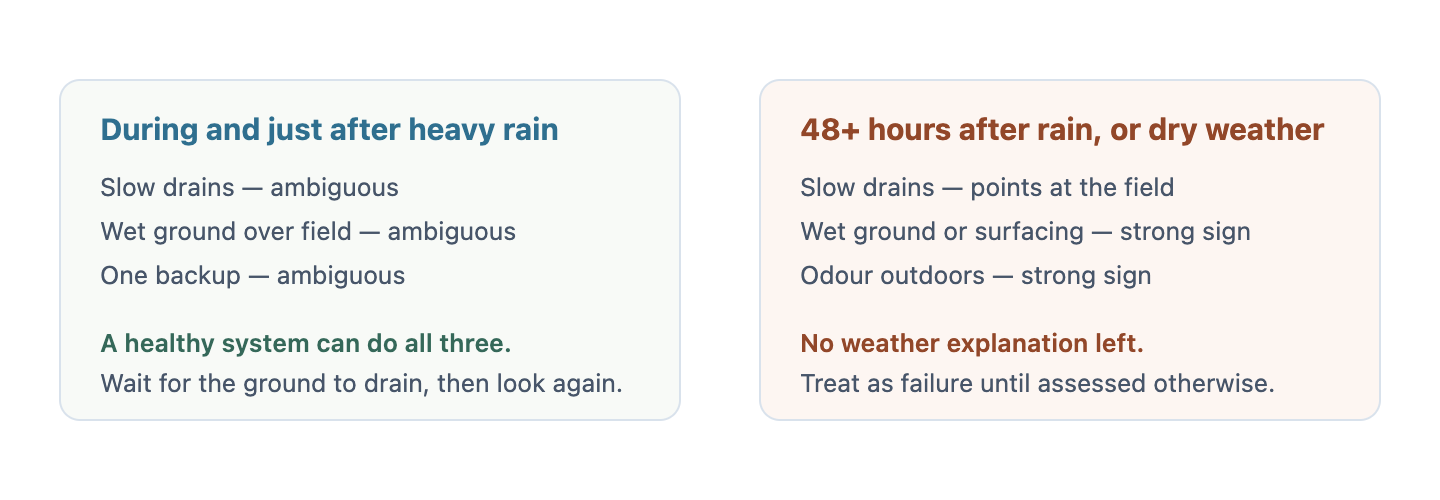
Clogged, overloaded, or genuinely worn out
"Failed" covers three situations that a professional would treat differently, and it is worth knowing which you might be describing.
- Sealed or clogged trench surfaces. Over years, a layer builds up at the interface between the trenches and the soil and gradually seals it. This is the ordinary end-of-life pattern for a field, and it is what most "clogged drain field" searches are really about.
- Hydraulic overload. The field is intact but is being sent more water than it was sized for — extra occupants, a running toilet, or surface water from the yard being added on top. This one can sometimes be improved without replacement, which is why it is worth ruling out.
- Physical damage or compaction. Vehicles, trailers, stored equipment, or construction over the field can crush pipes and compact the soil, and roots can intrude into trenches.
Two causes on that list — overload from surface water, and compaction — are the ones a homeowner has some control over, and both are ordinary yard drainage questions rather than septic ones.
The part you can actually do something about
A drain field is sized for household wastewater. It is not sized for that plus roof runoff and slope drainage, and adding those shortens its life.
Worth checking on your own ground:
- Downspouts discharging near the field. A single downspout can deliver a very large volume during a storm to exactly the wrong place. Extending it away is one of the cheapest useful things you can do, and it is covered in downspout drainage problems.
- Ground that slopes toward the field, or a new patio, driveway, or path shedding runoff that way. See yard grading and leveling and swales and berms for how that water gets redirected.
- Anything parked or stored on the field. Keep vehicles, trailers, and equipment off it.
- Trees planted close to the field, whose roots can find the trenches.
None of this repairs a field that has already failed. It reduces the load on one that has not, and it removes a cause a replacement would otherwise inherit.
Where this hands off
This page covers what shows up on the surface of your yard, because that is what this site knows. Confirming failure, soil and percolation testing, sizing and designing a replacement, tank work, pumping, and permitting all belong to a licensed septic professional, and the rules vary by county. Nothing here can confirm what is happening below your own lawn.
If water has surfaced over the field, treat it as untreated effluent: keep people and pets off it, do not mow it, and get it assessed rather than waiting to see whether it dries out.
What are the first signs of drain field failure?
Usually slow drains that do not improve once the ground has dried, followed by wet or spongy ground over the field in dry weather, and sewage odour outdoors near it. Water actually reaching the surface over the trenches is the clearest sign and also the most urgent, because that water is untreated. Backups that are becoming more frequent are worth taking seriously even if each one clears.
Does bright green grass mean my drain field is failing?
On its own, not really — it is the most over-quoted sign in the topic. Grass above a drain field often grows greener simply because there is moisture and nutrients below it, and that can describe a perfectly functional system. It carries weight when it appears alongside wet ground, odour, or slow drains, or when it is a sudden change rather than something that has looked that way for years.
Is a clogged drain field the same as a failed one?
Clogging is the most common route to failure rather than a separate problem. Over time a layer builds up where the trenches meet the soil and gradually seals that surface, until the field can no longer pass water into the ground. The practical difference worth establishing is whether the field is worn out, or whether it is intact but being overloaded with more water than it was designed for, because those do not lead to the same recommendation.
What causes a drain field to fail?
Most commonly age and gradual sealing of the trench surfaces. Beyond that: hydraulic overload, where more water enters than the field was sized for, including surface water from the yard; physical damage or soil compaction from vehicles, equipment, or construction over the field; and root intrusion from trees planted too close. Solids carrying over from a tank that has not been maintained can also accelerate sealing.
Can a failed drain field be repaired, or does it need replacing?
It depends which of the three situations you have, which is why assessment comes before pricing. A field that is intact but overloaded may improve when the extra water is removed. A field whose trench surfaces have sealed after years of service is usually at the end of its life, and replacement is the normal answer. Some jurisdictions also require a replacement field to meet current standards rather than simply restoring what was there, so local rules affect the answer as much as the field's condition does.
How long does a drain field last?
There is no single number, and any figure quoted without seeing the site is a rough average rather than a prediction. Lifespan depends heavily on soil type and absorption capacity, how much water the household sends it, whether the tank has been maintained so solids do not carry over, and whether the field has been kept clear of vehicles, construction, and roots. Two identical fields in different soils can differ substantially.
Is it safe to stay in the house with a failed drain field?
The house itself is usually still usable, but surfacing effluent in the yard is a genuine health hazard and should be treated as contaminated: keep children and pets away from it and do not mow through it. Sewage backing up inside the house is a different matter and needs immediate attention. Reducing water use while you arrange an assessment lowers the amount reaching a field that cannot handle it.
Sources consulted
- US EPA — septic systems overview and soil absorption
- Washington State Department of Health — signs of septic system failure
- NC State Extension — septic systems and their maintenance
By Under Your Home Team · Last reviewed 2026-08-30