French Drain vs Swale vs Dry Creek Bed: Surface or Subsurface?
These three split on one question: is your water on the surface or in the soil? A swale and a dry creek bed both carry water across the surface — the dry creek bed is just a swale finished in stone. A French drain is different in kind: it collects water from within saturated soil. If you can see water flowing, you want a surface fix, not a buried pipe.
Two of these are the same thing
The first thing to clear up: a dry creek bed is a swale in a nicer outfit. Both are graded surface channels that carry water flowing across the ground. The swale is the plain grassed version; the dry creek bed is the same channel lined with river rock so it looks like a natural streambed. They do the identical drainage job. The choice between them is mostly appearance and budget, not function.
The real divide is between those two surface tools and the French drain, which works on a different problem entirely.
The question that sorts all three
Is your water on the surface, or in the soil?
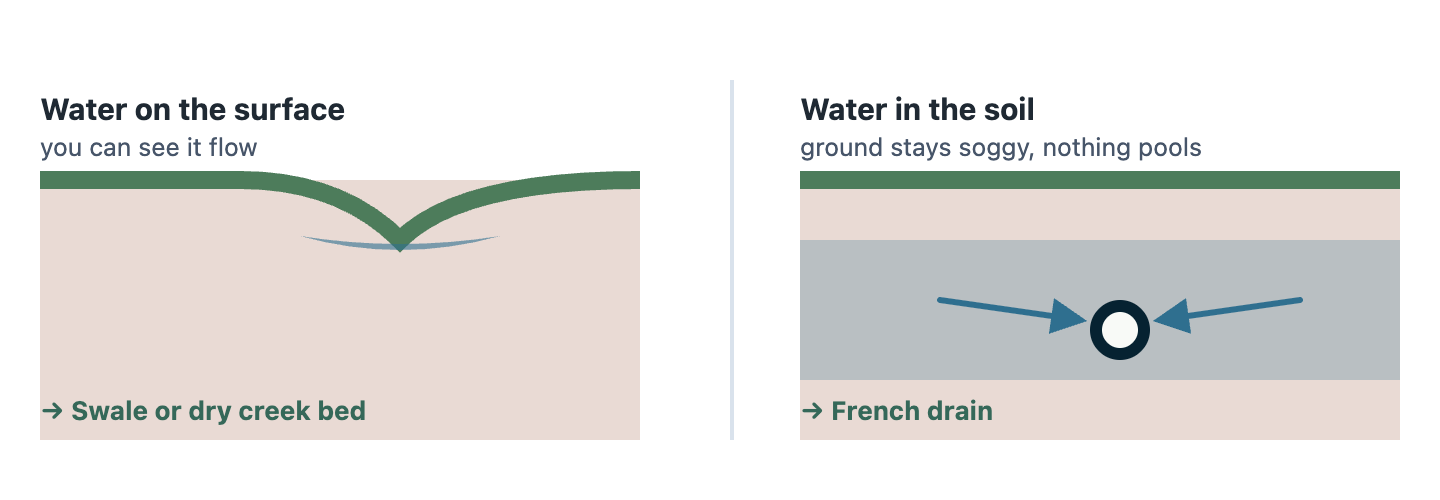
If you can watch water run or pool on top of the ground during rain, that is surface water, and a swale or dry creek bed catches and carries it — cheaply and, in the dry creek bed's case, attractively. Burying a French drain under that water does little, because the drain collects from within the soil and most of the surface flow never reaches it.
If the surface looks dry a day after rain but the ground stays soggy and a screwdriver slides in with no resistance, that is subsurface water, and a French drain is the tool. A swale over saturated soil just channels whatever surfaces; it can't reach the water held below.
The single most common and expensive mistake in yard drainage is burying a French drain to fix surface water. If you can see the water, look at the surface tools first.
Side by side
| Swale | Dry creek bed | French drain | |
|---|---|---|---|
| Handles | Surface flow | Surface flow | Subsurface (soil) water |
| Visible? | Grassed, subtle | Stone, a feature | Buried, hidden |
| Rough cost | $0.50–$1 / sq ft | $20–$50 / linear ft | $10–$35 / linear ft |
| Look | Plain lawn sweep | Natural streambed | None — it's underground |
| DIY-friendly | Yes | Yes, with effort | Sometimes |
| Best when | Cheapest surface fix | You want it to look good | Ground stays saturated |
Cost is not close
For the same surface-drainage job, a swale is dramatically the cheapest — often a fraction of what any buried pipe costs. A dry creek bed costs more than a plain swale because you're paying for the finished stone look, not better drainage. A French drain is a different product for a different problem, so comparing its per-foot price to a swale's is comparing tools, not deals. If your problem is surface water, the swale is almost always the value choice, with the dry creek bed as the pay-more-for-looks upgrade.
When none of the three fits
- A single pinpoint low spot — a catch basin is simpler than routing a channel to it.
- No fall and no outlet — surface channels need slope; with nowhere lower, look at a dry well or rain garden for storage.
- Water arriving from off your lot — intercept it at the boundary first; see runoff from a neighbour's yard.
Work through your yard's conditions, or see every option compared.
Related pages
FAQs
What is the difference between a swale and a dry creek bed?
Almost none, functionally — a dry creek bed is a swale lined with river rock to look like a natural streambed. Both are graded surface channels that carry flowing water the same way. The difference is appearance and cost: a swale is a plain grassed sweep, a dry creek bed is a finished landscape feature that costs more.
Is a swale or a French drain better?
They solve different problems, so neither is universally better. A swale handles water flowing on the surface; a French drain collects water from within saturated soil. If you can see water running or pooling, a swale is usually the right and far cheaper choice. If the ground stays soggy with nothing showing on top, a French drain is the tool.
When should I use a dry creek bed instead of a French drain?
When your water is on the surface and you want the fix to look good. A dry creek bed carries surface runoff along a visible stone channel; a French drain collects subsurface water and is buried. If the ground stays saturated below the surface, the dry creek bed won't reach that water — that's French drain territory.
Which is cheapest?
A grassed swale, by a wide margin — often $0.50 to $1 per square foot. A dry creek bed runs $20 to $50 per linear foot for the finished stone look. A French drain is $10 to $35 per linear foot but solves a different problem. For surface water, the swale is the value choice; pay more for a dry creek bed only if you want the appearance.
Can I combine a swale and a French drain?
Yes, where a yard has both problems — surface runoff and saturated soil. A swale can carry the surface water while a French drain handles the subsurface. More commonly, though, a yard has one or the other, and identifying which saves you from installing a tool for a problem you don't have.
Which looks best in a yard?
A dry creek bed, by design — it's built to look like a natural streambed and reads as a landscape feature rather than drainage. A swale is subtle, blending into the lawn. A French drain is invisible, since it's buried. If appearance matters and your water is on the surface, the dry creek bed is the one that turns the fix into a feature.
Sources consulted
- The Garden Scene — French drain vs swale vs dry creek bed
- Angi — swale vs French drain
- Ware Landscaping — swales vs French drains
- Houzz — how to build a dry creek bed
By Under Your Home Team · Last reviewed 2026-08-09