Downspout Drainage Problems: How Far Is Far Enough?
Published guidance ranges from 5 feet to 30 feet because there is no universal answer. The right distance depends on your grade, your soil, and where the water ends up. Six feet onto ground that falls away beats twenty feet into a flat spot. Fix the destination first, then the distance.
Why the advice contradicts itself
Look up how far downspouts should discharge and you will find, in the space of one search: at least 5 to 10 feet, 8 feet is a good goal, buried lines should run at least 20 feet, and 10 to 30 feet is typical. All from credible sources, all different.
They are not really disagreeing. They are answering slightly different questions, and none of them is stating the thing that actually decides it: a distance is only meaningful in relation to where the water lands.
Six feet onto ground that continues to fall away carries water off and away. Twenty feet into a flat area, or into a low spot, or onto compacted clay simply moves the puddle further out — and now you have paid for pipe as well. The number is a proxy for the real requirement, which is that water leaves the discharge point under its own steam.
So the useful sequence is: work out how much water you are dealing with, decide where it should end up, and let that determine the distance.
How much water are we talking about?
This is the part homeowners consistently underestimate, and it reframes the problem.
Rain falling on a roof produces roughly 0.62 gallons per square foot per inch. Because a roof absorbs nothing, essentially all of it exits through a small number of downspouts.
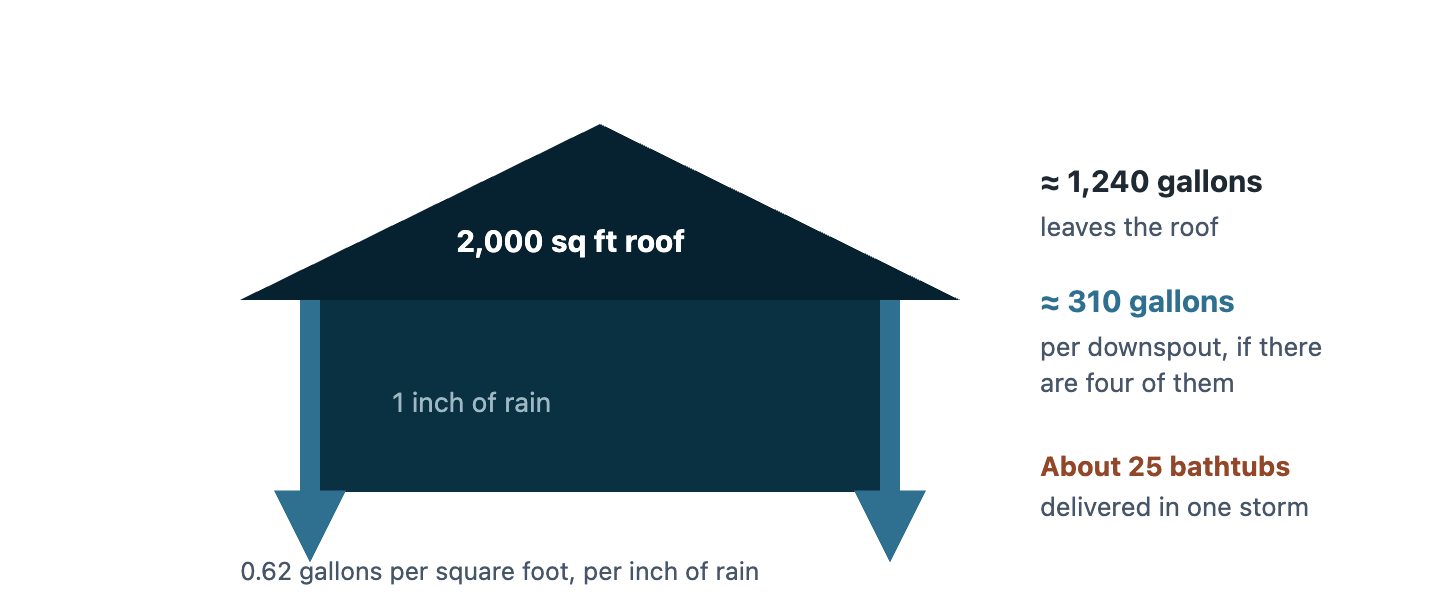
A 2,000 square foot roof sheds about 1,240 gallons in a one-inch storm. Split across four downspouts, that is roughly 310 gallons arriving at each — about 25 bathtubs' worth around the house in a single ordinary storm. A three-inch storm triples it.
Put that number next to a splash block two feet from the wall and the problem explains itself. This is usually the largest single water source on a residential lot, and the one you have the most control over.
Once you know the volume, decide the destination.
Where should the water go?
Somewhere lower than the house that can take a surge: ground that keeps falling away, a planted bed, a buried line to daylight or a pop-up emitter, or a dry well where nothing is lower. Never onto a neighbour's lot, into a spot that already ponds, or upslope of the house. Before burying anything, run a temporary extension along the route and watch it through a couple of storms.
Gutter drainage: where downspout water should go compares every destination side by side, with planning costs, the setback rules to check, and when each one is the wrong choice.
If you bury it
- Use solid pipe, not perforated. This line is carrying water away, not collecting it — perforated pipe leaks the water back into the soil you are trying to protect.
- Rigid pipe outlasts thin corrugated tubing, which crushes and traps sediment in its ridges.
- Maintain fall the whole way. Commonly cited is 1 to 2%; more is better where the terrain allows, since it moves sediment through instead of letting it settle.
- Typical burial is around 18 inches, deeper in freezing climates, and clear of the frost line where that applies.
- Include a cleanout or an accessible joint. Buried downspout lines silt up, and a line with no access point becomes an excavation job — see clogged yard drain.
- Call 811 before digging. Free, and required in most places.
What goes wrong
Water backing up out of the downspout. The buried line is blocked or its outlet is buried. Common after a few seasons where no cleanout was fitted.
A wet patch appearing at the emitter. Either the discharge point is too flat or the soil there cannot take the volume. Extend further, or add storage.
Discharging into a French drain. A frequent and usually poor idea. A French drain collects water from soil at a modest rate; a downspout delivers a surge. The drain gets overwhelmed and silts up faster. Keep roof water in its own solid line to its own outlet.
Ice at the outlet in winter. In cold climates a buried line with insufficient fall can freeze at the emitter and back water up. More slope and a daylight outlet help.
The extension that gets moved for mowing and never moved back. Genuinely one of the most common causes of persistent wet spots by a house. Buried lines exist partly to solve this.
Related pages
- Standing water in your yard
- Water pooling near the foundation — roof water is usually the cause
- When your yard floods after rain
- Clogged yard drain — for buried lines that stop working
- Roof Runoff Calculator — how much water your downspouts shed
Tool
Are there enough downspouts, and are they the right size?
Overflow at the corners and a flooded bed under one outlet often mean too few downspouts, not a bad yard. Enter the roof area, pitch, and gutter length to see the count and size the roof needs — and how much water lands at each one.
Solution
Thinking of burying the line?
Depth matters less than fall, and the pipe must be solid rather than perforated — burying perforated pipe puts the roof water straight back into the soil beside the house.
FAQs
How far should a downspout drain from the house?
Six feet is a reasonable minimum, ten or more is better, and buried lines often run further still. But distance alone is not the requirement — water has to keep moving once it gets there. Six feet onto ground that falls away works better than twenty feet into a flat area. Decide where the water should end up, then measure back from that.
How much water comes off my roof?
Roughly 0.62 gallons per square foot per inch of rain. A 2,000 square foot roof sheds about 1,240 gallons in a one-inch storm — around 310 gallons per downspout if you have four. Since roofs absorb nothing, this is usually the largest and most concentrated water source on a residential property.
Should I bury my downspouts?
It is worth it where you need water carried more than about ten feet, where above-ground pipe interferes with mowing, or where extensions keep getting moved and not replaced. It costs more and adds a line that can eventually clog. Test the route with an above-ground extension for a few storms first — if that solves the problem, bury the same route with confidence.
How deep should a buried downspout be?
Around 18 inches is typical, deep enough to be clear of normal garden activity and below the frost line in most temperate areas. In colder climates go deeper. What matters more than depth is consistent fall from the downspout to the outlet — a shallow line with good fall outperforms a deep one that dips.
What is a pop-up emitter and do they work?
It is a spring-loaded lid at the end of a buried line that sits flush with the lawn and lifts when water pressure builds, letting water out and then closing to keep debris out. They work well when the line has real fall and the ground at the emitter can take the water. They perform poorly on flat ground or heavy clay, where water surfaces and sits. Most have a weep hole so the line drains between storms.
Can I connect downspouts to a French drain?
Generally not a good idea. A French drain is designed to collect water gradually from saturated soil; a downspout delivers a large surge in minutes. The drain gets overwhelmed when you need it most and silts up faster. Keep roof water in a separate solid pipe running to its own outlet.
Why does water back up out of my downspout?
Almost always a blockage in the buried line or a buried, silted outlet. Find the discharge point first and clear it — that alone resolves a large share of cases. If water still backs up with a clear outlet, the line itself is obstructed and needs flushing or snaking. Lines installed without a cleanout are considerably harder to clear.
Sources consulted
- Home Inspection Insider — gutter drainage distances
- French Drain Man — how far to bury downspouts
- Angi — burying gutter downspouts
- Boggs Inspection — downspout extension distances
By Under Your Home Team · Last reviewed 2026-09-21