French Drain vs Dry Well: They're Not Alternatives
A French drain collects water and carries it to a lower outlet; a dry well receives water and stores it while the soil absorbs it. They do different jobs. If you have somewhere lower to send water, a French drain fits. If you don't, a dry well does. On many yards the right answer is a French drain that ends in a dry well.
The comparison most pages get wrong
Almost every "French drain vs dry well" article lines them up as two competing choices and asks which is better. That framing is the mistake, because they are not really alternatives — they solve different halves of the same problem.
- A French drain collects and moves water. It gathers water out of saturated soil along a perforated pipe and carries it, by gravity, to a discharge point somewhere lower.
- A dry well receives and disperses water. It takes water delivered to it, holds the surge, and lets the surrounding soil absorb it over the following hours.
One is a conveyor. The other is a destination. Asking which is better is like asking whether a hallway or a room is better — it depends what you need, and often you need both.
The question that actually decides it
Do you have somewhere lower to send the water?
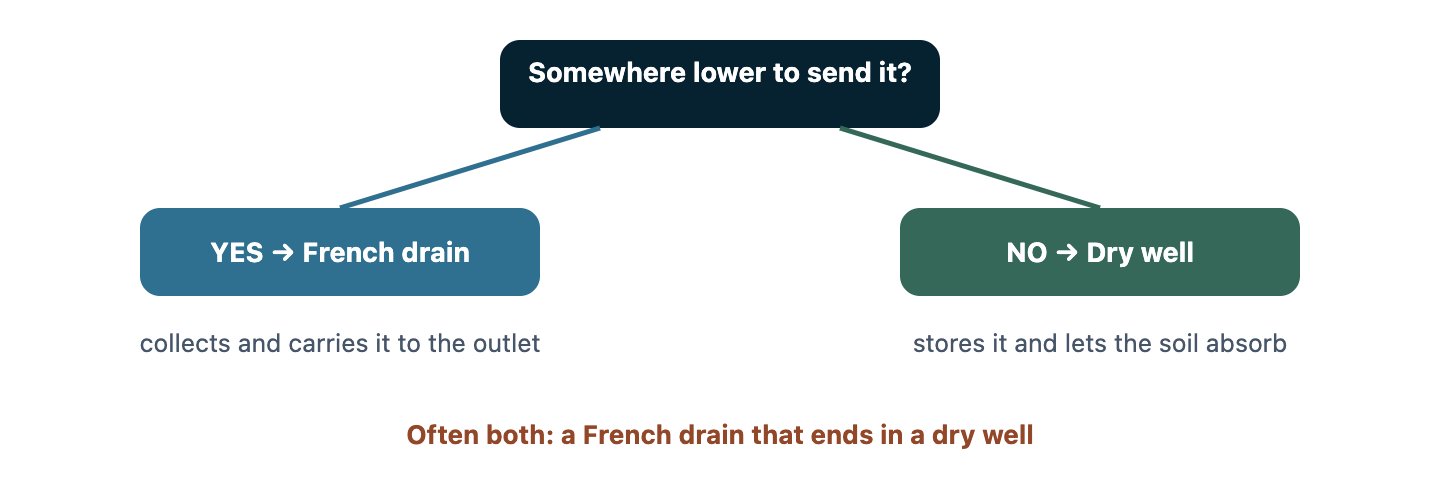
If there is a ditch, a slope that daylights, or a storm connection lower than the drain, a French drain can carry water to it. If your lot is flat or sits at the low point with nowhere lower to go, a French drain has nothing to discharge into — and that is exactly when a dry well earns its place, giving the water somewhere to be absorbed.
This is why the two so often appear together: a French drain collects the water, runs it to the far corner, and empties into a dry well that disperses it into the soil. The drain solves "how do I gather and move this," the dry well solves "where does it go."
Side by side
| French drain | Dry well | |
|---|---|---|
| Job | Collects and moves water | Receives and stores water |
| Best for | Saturated soil, with a lower outlet | Water to disperse, no outlet available |
| Needs an outlet? | Yes | No — it is the outlet |
| Soil sensitivity | Works in most soils; drains slower in clay | Fails in clay — must have soil that absorbs |
| Form | A buried line across the yard | A buried chamber at one point |
| Rough cost | $10–$35 per linear foot | $150–$3,500 depending on DIY vs pro |
| Main failure | Silted gravel, no fabric, no fall | Built in clay, or undersized |
The soil catch
One difference matters more than the table suggests: clay affects them very differently. A French drain in clay still works, just more slowly, because it only has to gather water and move it along. A dry well in clay often fails outright, because it depends entirely on the surrounding soil absorbing the water — and clay won't. If your soil is heavy, run a perc test before betting on a dry well; a French drain to a real outlet is the safer choice.
When neither is right
- Surface water pooling on top of the ground — neither collects that well. A catch basin or regrading fits.
- A high water table — gravity drainage can't beat it, and a dry well can't disperse into saturated ground. This needs a pumped system.
- You haven't confirmed the problem is subsurface — if the ground drains fine below and water just sits on top, start with standing water in your yard before choosing either.
Not sure which describes your yard? Work through your conditions or compare every option.
Related pages
FAQs
What is the main difference between a French drain and a dry well?
A French drain collects water and carries it somewhere lower — it moves water. A dry well receives water and holds it while the surrounding soil absorbs it — it stores water. A French drain needs a lower outlet to work; a dry well is used when you don't have one. They are frequently combined, a drain ending in a dry well.
Can you use a French drain and a dry well together?
Yes — it's one of the most common setups. The French drain collects water from saturated soil and carries it to a far corner or low area, where it empties into a dry well that disperses it into the ground. The drain handles gathering and moving; the dry well handles final absorption. Together they suit a yard with a subsurface water problem and no natural outlet.
Which is cheaper, a French drain or a dry well?
It depends on scope. A French drain runs roughly $10 to $35 per linear foot, so a long run adds up. A single dry well is $150 to $800 DIY or $1,500 to $3,500 installed. A short drain into a small dry well can be modest; a long drain across a big yard into a large chamber is more. Compare the whole system, not the unit prices.
Which works better in clay soil?
A French drain, clearly. It only needs to gather water and move it to an outlet, which it can do in clay, just more slowly. A dry well depends on the surrounding soil absorbing the water, and heavy clay won't — so dry wells commonly fail in exactly the clay soils that cause drainage problems. In clay, favour a French drain to a real outlet.
Do I need a dry well at the end of my French drain?
Only if the drain has nowhere lower to discharge. If it can daylight on a slope, reach a ditch, or tie into a storm system, it doesn't need one. A dry well is the answer when the drain has collected water but there's no lower point to release it — the dry well becomes its destination.
Which one is better for downspouts?
For roof water with a lower outlet, a solid pipe to daylight is simplest — you don't need either. Where there's nowhere lower, a dry well takes the downspout surge and disperses it, provided the soil drains. A French drain is generally a poor match for downspouts, since it's built to collect gradual soil water, not a fast roof surge — see downspout drainage.
Sources consulted
- Homes & Gardens — French drain vs dry well
- NDS — dry wells and French drains
- Bob Vila — dry wells 101
- Family Handyman — French drain guidance
By Under Your Home Team · Last reviewed 2026-08-09