How Yard Drainage Works: Surface Water vs Water in the Soil
Yard drainage manages two kinds of water: water on the surface, which runs and pools where you can see it, and water in the soil, which soaks in and saturates the ground below. Different tools handle each, and telling them apart is the one distinction that decides almost every drainage fix.
Two kinds of water, one crucial difference
When it rains on your yard, the water does one of two things. Some runs across the surface — downhill, into low spots, off the driveway — and you can watch it move. The rest soaks into the ground, filling the spaces between soil particles, and disappears from view while saturating the soil below.
Almost everything about yard drainage comes down to knowing which kind of water is causing your problem, because the tools that handle each are completely different.
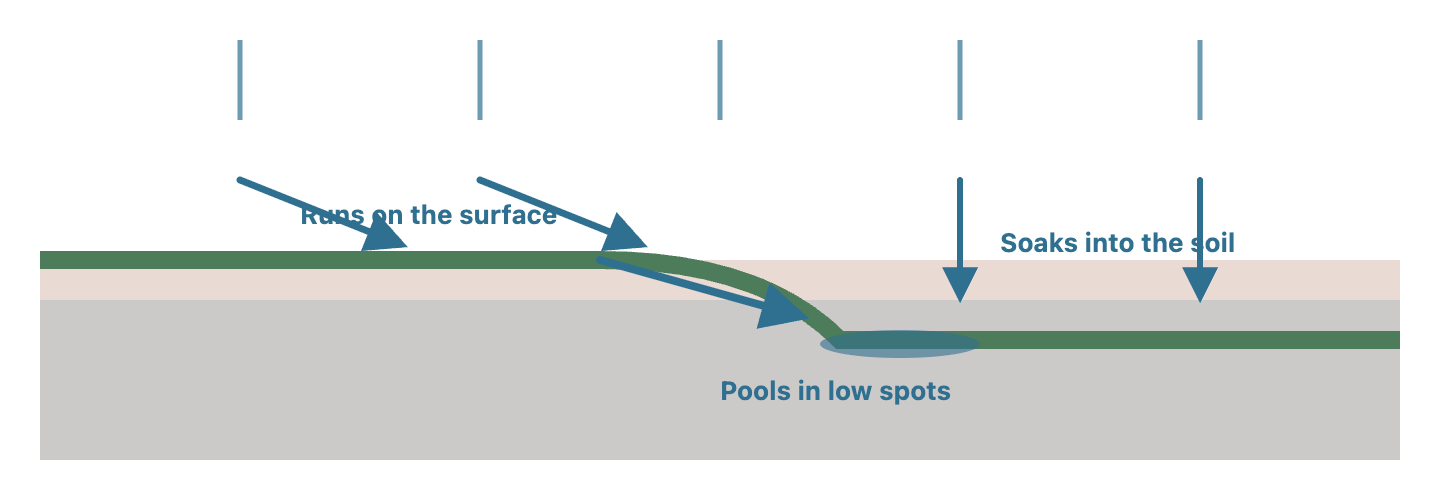
Surface water: the water you can see
Surface water is runoff — it arrives faster than the ground can absorb it, or it lands on something that absorbs nothing (a roof, a driveway) and runs off. It moves downhill, collects in low spots, and sits there until it either soaks away or evaporates.
Surface water is a collection and routing problem. The tools for it catch water and carry it somewhere better: catch basins at a low point, channel drains along a hard edge, swales across the yard, and regrading so it doesn't collect in the first place.
Soil water: the water you can't
Once water soaks in, it fills the pore spaces between soil particles. In well-draining soil it keeps moving down and away. But where a dense clay layer, a high water table, or compaction stops it, the soil stays saturated — spongy underfoot for days, even while the surface looks dry.
Saturated soil is a subsurface problem, and it needs a tool that reaches into the ground: a French drain, which collects water from within the soil along a buried perforated pipe and carries it to a lower outlet. Surface tools do nothing for it, because the water never surfaces to be collected.
Why the distinction decides everything
Here is the practical payoff. The most common and expensive mistake in yard drainage is burying a French drain to fix surface water. The drain sits below a puddle it cannot reach, collects almost nothing, and the puddle stays — several thousand dollars spent on the wrong category of tool.
The fix is a ten-minute observation. Watch your yard during and after rain:
- Water running or pooling on top of the ground → surface problem → surface tools
- Surface dries but the ground stays soggy for days, and a screwdriver slides in with no resistance → soil problem → a French drain
That single read — confirmed with the perc test if you want certainty — points you at the right half of every solution list before you compare anything else.
Where the water actually has to go
One more idea underlies all of it: drainage doesn't make water vanish, it relocates it. Every system needs a destination — a lower outlet to carry water to, or soil that can absorb it. A drain with nowhere to discharge, or a soak-away in ground that won't absorb, just moves the problem a few feet. Deciding where the water goes is as important as deciding how to collect it, which is why checking your slope and testing your soil come before choosing a fix.
Related pages
- Standing water in your yard — putting this into practice
- How to test your soil's drainage
- How much slope you need for drainage
- Compare every yard drainage option
FAQs
What is the difference between surface and subsurface drainage?
Surface drainage manages water moving across the top of the ground — runoff and pooling you can see — using tools that collect and route it, like catch basins, swales, and grading. Subsurface drainage manages water held within saturated soil, using a buried French drain to collect it. Which one you need depends on whether your water is on top of the ground or in it.
How does water move through soil?
Water fills the pore spaces between soil particles and, pulled by gravity, moves down and sideways through them. Coarse soils like sand have large pores and drain fast; fine soils like clay have tiny, tightly packed pores and drain slowly. When a dense layer or high water table blocks the downward path, water backs up and the soil stays saturated.
Where does yard drainage water go?
Somewhere lower than where it started — that's the constant. A drain carries water to a daylight outlet, a ditch, a dry well, or a storm connection; a soak-away lets the surrounding soil absorb it. Drainage relocates water rather than removing it, so every system needs a real destination. A fix with nowhere for the water to go simply moves the problem.
Why does my yard drain slowly?
Usually one of three reasons: heavy clay soil with tiny pores that pass water slowly, compaction that has squeezed those pores shut, or a high water table leaving the soil already full. Roof water and grading that deliver too much water to one spot make any of these worse. A perc test tells you whether slow soil is your problem or whether it's really surface routing.
Do I need to move water or absorb it?
Move it if your soil drains slowly or you have somewhere lower to send it — that points to drains, swales, and grading. Absorb it if your soil drains well and you have nowhere lower to discharge — that points to dry wells and rain gardens. A quick perc test and a look for a lower outlet answer this, and it narrows your options immediately.
Sources consulted
- Penn State Extension — soil and water movement
- NC Cooperative Extension — soil drainage
- NDS — drainage fundamentals
By Under Your Home Team · Last reviewed 2026-08-09