How to Test Soil Drainage: A Free DIY Perc Test
You can test soil drainage for free with a shovel, water, a ruler, and an hour. Dig a 12-inch hole, fill it and let it drain to pre-soak the soil, then refill it and measure the drop after one hour. A drop of at least 1 inch generally indicates well-drained soil; less than half an inch indicates poor drainage.
The test worth doing before anything else
Almost every drainage guide mentions "if your soil drains well" or "in poor-draining soil" — and then moves on, as if you already know which you have. You can find out for certain in about an hour, with a shovel and a bucket of water. It is the single most informative thing you can do about your yard, and it is the step most people skip.
The reason it matters so much: whether your soil absorbs water decides which whole category of solution can work. A dry well or rain garden depends entirely on the soil taking water; in tight clay, both fail. A French drain works either way but drains slower in clay. One test settles it before you spend a dollar.
What "well-drained soil" actually means
Well-drained soil lets rain move into and through the root zone without staying saturated for long periods. It still holds some moisture for plants; it does not have to be loose sand or let water disappear immediately. For a yard-drainage decision, the useful benchmark is what the soil does: a pre-soaked test hole dropping at least about 1 inch per hour is generally considered well drained for landscape plants.
You may notice a few supporting clues:
- Ordinary rain soaks in without leaving puddles for a day or more.
- A handful of damp soil breaks apart rather than smearing into a dense, sticky ribbon.
- The ground feels moist after rain but does not stay squishy or saturated for days.
- A planting hole does not remain full of water overnight.
No color or texture proves that soil drains well. Sandy soil often drains quickly, while clay often drains slowly, but compaction, buried construction layers, and a seasonal high water table can change the result. That is why the timed water test is more reliable than appearance.
Which kind of soil test do you need?
"Soil test" can describe several unrelated services. For a wet yard, the free DIY drainage test is usually the relevant one.
| Test | What it answers | Typical cost and limits |
|---|---|---|
| DIY soil drainage test | How quickly water moves through this part of the yard | Free if you have a shovel, bucket, ruler, and timer |
| Laboratory fertility test | Soil pH and plant nutrients | Often free or inexpensive through a state or county extension service, but it does not measure the yard's drainage rate |
| Formal septic perc test | Whether a site may support a septic drain field | Professionally performed, locally regulated, and priced by location and scope; a DIY result cannot replace it |
| Environmental or geotechnical test | Contamination or construction-bearing questions | Specialist work with a separate scope; a basic fertility or drainage test does not answer these questions |
In North Carolina, basic nutrient and pH testing is offered free for much of the year, with a small peak-season fee, but that laboratory report is about fertility rather than infiltration. Check the current schedule with NC State Extension before mailing a sample. If your goal is simply to learn whether a wet yard can absorb water, start with the no-cost test below.
The perc test, step by step
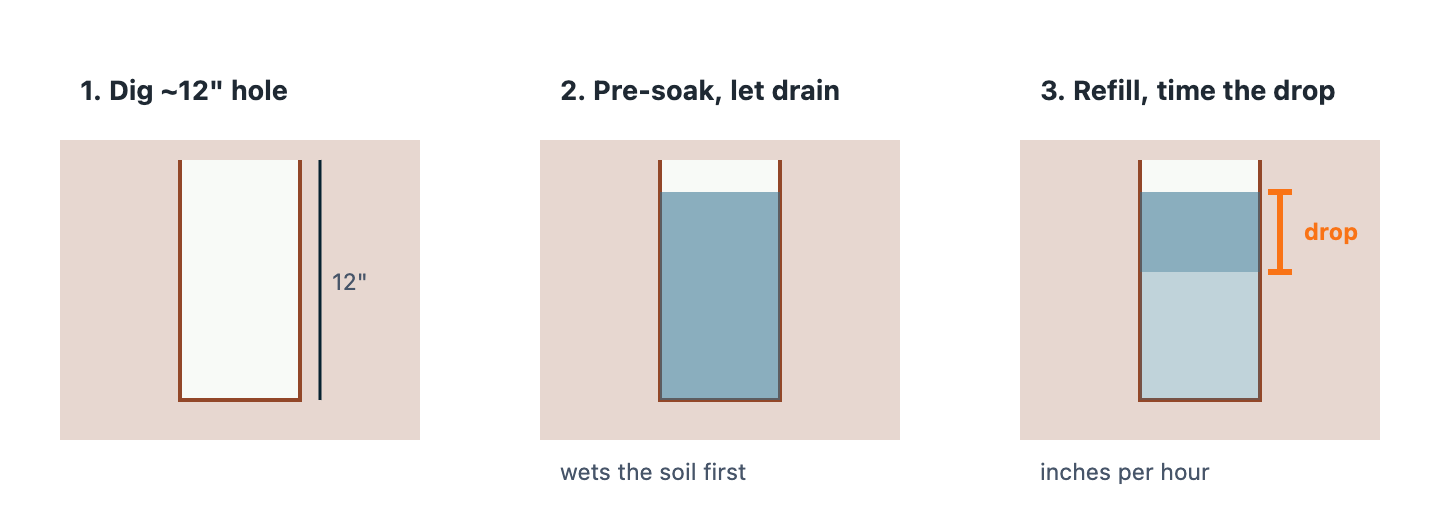
- Dig a hole about 12 inches deep and 6 to 12 inches wide, in the area you're worried about. Test where the problem actually is.
- Fill it with water and let it drain completely. This step — the pre-soak — matters. Dry soil absorbs an unrealistic first gulp; pre-soaking measures how the ground behaves when it is already wet, which is the condition that causes drainage problems.
- Fill it again, right after it drains.
- Measure how far the water level drops in one hour. A ruler laid across the hole, or a mark on a stick, is all you need.
That drop, in inches per hour, is your answer.
Read the result
Turn the drop into a drainage rate — and a verdict
Enter how far the water dropped and how long it took. The tool converts it to inches per hour and minutes per inch, averages several holes, tells you which fixes the soil rules in or out, and hands the rate to the dry well and rain garden calculators.
This video walks through the whole test — digging the hole, the pre-soak, and reading the one-hour drop — and what each result range means for your drainage plan.
What the number means
| Drop per hour | What it tells you | What it rules in or out |
|---|---|---|
| More than 4 inches | Free-draining, sandy or gravelly | Great for dry wells and rain gardens; your problem is likely surface routing, not soil |
| 1 to 4 inches | Normal, healthy soil | Soil isn't your main issue; look at grading and roof water |
| 0.5 to 1 inch | Slow — clay or compaction | Dry wells and rain gardens are marginal; French drains work but slowly |
| Less than 0.5 inch | Poor drainage | Rules out dry wells and rain gardens; you need to move water, not soak it in |
| Barely moves overnight | Effectively no capacity — heavy clay or high water table | Gravity soak-away won't work; think interception or pumping |
The most useful line in that table is the bottom two. If your soil drains slower than half an inch an hour, any solution that relies on the ground absorbing water is fighting your soil — which is exactly the mistake that sinks so many dry wells and rain gardens.
What a slow result does — and doesn't — mean
A slow perc test doesn't mean your yard is unfixable. It means you should choose solutions that move water somewhere rather than soak it into the ground:
- A French drain or catch basin to a lower outlet
- A swale to carry surface water across the yard
- Regrading so water doesn't collect in the first place
What it rules out is the soak-away family — dry wells, rain gardens, and relying on the ground to absorb a surge. Knowing that before you dig one of those is the whole point of the test.
What time of year is best for a drainage test?
There is no single best month. Test when the ground is unfrozen and its moisture is reasonably typical for the season. A mild stretch after ordinary weather gives you a more useful baseline than an extreme condition.
Avoid testing immediately after prolonged heavy rain, during flooding, before spring thaw, or in a severe drought. Saturated ground can make normal soil look unusually slow, while deeply dry or cracked soil can make water disappear through temporary cracks. The pre-soak reduces that distortion, but it cannot erase it completely.
If you are planning a dry well or rain garden, repeat the test during your yard's wetter season. The wetter result is the safer one to design around because the system must empty when the soil has less capacity, not only when conditions are ideal. The University of Minnesota Extension also advises against checking drainage immediately after heavy rainfall or before frozen ground has thawed.
A few practicalities
- Test more than one spot if your yard varies. Soil can change across a single property, and a low wet area often drains differently from higher ground.
- Test at the planned location for a dry well, rain garden, or other infiltration feature. A result from the opposite side of the yard may not describe the soil where the water will go.
- This is not the same as a septic perc test. A septic percolation test is a formal, often regulated procedure done by professionals to strict standards. The homeowner version here is for drainage decisions, not for permitting a septic system. See what a perc test is for how the formal version works.
Related pages
- Standing water in your yard — where this test fits in diagnosis
- Dry wells — the solution most sensitive to this result
- Rain gardens — same soil requirement
- Clay soil and drainage
- How yard drainage works
FAQs
What is a DIY perc test?
A DIY percolation test measures how fast water drains through your soil. You dig a hole, pre-soak it, refill it, and time how far the water level drops in an hour. The result — in inches per hour — tells you whether your ground can absorb water, which decides whether soak-away solutions like dry wells and rain gardens can work. The formal septic perc test is a different procedure; see what a perc test is.
How long should a perc test take?
The measurement is one hour, but budget more for the pre-soak. Fill the hole once and let it drain fully first, which can take from minutes in sandy soil to hours in clay, then refill and time the one-hour drop. In very slow soil you may need to check over a longer period, since a tight clay hole can take most of a day to empty.
Why do I need to pre-soak the hole?
Dry soil absorbs a large, misleading first gulp of water that has nothing to do with its real drainage rate. Pre-soaking wets the ground so your measurement reflects how the soil behaves when it's already saturated — which is the condition that causes drainage problems in the first place. Skip the pre-soak and a slow soil can test deceptively fast.
What is a good soil drainage rate?
Between about 1 and 4 inches per hour is healthy. Over 4 inches is free-draining sandy or gravelly soil. Under 1 inch is slow, indicating clay or compaction, and under half an inch is poor enough that soak-away solutions won't keep up. The lower your number, the more you should move water rather than rely on the ground absorbing it.
Does a slow perc test mean I can't fix my drainage?
No — it means you should move water rather than soak it into the ground. French drains, catch basins, swales, and regrading all work in slow-draining soil because they carry water to a lower outlet instead of relying on absorption. What a slow result rules out is dry wells and rain gardens, which depend on the soil taking water.
How many places should I test?
At least test the problem area, and test more than one spot if your yard varies in soil or elevation. Drainage can differ noticeably across a single property — a low wet corner often behaves differently from higher, drier ground. If you're planning a specific installation, test where it will go.
Do I need a professional perc test?
Not for drainage decisions — the homeowner version with a hole and a bucket is enough to choose between solutions. A formal, professional percolation test is a different, often regulated procedure required for permitting a septic system, done to strict standards. Don't confuse the two: the DIY test guides drainage; it doesn't qualify a septic field.
How much does it cost to have a soil test done?
A DIY soil drainage test costs nothing if you already have a shovel, bucket, ruler, and timer. A laboratory fertility test is often free or inexpensive through a state extension service, but it measures pH and nutrients rather than drainage. Formal septic, environmental, and geotechnical tests are separate professional services whose prices depend on location, site conditions, and the required report.
How do you tell if soil is well drained?
Use a timed drainage test rather than relying on appearance. Pre-soak a 12-inch-deep hole, refill it, and measure the water-level drop after one hour. A drop of at least about 1 inch per hour generally indicates well-drained landscape soil. Slow drainage, persistent puddles, and ground that stays squishy for days point to poor drainage.
What does well-drained soil look like?
It is often crumbly when damp, absorbs ordinary rain without prolonged ponding, and stays moist without remaining sticky or saturated for days. But there is no dependable color or texture that proves good drainage. Compaction or a buried clay layer can make healthy-looking topsoil drain poorly, so confirm what you see with a timed water test.
How can I test my soil for free?
For drainage, dig a 12-inch hole, fill it once to pre-soak the soil, let it empty, refill it, and measure how far the water drops in one hour. The test uses only water, a shovel, a ruler, and a timer. If you mean nutrient or pH testing, ask your state or county extension service; many offer free or low-cost laboratory testing.
What time of year is best for soil drainage testing?
Test whenever the ground is unfrozen and moisture conditions are typical. Avoid the period immediately after prolonged heavy rain, spring ground that has not thawed, and severe drought. For a dry well or rain garden, repeat the test in the wetter season and use the slower result for planning.
Sources consulted
- Groundwater Foundation — rain garden soil testing
- Old Farmer's Almanac — testing soil for a rain garden
- NC Cooperative Extension — soil testing
- Penn State Extension — soil percolation
- University of Minnesota Extension — checking soil drainage
- Duke Superfund Community Engagement Core — North Carolina soil testing services
By Under Your Home Team · Last reviewed 2026-08-21