Backyard Flooding After Rain: Find Where the Water Is Coming From
Yard flooding is a volume problem: more water arrives than the ground and its outlets can handle. That makes it different from ordinary pooling. Before choosing a fix, work out where the water is coming from — roof, hardscape, uphill ground, or the street — because flooding is solved at the source far more often than at the puddle.
Flooding and pooling are not the same problem
This matters because the fixes are different, and most advice treats them as one thing.
Pooling is an infiltration problem. Ordinary rain falls on your yard and the ground cannot absorb it fast enough, so it sits. The volume is normal; the ground's capacity is low. That is covered in standing water in your yard.
Flooding is a volume problem. A large quantity of water arrives in a short time — usually much more than actually fell on the affected area — and overwhelms whatever route out exists. The ground may drain perfectly well between storms.
The tell is simple. If your yard is wet after ordinary rain, that is pooling. If it is fine most of the time and then briefly becomes a pond when it rains hard, that is flooding, and the useful question is not "how do I drain this?" but "where is all this water coming from?"
Where the water is actually coming from
Very little of the water flooding a yard usually fell on that yard. Working out the sources is the whole job.
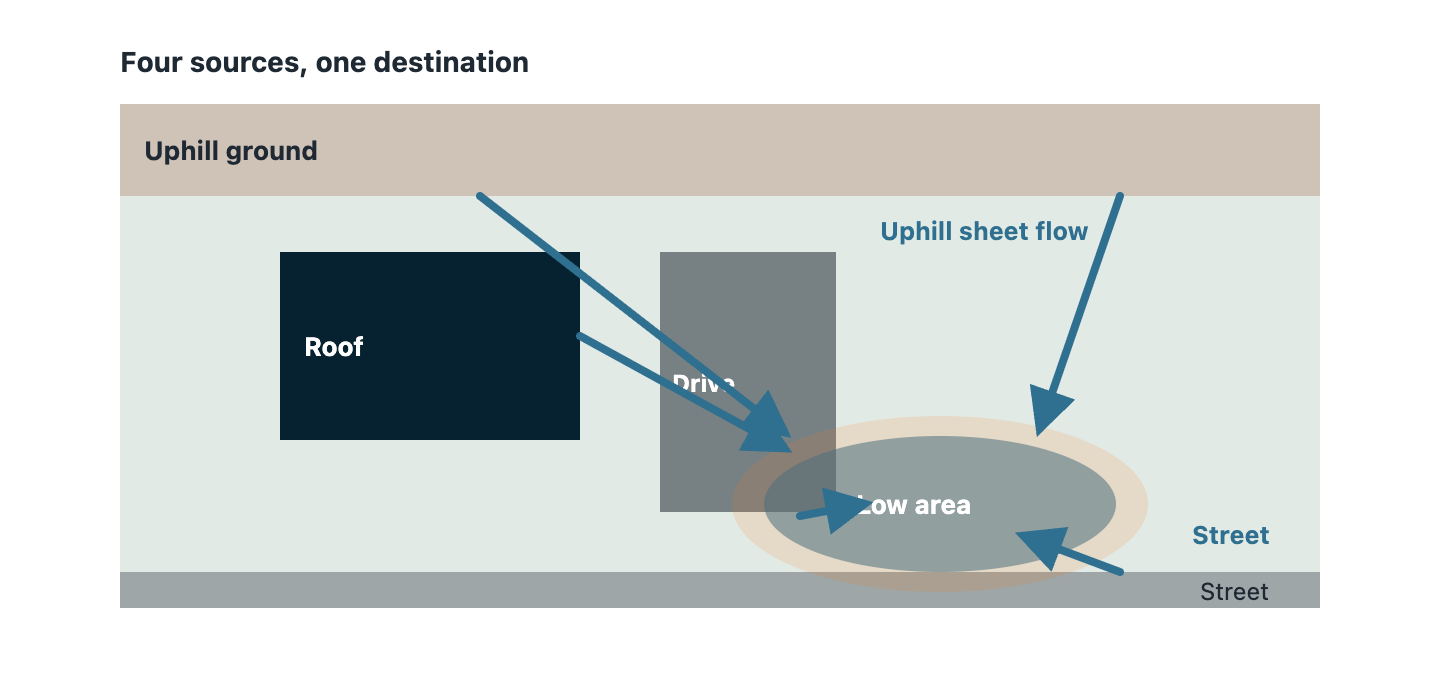
Your roof. The easiest to quantify and the most commonly underestimated. Roughly 620 gallons falls on every 1,000 square feet of roof per inch of rain — so a 2,000 square foot roof sheds about 1,250 gallons in a one-inch storm, and a three-inch storm puts nearly 4,000 gallons somewhere. If downspouts discharge near the house, essentially all of it goes into your yard at a handful of points. Start here; it is the source you fully control.
Driveways, patios and paths. Paving absorbs nothing. A 600 square foot driveway contributes another 370 gallons per inch, usually delivered to whichever edge sits lowest.
Ground sloping toward you. A neighbouring lot, a common area, or an undeveloped rise can contribute more than your entire property. This is the source people most often miss, because it arrives as a broad sheet rather than from a visible pipe.
The street. Where a road crowns toward your frontage or a storm inlet is undersized or blocked, road water enters the lot. Blocked municipal inlets are worth reporting rather than draining.
Work out your own numbers
Measure the roof footprint and the paved areas, and multiply each by 0.62 gallons per square foot per inch of rain. Compare that with the wet area's size. When the arriving volume dwarfs the low spot, no amount of drainage installed at the low spot will keep up — the fix belongs upstream.
Fix it at the source, in this order
- Move roof water further away. Extending or burying downspouts to a genuine discharge point is the highest-leverage change on most properties. See downspout drainage problems.
- Intercept hardscape runoff. A channel drain along the low edge of a driveway or patio catches sheet flow before it reaches the lawn.
- Intercept water arriving from uphill. A swale or interceptor drain across the top of the slope cuts it off before it spreads. Cutting across the flow beats chasing it downhill.
- Give the low area a route out. Once inbound volume is reduced, a catch basin piped to a lower outlet handles what is left.
- Add storage where there is nowhere lower. A dry well or rain garden buys time by holding water and releasing it slowly. On a flat lot with no outlet, storage is often the only real option.
Steps 1 to 3 reduce the water arriving. Steps 4 and 5 deal with what remains. Doing them in the other order is how people end up with an expensive drain that still floods.
Not sure which applies to your lot? Work through your yard's conditions or compare the options side by side.
When drainage can't fix it
Worth knowing before spending money.
Floodplain and floodway. If your lot sits in a mapped flood zone, flooding is the land's normal behaviour, not a fault in your yard. Drainage work can improve day-to-day conditions but will not change what happens in a large event. FEMA's flood map service and your county GIS will tell you where you sit.
Upstream development. When a nearby site is built out, runoff patterns change and existing yards downstream can begin flooding for the first time. This is a stormwater management question, and your local stormwater department is the right first call — in North Carolina, requirements attach at the municipal level and vary considerably. Fixing it privately may be treating someone else's overflow.
Municipal capacity. Undersized or blocked storm infrastructure produces neighbourhood flooding that no individual yard can solve. If several properties flood together, it is worth comparing notes with neighbours before anyone excavates.
No outlet at all. On a flat lot at the bottom of its surroundings, with nowhere lower to discharge, the honest options are storage, pumping, or accepting a wet area and planting it accordingly. Any contractor promising gravity drainage without identifying an outlet is worth questioning.
If water has begun entering a basement rather than just standing in the yard, yard drainage is no longer the whole answer and interior systems become part of the conversation.
Related pages
- Standing water in your yard — for pooling rather than flooding
- Runoff from a neighbour's yard
- Downspout drainage problems
- Catch basins
- Compare every yard drainage option
- Who to call for yard drainage
FAQs
Why does my yard flood when it rains?
Because more water arrives than the ground and its outlets can carry away in the time the storm lasts. Most of that water did not fall on the flooded spot: it was shed by the roof through the downspouts, ran off the driveway and patio, or flowed down from higher ground or the street. Lawn absorbs some rainfall; roofs and paving absorb none, so a modest storm can deliver more than a thousand gallons to one low corner. Find the sources first, then decide whether to move roof water, intercept uphill flow, or add a surface drain at the low spot.
What is the difference between yard flooding and standing water?
Standing water is an infiltration problem — ordinary rain that the ground cannot absorb fast enough. Flooding is a volume problem — a large amount of water arriving quickly, often mostly from off the affected area. A yard that pools after light rain has poor soil or grading. A yard that is fine normally but becomes a pond in storms is receiving more water than its outlets can carry.
How much water lands on my property in a storm?
About 0.62 gallons per square foot per inch of rain. A 2,000 square foot roof sheds roughly 1,250 gallons in a one-inch storm; a 600 square foot driveway adds about 370. Because roofs and paving absorb nothing, they deliver essentially all of it to a few discharge points — which is why they dominate the water arriving at a low spot.
Can drainage fix a yard that floods from the street?
Partly. You can intercept water at the property edge with a swale or channel drain and route it around the areas you care about, but you cannot make road water stop arriving. If a storm inlet nearby is blocked or undersized, report it to your municipality — that is their infrastructure, and clearing it may solve the problem at no cost to you.
Does my yard flood because of new construction nearby?
It can. Development replaces absorbent ground with roofs and paving and often redirects runoff, so downstream properties can start flooding where they never did before. If flooding began after nearby building work, contact your local stormwater department — post-construction stormwater requirements exist precisely to prevent this, and the site may not be meeting them.
Will a French drain stop my yard flooding?
Usually not on its own. A French drain collects water from saturated soil at a modest rate; it is not designed to carry a storm surge. Flooding is better addressed by reducing what arrives — moving roof water, intercepting uphill flow — and then using surface collection for the remainder. A French drain installed against a volume problem tends to be overwhelmed during exactly the storms it was bought for.
Is my yard in a floodplain?
Check FEMA's flood map service centre and your county's GIS parcel viewer, both free. Being in a mapped flood zone does not mean nothing can be improved, but it does reset expectations: in a large event the land will do what the map says regardless of what is installed in the yard.
Who is responsible if runoff floods my yard?
It depends on where the water comes from and on state law, which varies considerably. Water following its natural course is generally treated differently from water a neighbour has collected, concentrated, and discharged. Municipal infrastructure is the municipality's responsibility. This is genuinely legal territory rather than a drainage question — see runoff from a neighbour's yard for how the distinction works, and speak to a local attorney before acting on it.
Sources consulted
- Angi — backyard flooding solutions
- Bob Vila — preventing a soggy yard
- NC DEQ — stormwater programme
- Garden Gate — yard flooding guidance
By Under Your Home Team · Last reviewed 2026-08-09