Connecting a Downspout to a Catch Basin: How to Do It Right
To connect a downspout to a catch basin, dig a basin at the base of the downspout, feed the downspout into the basin's inlet with a sealed adapter, then run 4-inch solid pipe from the outlet at a 1% slope — 1 inch of fall per 100 feet — to a lower discharge point. The sump below the outlet traps roof grit so the pipe stays clear.
First, is a catch basin the right connection?
A catch basin is not the only way to get roof water away from the house, and it is not always the best one. The searcher standing at the bottom of a downspout is really choosing between three things, and the right answer depends on how far the water has to travel and whether the ground falls away.
| Option | Best when | What it is | Rough cost |
|---|---|---|---|
| No-dig low-profile kit | Short run, ground already slopes away, you want it hidden under mulch | A shallow tray under the downspout with a flexible pipe you bury a few inches | $30–$80, DIY |
| Buried pipe to a catch basin | The water has to cross a distance, several downspouts combine, or the yard is flat | A basin at the downspout piped to a lower discharge, with a sump that traps grit | $150–$400 DIY, $600–$2,000 installed |
| Pop-up emitter | A single downspout, a lawn with fall, no debris concern | Buried pipe that surfaces at a spring-loaded lid and releases water onto the lawn | $80–$200, DIY |
The honest split: a kit or a pop-up emitter is often enough for one downspout on a yard that already drains, and paying for a full catch-basin system there is over-building. A catch basin earns its cost when water has to travel, when several downspouts tie into one line, or when the yard is flat and the buried run needs a grit trap and a cleanout so it does not silt up. If the real problem is simply that the ground slopes back toward the house, the fix may be regrading so it drains on the surface, not a pipe at all.
The problem this actually solves
A downspout dumping at the foundation is the classic reason to pipe it away. If that is your situation, start with how far a downspout needs to drain — distance and where the water ends up matter more than the connection method itself.
How the connection works
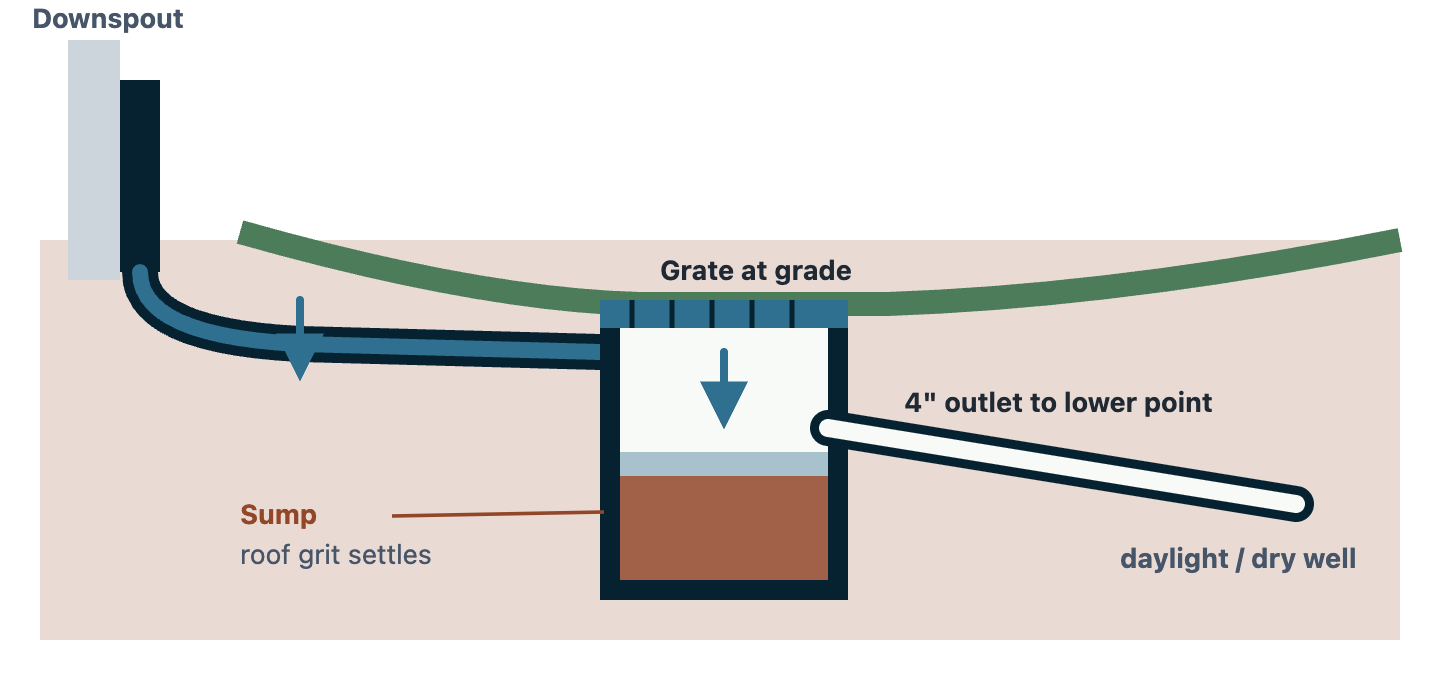
The downspout drops roof water into the basin through an inlet near the top. Inside, the outlet pipe leaves partway up the wall, and the space beneath it — the sump — collects the grit and shingle granules that roof runoff always carries. Only the cleaner water above the sump leaves through the outlet, which is what keeps the buried pipe from silting shut.
The specs that matter
Most downspout-to-basin failures are not product problems — they are size-and-slope problems. Get these four right and the rest is digging.
| Spec | What to use | Why |
|---|---|---|
| Outlet pipe size | 4-inch solid (6-inch where several downspouts combine) | Carries the surge from a roof without backing up into the basin |
| Slope | 1% minimum — 1 inch of fall per 100 feet, more if you have it | Below this, water stalls and grit drops out in the pipe instead of the sump |
| Pipe type | Solid for the run, not corrugated | Smooth wall resists the silt and biofilm that clog ribbed pipe |
| Basin depth | Enough for a sump below the outlet plus fall to discharge — commonly 12–24" | The sump is the whole point; a basin with no room under the outlet is just a hole |
Use solid pipe for the carrying run even though corrugated is cheaper and easier to lay. Corrugated pipe's ribbed wall catches the fine grit that roofs shed, and a downspout line carries far more of it than people expect. To size the run to your actual roof, the roof-runoff calculator turns roof area and local rainfall into a flow figure.
Installing it, step by step
- Confirm the outlet first. Find a spot lower than the basin's outlet — daylight on a slope, a dry well, or a permitted storm connection. If there is nowhere lower, a buried run will not drain. Settle this before buying anything.
- Call 811. Utility locates are free and required in most places.
- Dig the basin pit at the downspout base, a few inches wider than the basin and deep enough to leave a sump under the outlet. Compact a gravel base so the basin does not settle and lift the grate proud of the lawn.
- Set the basin with the grate at grade, then cut the downspout and feed it into the basin's inlet with the matching adapter. A bead of exterior sealant on the joint keeps roof water from escaping into the pit.
- Trench the outlet run at a steady 1% fall — no dips. Lay 4-inch solid pipe from the basin outlet to the discharge point.
- Backfill and firm around the basin and along the trench, then restore the surface.
- Test with a hose down the downspout before you cover everything. Water should reach the discharge point and the basin should not overflow.
The two failures that show up months later are a basin set slightly too high and an outlet trench with a dip in it. Both are grade problems fixed with a level and patience, not with a bigger basin.
Why these systems fail (and how to avoid it)
A downspout catch basin is fed by concentrated roof runoff, not by water creeping across a lawn, and that changes what goes wrong. These are the roof-runoff-specific failure modes a general catch-basin guide misses.
| Failure | What happens | How to avoid it |
|---|---|---|
| Bellies | A dip in the buried pipe holds water; grit drops out there and slowly blocks the run | Lay solid pipe on firmly compacted, continuously falling bedding — no sags |
| Grit-packed sump | Asphalt shingles shed granules that fill the sump far faster than a lawn basin | Clean the sump once or twice a year, not once every few years |
| Grate set wrong | On a pipe-fed basin the inlet does the work, so a grate mounted proud invites debris and mowing damage | Set the grate flush at grade; it is a cleanout and overflow, not the main inlet |
| Outlet undersized | A 3-inch line cannot pass a roof's peak surge, so the basin overflows in heavy rain | Use 4-inch solid, step up to 6-inch where downspouts combine |
A sump that has filled to the outlet stops trapping anything and starts feeding silt straight into the run — which is the usual path from a working system to a clogged yard drain.
Where the water goes
The outlet has to end somewhere lower and legal. On a sloped lot the simplest answer is daylight — the pipe surfaces on the slope and releases onto a stable, planted area. On a flat lot with soil that soaks in, a dry well stores the surge and lets it seep away. A pop-up emitter works for a single downspout on a lawn with a little fall. What you cannot do is run the outlet to a spot no lower than the basin, or onto a neighbour's property — both just move the puddle.
If the line from the basin runs underground for any distance, use solid pipe and plan the outlet before the trench: underground downspout drainage covers pipe choice and why depth is the wrong question.
Size it first
How much water does your roof actually shed?
A downspout concentrates a surprising volume in heavy rain. Enter your roof area and rainfall to size the pipe and outlet so the basin does not overflow when it matters.
What it costs and what it needs
A DIY basin with a short pipe run is typically $150–$400 in materials; a professional single-basin connection with a modest run commonly runs $600–$2,000, and systems tying several downspouts into one outlet more. These are planning ranges, not quotes — distance to the outlet and site access move them most. The catch basin page carries the full cost breakdown.
Maintenance is short and the part everyone skips: lift the grate and empty the sump once or twice a year, clear it during leaf fall, and flush the outlet line before the wet season.
Related pages
- Catch basins for yard drainage — how the basin itself works and what it costs
- Downspout drainage problems — how far a downspout needs to drain
- Dry wells — a discharge option when there is no lower outlet
- Underground downspout drainage — burying the line from the basin to its outlet
- Yard grading and leveling — when the surface fix beats a buried pipe
- Clogged yard drain — what a neglected sump or a belly turns into
- Compare every drainage option
Related
Where should the buried line end?
A basin collects the water; the pipe still needs somewhere to discharge. On a flat lot that usually means a pop-up emitter, which works well and fails in one specific, avoidable way.
FAQs
How do you connect a downspout to a catch basin?
Dig a basin pit at the base of the downspout, set the basin with its grate at lawn grade, and feed the cut downspout into the basin's inlet with the matching adapter, sealed at the joint. Then run 4-inch solid pipe from the basin's outlet at a 1% slope to a lower discharge point, backfill, and test with a hose before covering it. The sump under the outlet traps roof grit.
How deep should a catch basin be for a downspout?
Deep enough to leave a sump below the outlet pipe, plus enough fall from that outlet to the discharge point. Common residential basins are 12 to 24 inches deep. Depth is set by the outlet, not by a fixed number — a deep basin with a buried outlet drains nothing, and a shallow one with no sump traps no grit.
What size pipe do you use for downspout drainage?
Four-inch solid pipe is standard for a single downspout run, stepping up to 6-inch where several downspouts combine into one line. Use solid, smooth-wall pipe rather than corrugated for the carrying run — the ribbed wall of corrugated pipe catches the fine grit that roofs shed and clogs sooner.
Can you bury a downspout straight into a catch basin?
Yes — that is exactly what the connection is for. Burying the downspout into a basin gives the underground line a grit trap and a cleanout, which a downspout piped straight into buried tubing does not have. The sump catches shingle granules and silt so the run beyond it stays clear.
Do you even need a catch basin for a downspout?
Not always. For a single downspout on a yard that already slopes away, a no-dig low-profile kit or a pop-up emitter is often enough and cheaper. A catch basin earns its cost when the water has to travel a distance, when several downspouts tie into one line, or when the yard is flat and the buried run needs a grit trap so it does not silt up.
How do you keep a downspout catch basin from clogging?
Empty the sump of roof grit and leaves once or twice a year — roof runoff fills it faster than a lawn basin. Keep the outlet pipe running at a continuous slope with no dips, since a low spot in the line holds water and collects the silt that eventually blocks it. Flush the run with a hose before the wet season.
Sources consulted
- French Drain Man — catch basin for downspouts, bellies, and roof-grit maintenance
- NDS — how to install catch basins, pipe size and slope
- TrenchDrainBlog — residential downspout catch basin installation
- Manufacturer low-profile no-dig downspout kits (Amerimax, NDS) — kit option
By Under Your Home Team · Last reviewed 2026-08-17