Catch Basins for Yard Drainage: When a Point Drain Is the Right Answer
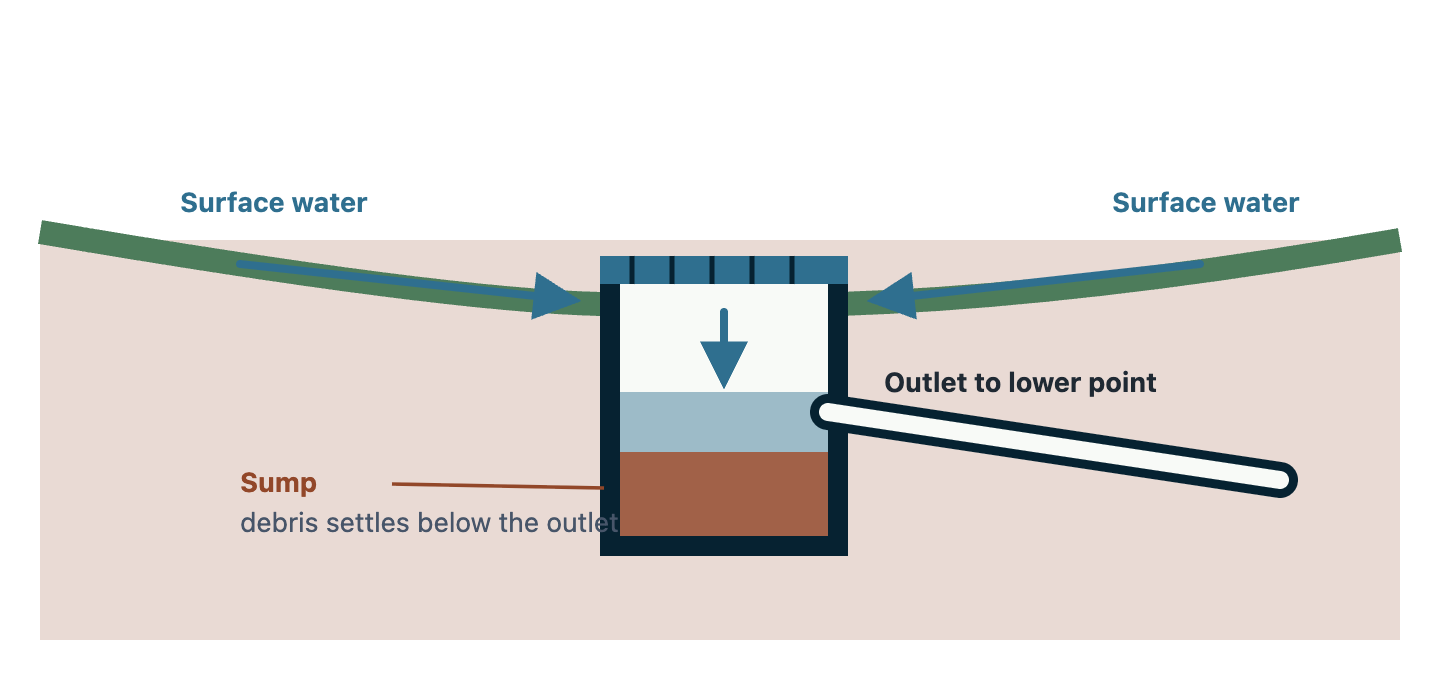
A catch basin is a grated box set at the lowest point of a wet area. Surface water falls through the grate, debris settles in a sump below the outlet, and the water pipes away to a lower discharge point. It is the right tool when water pools on the surface in one identifiable spot — which is exactly where a French drain is the wrong tool.
How a catch basin works
A catch basin — also sold as a yard drain box, drain basin, area drain, or yard drainage basin — is a box, usually plastic, sometimes concrete, set into the ground with its grate flush to the surface at the low point of the area you want drained. Water runs across the ground, falls through the grate, and leaves through an outlet pipe near the top of the box. The names are used interchangeably: a "drain box" or "drain basin" at the hardware store is the same product as a catch basin, whether it is plastic or a heavier concrete unit.
The part that makes it a catch basin rather than a hole is the sump: the space below the outlet pipe. Silt, grit, and leaf fragments settle there instead of washing into the pipe run. That sump is why a catch basin keeps working for years and why it needs occasional cleaning out.
This video walks through the same idea, showing how a catch basin collects surface water at a low point, traps debris in its sump, and pipes the cleaner water away.
When a catch basin is the right choice
It suits surface water arriving at an identifiable low point. If you can stand in the yard after rain and point at where the puddle forms, that is a catch basin situation.
Good fits:
- A low spot in the lawn that collects and holds water
- The bottom of a slope where runoff naturally arrives
- Where a downspout line needs somewhere to discharge into a wider system
- The low corner of a patio, driveway, or paved area
- Where several sources converge on one point
Poor fits:
- Ground that stays saturated with no surface pooling. Nothing to catch — that is a French drain problem.
- Water spread thinly over a wide area. A basin drains what reaches it. If water sheets across 40 feet of lawn without collecting, a basin at one end catches very little.
- A long edge rather than a point — the low side of a driveway or patio. That is a channel drain, which collects along a line instead of at a point. See patio and hardscape drainage.
- Anywhere with no lower outlet. A basin has to discharge somewhere lower. Without that, it is a bucket.
The distinction people most often get wrong is point versus line. A catch basin collects at one spot; a channel drain collects along a run. Choosing the wrong one produces a drain that works technically and does not solve the problem.
How to install a catch basin
The basin itself is simple. The parts that determine whether it works are the outlet and the grade.
- Confirm the outlet first. Find somewhere lower than the basin's outlet pipe where water can be discharged — daylight on a slope, a dry well, or a storm connection where permitted. Do this before buying anything.
- Locate utilities. Call 811. Free and required in most places.
- Excavate at the true low point. Not near it — water goes to the lowest point, and a basin six inches high is a basin that does nothing.
- Set the basin with the grate slightly below surrounding grade, so water runs in rather than around. A quarter to half an inch is enough.
- Run the outlet pipe with continuous fall — 1% minimum, more if available. Use solid pipe, since this line carries water rather than collecting it.
- Backfill and firm around the basin so it does not settle and lift the grate proud of the lawn.
- Shape the surrounding ground to fall gently toward the grate. A basin at the bottom of a saucer works far better than one in flat ground.
The two most common failures are a basin set slightly too high, and an outlet with insufficient fall. Both are grade problems, not product problems.
Size it
What size basin, grate and pipe does your low spot need?
Enter the lawn, paving and roof draining to the spot and the fall to your outlet. The tool sizes the grate, basin and outlet pipe together — the pipe is usually what limits a yard basin — and lists what to buy.
What it costs
Materials are cheap; the installation is what you pay for.
| Item | Rough planning range |
|---|---|
| Plastic basin, 9"–24" | $20–$130 |
| Grate | Included, or $15–$60 for decorative or heavy-duty |
| Outlet pipe | $1–$3 per foot |
| DIY total, short run | $150–$400 |
| Professional single basin with a modest pipe run | $600–$2,000 |
| Concrete basin, larger or heavier duty | $2,400–$6,000 |
| Multi-basin system across a yard | $1,000–$4,000+ |
Planning estimates, not quotes. What moves the number: how far the outlet is, whether machinery can reach, depth, whether paving has to be cut and reinstated, and how many basins tie into one run.
A single basin with a short run to a slope is genuinely within DIY reach. A system tying several basins and downspouts into one outlet is worth having designed, because the pipe sizing and fall have to work as a whole.
Maintenance
This is the part that gets skipped and then blamed on the product.
- Lift the grate and empty the sump once or twice a year, more where leaves fall heavily. That is the entire routine.
- Keep the grate clear during autumn. A leaf-covered grate drains nothing.
- Flush the outlet line annually with a hose before the wet season.
A basin whose sump has filled to the outlet pipe stops trapping debris and starts feeding silt into the pipe run, which is how a working system becomes a clogged yard drain.
Related pages
- French drains for yards — for saturated ground rather than surface pooling
- Patio and hardscape drainage — for edges and paved surfaces
- Compare every yard drainage option
- Standing water in your yard
- Clogged yard drain
FAQs
What is a catch basin, and what is it used for?
A catch basin — sometimes called a yard drain box, drain basin, area drain, or yard drainage basin — is a grated box set into the ground at a low point. Its purpose is to catch surface water that collects in one spot, trap silt and debris in a sump below the outlet, and pipe the cleaner water away to a lower discharge point. In a yard it is used wherever water pools at an identifiable low spot: a dip in the lawn, the bottom of a slope, the end of a downspout line, or the low corner of a patio or driveway.
What is the difference between a catch basin and a French drain?
A catch basin collects water from the surface at one point and pipes it away. A French drain collects water from within saturated soil along a line. If you can see a puddle, a catch basin addresses it. If the ground squelches for days but nothing pools, a French drain does. They are frequently used together — a basin handling surface water, a drain handling the soil.
Can you connect a catch basin to a French drain?
Yes, and it is a common pairing, as long as the connection runs in the right direction. Bring the French drain into the catch basin as an inlet, so the basin's sump traps the silt the drain carries, and send the basin's outlet away through solid pipe. Do not pipe a catch basin into the perforated section of a French drain: that pushes collected surface water back out into the soil you are trying to dry.
How deep should a yard catch basin be?
Deep enough that the outlet pipe still has fall to its discharge point, plus a sump beneath the outlet for debris. Common residential basins are 12 to 24 inches deep. Depth is dictated by the outlet, not by a standard figure — a deep basin with a buried outlet drains nothing.
How much does a catch basin cost to install?
A DIY basin with a short pipe run is typically $150 to $400 in materials. Professional installation of a single basin commonly runs $600 to $2,000, and multi-basin systems $1,000 to $4,000 or more. Concrete basins for heavier duty sit higher, around $2,400 to $6,000. These are planning ranges — distance to outlet and site access move them considerably.
Do catch basins need maintenance?
Yes, and it is the main reason they fail. Lift the grate and empty the sump once or twice a year, keep the grate clear through leaf fall, and flush the outlet line annually. A sump filled to the level of the outlet stops trapping debris and starts sending silt down the pipe, which eventually blocks the run.
Can a catch basin work without a slope?
It needs fall from the outlet to the discharge point — that is what moves the water. On a flat lot the options are to find fall over a longer run, discharge into a dry well that stores and releases slowly, or add a pump. A basin with a level outlet pipe fills up and stops.
How many catch basins do I need?
One per distinct low point that collects water. Adding basins where water does not naturally gather achieves little — water goes to the lowest place regardless of how many grates you install. It is usually better to shape the ground so water reaches one well-placed basin than to install several in a flat area.
What size catch basin do I need?
For most residential low spots a 9 to 12 inch basin is enough. Larger basins — 18 to 24 inches — suit points receiving runoff from a big area, several converging inlets, or heavy leaf load, since the bigger sump needs emptying less often. Outlet pipe size matters more than basin size for capacity; 4 inch is standard, 6 inch where several lines combine. The catch basin calculator sizes the grate, basin and outlet pipe together from the area draining to the low spot.
Sources consulted
- French Drain Man — when to use a catch basin instead of a French drain
- The Garden Scene — catch basin vs channel drain
- HomeGuide / Angi — drainage system installation costs
- Advanced Drainage Solutions — catch basins and channel drains
By Under Your Home Team · Last reviewed 2026-09-15