How to Stop Yard Erosion: Fix the Water Before You Buy the Product
Yard erosion comes in three patterns — thin sheet wash, small channels called rills, and a concentrated firehose from a pipe or downspout. Each needs a different fix, and all of them are caused by water that is too much or too fast. Slow and reduce the water at its source before you buy matting or rock for the gully.
Why erosion products so often fail
Walk into a store with an erosion problem and you leave with matting, or rock, or a roll of netting — a product for the bare, washing-out spot you can see. A season later the spot is washing out again, because the product treated the wound and left the cause alone.
Erosion is not really a soil problem. It is a water problem showing up as a soil problem. Soil washes away because water arrives faster or in greater volume than the ground and its plants can absorb. Armour the channel without changing the water, and the water simply finds the next weak point. The fix starts by reading what kind of erosion you have.
Three patterns, three fixes
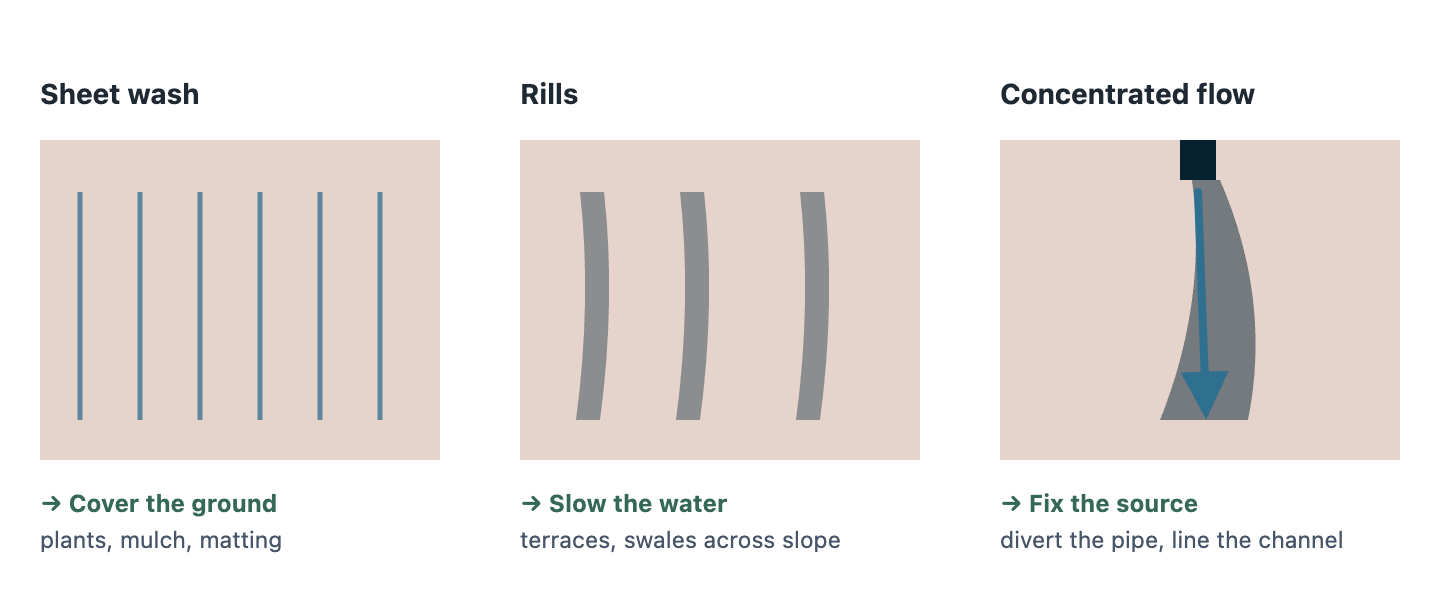
Sheet wash removes a thin, even layer across a broad area — the ground looks scoured, grass thins, and mulch drifts downhill. It means bare or sparse ground is exposed to rain across the whole face. The fix is cover: deep-rooted plants and ground cover, mulch (on gentle slopes only), or erosion matting to hold soil while roots establish.
Rills are small parallel channels, an inch or few deep, cut into a slope. They mean water is starting to concentrate and pick up speed. The fix is to slow it: terraces or a series of swales across the slope break the run into shorter, gentler sections so water can't build momentum.
Concentrated flow carves one deepening gully, usually below a pipe, a downspout, a paved edge, or a low point where everything converges. This is the most destructive and the most misdiagnosed. The fix is to address the source: move or spread the discharge, and where the channel must stay, line it with stone as a dry creek bed. Armour alone, without touching the firehose feeding it, just moves the gully downstream.
Fix the water first, in this order
Whatever the pattern, the leverage is on the water, not the dirt.
- Find and reduce the source. A downspout, a paved area, or an uphill neighbour is often delivering far more water to the spot than the rain falling on it. Extending a downspout or intercepting runoff at the top of the slope removes the cause. See downspout drainage problems.
- Slow what remains. Terraces, swales across the slope, and berms break the water's run and give it time to soak in instead of accelerating.
- Cover the ground. Deep roots are the best erosion control there is. Plant it, mulch gentle slopes, and use matting to protect bare soil until vegetation takes hold.
- Armour only where water must concentrate. A stone-lined channel or dry creek bed belongs where flow genuinely has to pass — after you've reduced and slowed it, not instead of doing so.
Work through your yard's conditions if you're not sure where the water is coming from.
A few cautions
- Mulch has limits. It helps on gentle slopes but washes off steeper ground, and piled too deep it traps water and makes washout worse. On slopes steeper than roughly a third grade, mulch alone won't hold.
- A retaining wall is not automatically the answer. Walls suit steep grade changes, but they need their own drainage behind them or they become a new water problem. They're a big spend for what a terrace-and-planting approach often handles — see retaining wall vs regrading vs terracing before committing.
- Erosion near a foundation or wall can undermine structure. If a gully is running toward the house or a retaining wall is bulging, that moves beyond yard drainage and is worth a professional look.
Related pages
- When your yard floods after rain — often the same excess water
- Runoff from a neighbour's yard
- Swales and berms — for slowing water on a slope
- Dry creek beds — to stabilise and beautify a channel
- Yard grading and levelling
FAQs
What causes erosion in a yard?
Water arriving faster or in greater volume than the ground and its plants can absorb. Bare soil, steep slopes, and concentrated discharge from downspouts or paved areas all speed it up. Erosion is a symptom of a water problem, which is why armouring the eroded spot without reducing or slowing the water usually just moves the problem downstream.
How do I stop erosion on a slope?
Read the pattern first. Broad thin scouring (sheet wash) needs ground cover and deep-rooted plants. Small channels (rills) need the water slowed with terraces or swales across the slope. A single deep gully needs its source addressed — usually a pipe or paved edge — and the channel lined only after that. Cover, slow, and reduce beat armouring alone.
Why does my mulch keep washing away?
Because water is moving too fast for mulch to hold, or the slope is too steep for it. Mulch works on gentle grades to protect soil while plants establish, but on steeper ground it floats off, and piled too deep it traps water and worsens washout. If mulch keeps leaving, you have a water-speed problem to solve first, not a mulch problem.
Will grass stop erosion?
Established deep-rooted grass and ground cover are among the best erosion controls there are — roots hold soil and the cover slows water. The catch is getting it established on ground that is actively washing: you often need matting or temporary cover to protect the seed until roots take hold, and on concentrated flow paths grass alone won't survive the scour.
Do I need a retaining wall to stop erosion?
Not usually. Retaining walls suit steep grade changes, but they are expensive and need proper drainage behind them or they create a new water problem. For most yard erosion, terracing, planting, and slowing the water handle it for far less. Consider a wall when the grade change is severe or a slope is genuinely failing.
How do I stop a gully from getting bigger?
Find what feeds it — almost always a concentrated source like a downspout, a paved edge, or a convergence point — and reduce or redirect that flow first. Then stabilise the channel, lining it with stone as a dry creek bed if water must keep passing through. A gully grows because something keeps firing water into it; stop that and it stops advancing.
Can a French drain stop erosion?
Sometimes, but it's often the wrong tool. Erosion is surface water moving too fast; a French drain collects subsurface water. Where erosion comes from groundwater seeping out of a slope, an interceptor drain can help. Where it's runoff racing over the surface — the common case — slowing and covering the surface and diverting the source does more than a buried pipe.
Sources consulted
- Angi — how to stop erosion in your yard
- LawnStarter — how to control erosion in the yard
- The Garden Scene — stop erosion on a sloped backyard
- Lowe's — control erosion in the landscape
By Under Your Home Team · Last reviewed 2026-08-09