Curtain Drain vs French Drain: What a Curtain Drain Is and When It Works
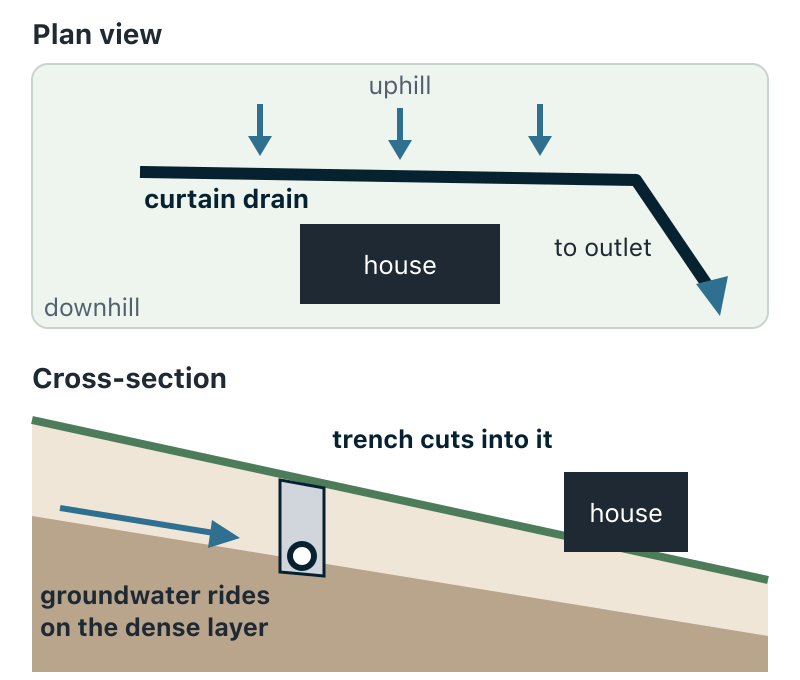
A curtain drain is a French drain placed across a slope, upslope of the house, yard or drain field it protects. It intercepts groundwater moving downhill underground and carries it around to a lower outlet. A standard French drain sits in the wet area itself. Same trench, pipe and gravel; the position is what differs.
Why the definitions online don't agree
Look up "curtain drain" and you'll find the same name used for opposite things:
| Where you read it | What it calls a curtain drain |
|---|---|
| A drainage contractor's guide (MT Drain) | The deeper, fully buried drain, with "French drain" meaning one with gravel at the surface |
| A landscaping company's comparison (Ware Landscaping) | The shallower drain for surface runoff, with "French drain" meaning the deeper groundwater drain |
| A waterproofing contractor (All Aspects) | A shallow drain for surface water, built like a French drain |
| Wikipedia | A buried pipe in gravel with soil over the top, as opposed to gravel open to the surface |
They disagree because depth and visible gravel aren't what make something a curtain drain. The trench, fabric, stone and perforated pipe are the same as any French drain in a yard. What makes it a curtain drain is where it goes and what it's for. It runs across a slope, above whatever you want to keep dry, to catch water travelling downhill before it gets there. "Interceptor drain" is the same idea under a clearer name.
How a curtain drain works
Rain that soaks into a slope doesn't only move straight down. When it reaches a denser layer, such as compacted subsoil, clay or rock, it spreads sideways and moves downhill along the top of that layer. Lower on the slope it can surface as a seep or a band of ground that never quite dries out. That's the water a curtain drain is built to catch.
The drain runs along the slope, nearly level but with a slight fall toward one end, so it cuts across that sideways flow. Water moving downhill meets the stone, drops into the pipe, and follows the pipe to an outlet off to the side, clear of the area below. For that to work, the trench has to reach the layer the water is moving along. A drain that stops short lets the water pass underneath it.
Curtain drain vs French drain
| Curtain drain | French drain in the wet area | |
|---|---|---|
| Where it goes | Across the slope, uphill of the house, patio, lawn or drain field | In or around the ground that stays wet |
| Water it catches | Groundwater moving downhill toward the area | Water already saturating the area |
| Layout | A single line along the slope, turning downhill at one end | Follows the wet area, as one line or branches |
| Depth | Set by how deep the water travels: about a foot for a shallow seep, 2 to 3 feet on a deeper layer | Commonly 18 to 24 inches in a yard |
| Outlet | Around the side of what it protects | Downhill of the wet area |
| Built from | Trench, fabric, stone and perforated pipe | The same |
Do you have water a curtain drain can catch?
The question that matters is direction: is water arriving sideways from uphill, or rising from below? Look after a few days of rain:
| What you see | What it suggests | Likely fix |
|---|---|---|
| A band of soggy ground or a seep line across a slope, wettest at its uphill edge | Groundwater moving downhill along a denser layer | A curtain drain above the band |
| Ground below a neighbour's yard, a driveway or a hill that stays wet for a day or two after rain stops | Water arriving underground from uphill | A curtain drain along the uphill side. See water from a neighbour's yard |
| Water running across the surface during rain that dries soon after | Surface runoff, not groundwater | A swale, which catches surface flow that a buried drain misses and costs less |
| A wet area on flat ground with no uphill source | A high water table or slow soil | A French drain through the area, or the flat-yard options |
| A spot that stays wet in dry weather, sometimes bubbling | A spring, or a leaking water or irrigation line | Rule out a leak first, then drain at the source |
| A wet, lush strip over a septic drain field | Possibly a saturated or failing field | Stop and read saturated drain field before draining anything |
A test pit settles it. After rain, and after calling 811, dig a hole 2 to 3 feet deep just uphill of the wet area. If water seeps in from the uphill side at a particular depth, that's the layer a curtain drain has to reach. If the hole fills from the bottom instead, the water is rising, and a drain upslope won't stop it.
Depth, placement and outlet
- Depth: down to the layer where the water is moving, and a few inches into it. That's often about a foot for a shallow seep and 2 to 3 feet where water rides on deeper clay or rock.
- Placement: uphill of what you're protecting, with enough room that the trench, the soil you dig out and the outlet run stay clear of the foundation, patio footings and tree roots. A deep trench dug tight against a foundation can disturb the soil supporting it, so give it space.
- Fall and outlet: at least 1% fall along the pipe toward one end, then turn downhill to an outlet beside or below the protected area, never back onto it and never onto a neighbour. See how much slope you need, and use the yard slope calculator to check your route.
- Access: a capped cleanout at the upstream end, so the line can be flushed when needed.
When a curtain drain is the wrong fix
- The water is on the surface. Runoff during storms passes over a buried drain faster than it can soak in. A swale or berm catches it for a fraction of the cost.
- The water comes from below. A high water table or a spring in the middle of the wet area isn't travelling downhill, so there's nothing for an upslope drain to intercept.
- There's no lower outlet. The drain has to empty somewhere lower than itself. On a flat lot, see how to drain a flat yard.
- The slope itself is washing away. Runoff cutting gullies needs the surface stabilised first, as covered in yard erosion from runoff, though a curtain drain can help where seeping water is loosening the soil.
- Water is already inside the basement. An upslope drain may cut the water reaching the wall, but it won't fix water coming through it. See the note below.
Curtain drains above a septic drain field
A drain field only works if the soil around it has room to absorb wastewater. Groundwater arriving from uphill can fill that room, leaving the field saturated after every wet spell. NC State Extension's septic owner's guide suggests that a system at the base of a slope may need a drain to divert underground water, along with keeping roof and surface water off the field.
Two cautions. Many jurisdictions set minimum distances between drainage trenches and drain fields, so wastewater isn't drawn into a drain and carried away untreated, which makes a drain near a septic system a permit question. And a wet drain field can mean a failing field, not only an uphill water problem, so check the signs of failure first. Talk to the county health department or a licensed septic professional before digging near one.
Building one
A curtain drain is built exactly like a yard French drain. Only the layout changes:
- Find the depth the water travels at with a test pit, and choose an outlet lower than the end of the trench.
- Call 811, then stake a line across the slope with 1% fall toward the outlet end.
- Dig down to the water-carrying layer, line the trench with fabric, lay a stone bed and perforated pipe with the holes down, and fit a cleanout.
- Cover with stone, fold the fabric over, restore the surface, and turn the pipe downhill to the outlet.
The full sequence, with trench depths, a materials list and a test before backfilling, is in how to install a French drain in your yard.
What it costs
| Scope | Planning range |
|---|---|
| DIY, 50 to 100 feet, materials | A few hundred dollars up to about $1,000; deeper trenches need more stone |
| Hired, per linear foot | Roughly $10–$35, higher for deep trenches, rock or long outlet runs |
| Hired, 100-foot run | About $1,000–$3,500 |
Planning estimates, not quotes. Depth drives the number more than anything, because a trench that has to reach a layer 3 feet down moves roughly twice the soil and needs twice the stone of an 18-inch one.
Related pages
- French drains for yards — when the drain goes in the wet area itself
- How to install a French drain in your yard — the step-by-step build
- Swales and berms — for water running over the surface
- Water runoff from a neighbour's yard
- Saturated drain field
- Does gravel help drainage? — why a gravel-filled hole rarely works
FAQs
What is the purpose of a curtain drain?
To intercept groundwater moving downhill before it reaches something you want to keep dry, such as a house, patio, lawn or septic drain field, and carry it around to a lower outlet. It's a French drain positioned across the slope above the problem, rather than in the wet area itself.
How deep does a curtain drain need to be?
Deep enough to reach the layer the water is travelling along. For a shallow seep that can be about a foot; where water rides on deeper clay or rock, 2 to 3 feet is common. A test pit dug after rain shows the depth at which water seeps in from the uphill side.
How far from the house should a curtain drain be?
Far enough uphill that the trench, the dug-out soil and the outlet stay clear of the foundation, footings and tree roots, and the pipe can turn around the house to its outlet. The right spot depends on where the water is moving. Avoid digging a deep trench tight against a foundation.
How much does a curtain drain cost?
As a planning range, hired installation commonly runs about $10 to $35 per linear foot, or roughly $1,000 to $3,500 for a 100-foot run, with deep trenches, rock and long outlet runs at the higher end. Doing it yourself typically costs a few hundred dollars to about $1,000 in stone, pipe and fabric.
Can I build a curtain drain myself?
Yes, if the run is modest, the depth is manageable and there's a clear lower outlet. It's the same build as a yard French drain. Call 811 first, and bring in help for deep trenches, rocky ground, or anything near a septic system or a foundation.
Are curtain drains effective?
Very, when water is arriving sideways from uphill and the trench reaches the layer it travels along. They don't help when water is rising from below, as with a high water table or a spring, or when it's running over the surface, where a swale works better.
What does a curtain drain look like?
Usually like nothing at all. Once the trench is capped with soil and turf, the only visible parts are a cleanout cap and the outlet. Some are left with a strip of gravel at the surface, which also lets surface water in and makes the line easy to find.
Is a curtain drain the same as an interceptor drain?
Yes. Both names describe a French drain placed across a slope to intercept water before it reaches a protected area. Some people also use "curtain drain" loosely for any buried French drain, which is why definitions online vary.
Sources consulted
By Under Your Home Team · Last reviewed 2026-09-15