How to Drain a Flat Yard With No Slope
Measure first: most "flat" yards have a few inches of usable fall. With about 1% fall to a lower outlet, a French drain or swale works. With no outlet, store the water in a dry well or rain garden if the soil drains an inch an hour, or pump it out if it doesn't. Regrading to create fall fixes the cause.
Flat is rarely as flat as it looks
Water that sits on a yard for days makes the ground look level, and the eye is bad at judging a few inches over fifty feet. That matters, because the difference between "dead flat" and "an inch of fall every ten feet" is the difference between needing a pump and not needing one.
A drain moving water by gravity needs roughly 1% fall — about ⅛ inch of drop per foot, or 6 inches over 50 feet. Many yards that look flat have that toward one corner, the street, or a ditch, once you measure along the right line.
The check takes ten minutes with two stakes, a string, a line level and a tape: tie the string at ground level on the wet spot's stake, level it to a stake where the water could go, and measure the gap to the ground. Fall divided by distance is your slope. The step-by-step version, with a diagram, is in how much slope you need for drainage, and the yard slope calculator does the arithmetic.
Measure along more than one line. The best outlet is often not the nearest edge but the lowest point anywhere on the property: a back corner, a side-yard swale, a curb, or a ditch.
The two measurements that decide the fix
Every flat-yard method either moves water somewhere lower, stores it until the soil absorbs it, lifts it with a pump, or changes the ground so it runs off. Which one works on your yard comes down to two numbers:
- Fall to a possible outlet — from the string-line check above.
- How fast the soil drains — from a free perc test: dig a 12-inch hole, fill it to pre-soak, refill, and measure the drop over an hour. The full method is in how to test soil drainage.
If water appears in the bottom of the test hole on its own, you have a high water table. That rules out storing water in the ground at all, and it is worth knowing before anyone digs.
Match your yard to a method
| What you measured | Soil drains 1 in/hr or more | Soil drains ½ to 1 in/hr | Soil under ½ in/hr, or water table high |
|---|---|---|---|
| 1% or more of fall to an outlet | Move it: French drain or swale | Move it: French drain or swale | Move it: French drain or swale — soil speed doesn't matter when water leaves |
| About ½% to 1% of fall | Move it with solid, smooth pipe from catch basins, laid carefully | Same, or regrade to add fall | Same, or regrade to add fall |
| No usable fall or outlet | Store it: dry well or rain garden | Store it with a larger rain garden, plus regrading | Lift it with a pump, or raise the ground |
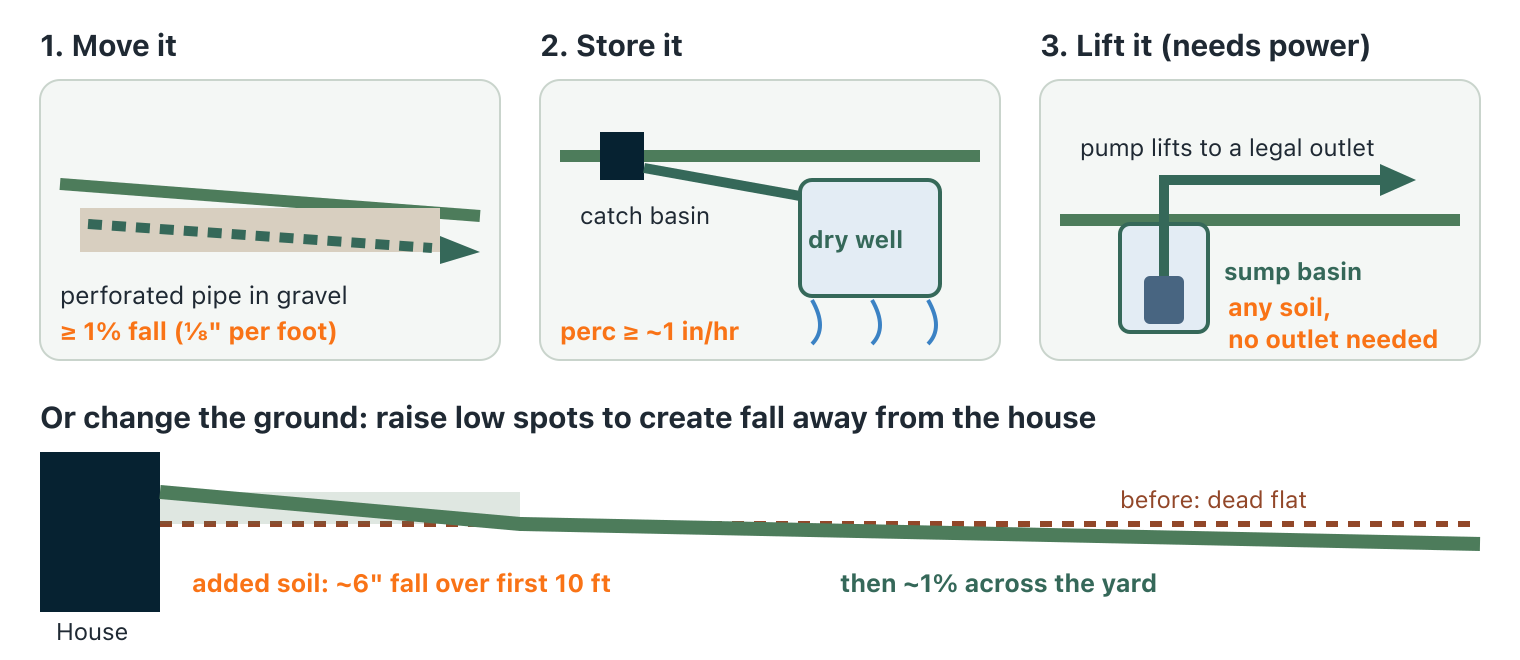
Move it: when there is somewhere lower
If the string line finds 1% fall to an outlet, gravity drainage is almost always the cheapest and most reliable answer, even over a long run. A French drain collects water from saturated ground along its length; a swale is a shallow, grassed channel that carries surface water with no pipe to clog.
Between ½% and 1%, perforated French drain pipe gets unreliable — water lingers in it, silt settles, and it can freeze. For that range, collect surface water at the low spots with catch basins and connect them with solid, smooth-walled pipe, laid with a laser or string line so there are no dips. Smooth pipe keeps water moving at slopes where corrugated pipe stalls.
Where the outlet is, and whether you can send water there, matters as much as slope. Water released onto a neighbour's property or a public sidewalk can create a legal problem even when it solves yours.
Store it: when there is nowhere lower, but the soil drains
With no outlet, the next question is whether the ground can take the water. If your perc test drops an inch an hour or more, storage works:
- A dry well is a buried chamber or gravel pit that holds runoff from a catch basin or downspout and lets it soak away.
- A rain garden is a shallow planted depression that does the same at the surface, with plants that tolerate wet feet.
Size is where flat-yard storage usually goes wrong, so it is worth doing the arithmetic. One inch of rain on one square foot is about 0.623 gallons. A 1,500 square foot roof sheds roughly 935 gallons in a one-inch storm, before counting water running off the lawn itself. A 4 × 4 × 4 foot gravel pit holds about 480 gallons of space, but with gravel filling it only around a third of that — roughly 170 gallons — is room for water. That pit fills in the first part of the storm unless the soil is draining it at the same time, which is exactly why the perc rate decides whether storage can work. The dry well calculator sizes one from your roof area and soil, and drainage gravel sizes and void space explains the one-third figure.
In slow clay, a dry well tends to become a buried bathtub that is full when the next storm arrives. Storage is the wrong tool there, however large you make it.
Lift it: when there is no outlet and the soil won't take water
A pump turns a flat yard into a solvable problem regardless of soil. Surface water collects in a catch basin or a French drain that ends in a sump basin sunk below grade, and a submersible pump lifts the water through a discharge line to wherever it can legally go — a curb, a storm drain connection your local authority allows, or a lower part of the property.
The trade-offs are honest ones: a pump needs power at the basin, maintenance, and a discharge route, and it stops during power outages, which are common in exactly the storms that flood yards. It is the right answer for a genuinely flat lot with tight soil, and an expensive answer for a yard that turned out to have fall.
Change the ground: create the slope you don't have
On many flat yards the lasting fix is not a drain at all but regrading — adding and shaping soil so water runs where you want it. Near the house, aim for about 6 inches of fall over the first 10 feet away from the foundation. Across the yard, 1% is enough.
Done well, regrading uses a good screened topsoil or a loam over the existing ground, built up in thin compacted layers and shaped with a long straightedge, then seeded or sodded. It can also create a shallow swale to lead water to a corner. Two limits: soil against the house must stay below siding and weep screeds, and piling fill over tree roots can kill the tree. The details are in yard grading and leveling.
What doesn't work on a flat yard
- A French drain with no outlet. It fills and stays full. On flat ground it needs an outlet, a dry well at the end, or a pump.
- Filling a low spot with topsoil over clay. The puddle moves to the edge of the new soil, or sits under the surface where the clay starts.
- A gravel-filled hole in clay. It makes a bigger, hidden puddle. See does gravel help drainage.
- Aerating alone. It helps compacted lawns absorb light rain, but it does not create anywhere for heavy runoff to go.
Related pages
- Standing water in the yard — diagnosing why it pools
- How much slope you need for drainage — the numbers and the string-line check
- Yard French drains — when you do have fall
- Dry wells — storing water on a yard with no outlet
- How to test soil drainage — the free perc test
FAQs
Will a French drain work without a slope?
Not reliably as a gravity system. A French drain moves water by gravity, so without roughly 1% fall to an outlet the water sits in the pipe, silt settles out, and the drain slowly stops working. On flat ground a French drain works only if it ends in a dry well in soil that drains well, feeds a sump pump, or is laid in a trench dug deeper at the outlet end to create the fall the surface lacks.
What happens if there is not enough slope in a drain pipe?
Water moves slowly or stands in the low sections. Sediment settles where the flow slows, gradually narrowing the pipe, and standing water can freeze in winter or breed mosquitoes at open outlets. Dips are worse than uniformly shallow slope, because every dip is a permanent pool. Solid smooth pipe laid without dips tolerates shallow slope far better than corrugated pipe.
Do drains need to be sloped?
Gravity drains do: about 1% for a perforated French drain, and at least ½% for smooth solid pipe laid carefully. A pumped discharge line does not need slope to move water, because the pump pushes it, but it should still drain back or out between cycles so it does not hold water that can freeze.
Do rocks help with drainage in a flat yard?
Only when the water has somewhere to go. Gravel gives water space to collect and move, which helps around a French drain pipe or inside a dry well in soil that drains. In clay with no outlet, a gravel-filled hole or trench just holds a hidden pool. Rocks spread on the surface do little for drainage.
Can I just add dirt to fix a flat yard?
Often, yes — regrading with added topsoil is one of the most effective fixes, as long as it creates real fall rather than just raising a low spot. Build it up in thin, firmed layers, slope it away from the house by about 6 inches over the first 10 feet, keep it below siding, and avoid burying tree roots. Spreading soil into a puddle without shaping a slope usually moves the puddle.
How do I get standing water out of a flat yard quickly?
For an immediate fix after a storm, a small utility or transfer pump with a garden hose outlet can move a pooled area to a lower spot or the street, where that is allowed. It treats the symptom, not the cause; the lasting fixes are the methods on this page, chosen from the fall and soil measurements.
What is the cheapest way to drain a flat yard?
Usually the ones that need no equipment: extending downspouts so roof water lands away from the problem area, regrading a low spot yourself, and a hand-dug swale where there is a little fall. Among installed systems, a short DIY catch basin with solid pipe to a nearby outlet is typically the least expensive. Pumped systems cost the most to install and to run. The yard drainage cost calculator gives planning ranges.
Sources consulted
- French Drain Man — draining a flat yard with no slope
- JDI — how to drain a yard with no slope
- NDS — drainage slope guidance
- University of Minnesota Extension — checking soil drainage
- USGS Water Science School — rainfall calculator (0.623 gallons per square foot per inch)
By Under Your Home Team · Last reviewed 2026-09-13