Yard Grading and Resloping for Drainage: Two Opposite Slope Problems
Yard grading — also called resloping or regrading — reshapes the ground so water runs away from the house instead of toward it. Sloped-yard drainage is really two opposite problems. A yard that slopes toward the house needs regrading to reverse the fall — aim for about 6 inches of drop over the first 10 feet. A yard that slopes away too steeply needs the water slowed, not regraded. Identify which you have before moving any soil.
Two problems that get treated as one
Search "sloped yard drainage" and the advice runs together, because "sloped" describes two situations that need opposite responses. Sorting yours out is the first and most important step.
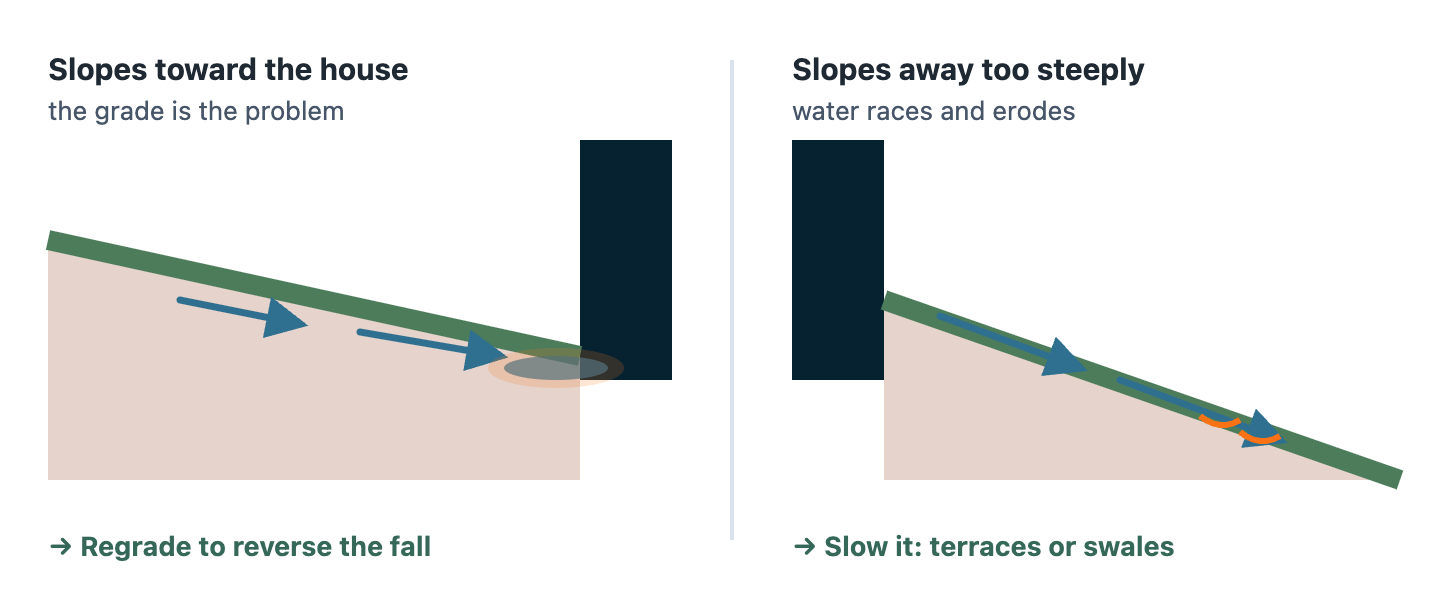
If your yard slopes toward the house, the grade itself is the fault. Water is being delivered to the one place you least want it. This is the more urgent case, and regrading — also called resloping — to reverse the slope near the house is the real fix, not a drain bolted on to manage a problem the ground is actively creating. See water pooling near the foundation for what that water can and can't do.
If your yard slopes away but too steeply, water isn't pooling — it's racing downhill, scouring channels, and washing out mulch and soil before it can soak in. Regrading a steep slope flat is usually impractical and often impossible. The answer is to slow the water: terraces, a series of swales across the slope, or planting — not to level the yard.
The rest of this page covers the first case, regrading, since that is where "grading and levelling" actually applies. For the steep-runoff case, swales across the slope are the main tool.
How much slope you actually need
Grading has target numbers, and they differ by where you are on the lot. The grading slope you aim for is a small number; the summary is below, and the full per-foot table with worked examples is in How much slope do you need for drainage?.
Right next to the house: the widely used standard is about 6 inches of fall over the first 10 feet — roughly a 5% grade, or a little over ½ inch per foot — so water is pushed decisively away from the foundation.
Out in the yard: a much gentler slope moves water once it is clear of the house — around 1 to 2% is enough, as long as water keeps moving toward somewhere lower and doesn't hit a flat spot and stop.
Slope is often written as a fall per foot, which is useful with a level. As a quick reference: a 1% minimum slope for drainage is about ⅛ inch per foot, 2% is about ¼ inch per foot, and the 5% next-to-the-house target is a little over ½ inch per foot. Any of these keeps water moving; below about 1% (⅛ inch per foot), water tends to stall.
Check your grade first
Yards that look flat often aren't, and yards assumed to slope away sometimes slope back. Confirm it with a string line before deciding anything.
- Drive a stake at the house and another 10 feet out.
- Tie a string at ground level on the house stake, run it to the far stake, and level it with a line level.
- Measure from the string down to the ground at the far stake — that gap is your fall over 10 feet.
Six inches or more falling away is good. Less than that, level, or falling back toward the house means regrading is worth considering.
This short shows the string-line slope check and why fixing a bad grade — rather than bolting on a drain — is the most durable way to keep water off your foundation.
Regrading done right
- Confirm the direction and target with the string-line check above.
- Call 811 before moving soil near buried services.
- Use the right fill. Clean fill dirt or a clay-rich soil that sheds water — not gravel, which lets water percolate straight down against the foundation instead of running off.
- Build the low point up to become the high point, tapering the new grade smoothly out into the existing yard.
- Keep soil several inches below siding, weep holes, and any wood, so you are not trapping moisture against the structure.
- Compact in layers rather than dumping a single deep pile, so the new grade doesn't settle back over the first wet season.
- Restore the surface with sod or seed quickly, since fresh fill erodes.
Small areas are within DIY reach. Reversing the grade around a whole house, or working with rock, mature trees, or a steep bank, is where machinery and a professional earn their cost.
Regrade, or add a drain?
This is the real decision, and it is worth stating plainly. Regrading fixes the cause; a drain manages the symptom. Where the ground is delivering water to the wrong place, correcting the grade is usually cheaper over time and more durable than installing and maintaining a drain to fight it.
A drain becomes the better answer when regrading isn't practical — an established landscape you don't want to tear up, a slope too steep to reshape, or hardscape in the way. In those cases a French drain, a catch basin, or a swale manages what the grade won't. Often the best answer is a modest regrade plus a small drain, rather than a large drain compensating for a grade left wrong. Compare the options once you know which situation you're in.
What it costs
| Scope | Rough planning range |
|---|---|
| Regrading a low spot or small area | $500 – $1,500 |
| Regrading around a house perimeter | $1,000 – $3,000 |
| Larger regrading with fill and machinery | $0.40 – $2.00 per square foot |
| Terracing a steep slope | Higher — retaining structures add cost |
Planning estimates, not quotes. Cost moves with volume of soil, access for machinery, how much has to be removed versus added, and restoration.
Related pages
- Yard Slope Calculator — check whether you have enough fall
- Water pooling near the foundation — for a yard sloping toward the house
- Swales and berms — for slowing water on a steep slope
- Standing water in your yard
- French drains for yards
- Compare every yard drainage option
FAQs
How do I know if my yard slopes toward the house?
Check with a string line: drive a stake at the house and one 10 feet out, tie a level string at ground level on the house stake, and measure the gap to the ground at the far stake. If the ground is higher at the far stake — or level — water is running back toward the house. You can also just watch during rain and see which way water actually moves.
How much slope does a yard need to drain?
Near the house, about 6 inches of drop over the first 10 feet — roughly 5%, or a little over ½ inch per foot. Out in the yard, the minimum slope for drainage is about 1 to 2%, which is ⅛ to ¼ inch per foot, enough to keep water moving toward a lower outlet. The steeper grade close to the foundation gets water decisively away; the gentler grade beyond just needs to avoid flat spots where water stops.
Can I regrade my yard myself?
A small area or a single low spot, yes — with fill dirt, a rake, a level, and patience. Full perimeter regrading, or anything involving rock, mature trees, a steep bank, or large volumes of soil, is where machinery and a professional are worth it. The grade has to be right and compacted in layers, or it settles back within a season.
What kind of soil should I use to regrade?
Clean fill dirt or a clay-rich soil that sheds water, built up in compacted layers. Avoid gravel or very sandy fill against the foundation — it lets water percolate straight down to the wall instead of running off, which defeats the purpose. Finish with a few inches of topsoil so grass will establish.
Should I regrade or install a drain?
Regrade when the grade itself is delivering water to the wrong place — it fixes the cause and usually lasts longer than a drain fighting a bad slope. Install a drain when regrading isn't practical: an established landscape, a slope too steep to reshape, or hardscape in the way. Frequently the best result is a modest regrade combined with a small drain.
How much does regrading a yard cost?
Regrading a small area or low spot commonly runs $500 to $1,500; a full house perimeter $1,000 to $3,000; and larger machine-graded work $0.40 to $2.00 per square foot. Terracing a steep slope costs more because of the retaining structures involved. These are planning ranges — soil volume and site access move them most.
What if my yard is too steep to regrade?
Don't try to level it — slow the water instead. Terraces, retaining walls with drainage behind them, and a series of swales across the slope break the water's run and give it time to soak in rather than scour. Comparing a wall against regrading and terracing starts with measuring the slope. On a steep lot, managing flow across the slope is realistic; flattening it usually isn't.
What is resloping a yard?
Resloping is the same job as regrading: cutting soil from the high side, adding compacted fill on the low side, and reshaping the ground so it falls away from the house at a steady grade. The three words — grading, regrading, resloping — get used interchangeably by contractors; "grading" usually means setting the slope on new ground, while "resloping" or "regrading" means correcting an existing yard that drains the wrong way.
Who does yard grading and resloping?
Landscape contractors, excavation or grading contractors, and many drainage contractors all do resloping work; for a small low spot a landscaper is usually enough, while reversing the grade around a whole house or working near a foundation calls for a grading or drainage contractor with compaction equipment. Who to call for yard drainage sorts out which trade fits which job, and how to compare drainage quotes covers what a fair grading estimate should spell out.
Sources consulted
- Pretty Purple Door — yard grading 101
- YardBlogger — yard slopes toward house
- Salcorp Landscaping — sloped yard drainage solutions
- Bucktown Grading — yard sloping toward house
By Under Your Home Team · Last reviewed 2026-09-06