Soil Drainage Rate Calculator
Percolation calculators are built for septic drain fields: they give you minutes per inch and stop. If you dug a hole in a wet lawn, you want a different answer — can this ground soak water up, and which fixes does that rule in or out? This converts your test into both units, reads it against the thresholds on the soil drainage test page, and hands the rate to the dry well and rain garden calculators.
Drainage rate
1 in/hr = 60 minutes per inch
1 in/hr — normal, healthy soil
Normal · likely loam or sandy loam
This is the range most drainage advice assumes. The soil itself isn't the problem; look at where the water is coming from — downspouts, a neighbour's runoff, a grade that falls toward the house — before choosing a fix. Every solution on the site is on the table.
What it rules in or out
- Dry wellWorks
Empties between storms as designed.
- Rain gardenWorks
Drains inside the 24–48 hour window.
- Yard French drainWorks
Works; the outlet matters more than the soil.
- Regrading, swales, dry creek bedsUnaffected
Surface fixes don't depend on the soil absorbing anything.
At this rate
- A 6-inch-deep rain garden empties in about 6 hours
- A full 12-inch test hole clears in about 12 hours
What this doesn't tell you
One hole tells you about one spot, on one day. Skip the pre-soak and the number reads fast; test in a wet week and it reads slow; a buried layer of construction fill or a seasonal water table can make the same yard read differently two holes apart. The rate is a strong hint about which category of fix suits your ground — not a design value. The sizing tools that take it already build in a margin for that.
How to do the test
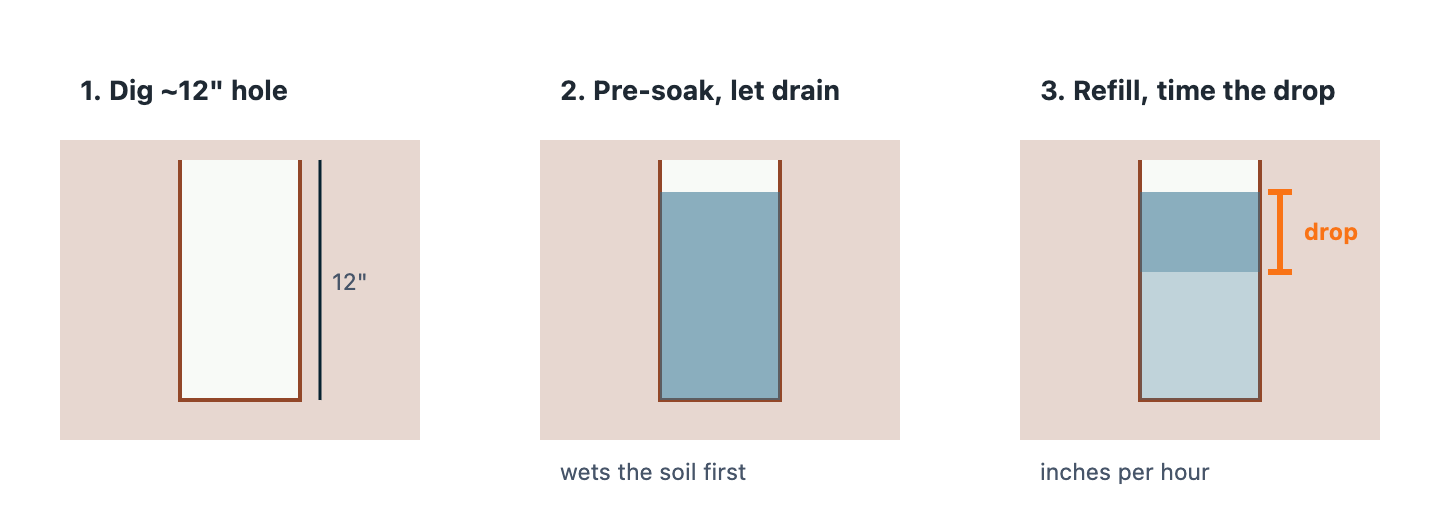
A shovel, a bucket and a ruler. Dig a hole about 12 inches deep where the problem is. Fill it and let it drain fully — the pre-soak. Refill it, lay the ruler across the top, and read the drop after an hour. In very slow soil measure over a longer time and enter that instead; the tool works with any duration. Two or three holes across the wet area tell you whether the whole yard drains the same way, and the tool averages them.
The formula — check it yourself
inches per hour = drop (in) ÷ time (hr)
minutes per inch = 60 ÷ inches per hour
Two inches in 30 minutes is 4 inches per hour, or 15 minutes per inch. The bands the tool uses — free-draining above 4 in/hr, normal from 1 to 4, slow from 0.5 to 1, poor below 0.5 — are the ones the site's solution pages are written against, so a result here maps directly onto which pages apply to your yard.
Conversion and interpretation chart
| Minutes per inch | Inches per hour | Band | Likely soil |
|---|---|---|---|
| 5 min/in | 12 in/hr | Free-draining | Sandy or gravelly |
| 10 min/in | 6 in/hr | Free-draining | Sandy or gravelly |
| 15 min/in | 4 in/hr | Normal | Loam or sandy loam |
| 30 min/in | 2 in/hr | Normal | Loam or sandy loam |
| 60 min/in | 1 in/hr | Normal | Loam or sandy loam |
| 120 min/in | 0.5 in/hr | Slow | Silty clay loam, or compacted |
| 240 min/in | 0.25 in/hr | Poor | Heavy clay, or a water table |
What the number decides
Whether your soil absorbs water decides which whole category of fix applies. Above about 1 inch per hour, storing water in the ground works: a dry well for a downspout, a rain garden for a wider area. Below about half an inch, the ground is the problem and water has to be moved instead — regrading, a swale, or a French drain to a real outlet. The comparison of every option is sorted the same way. Heavy clay soil is the usual reason for a slow result, and it is common across the North Carolina Piedmont.
Frequently asked questions
What is a good percolation rate for yard drainage?
How do I do a perc test at home?
What does 1 inch per hour mean?
Why convert minutes per inch to inches per hour?
My perc test was slow. Can I still fix my drainage?
Why do I have to pre-soak the hole?
Related
- How to test soil drainage — the full procedure and a video walkthrough
- Dry well calculator — takes this rate and checks the drain-down
- Rain garden calculator — takes this rate and sizes the bowl
- Solution finder — eight questions, including this one, to narrow the fix