How to Set Up a Rain Barrel (and Where the Overflow Should Go)
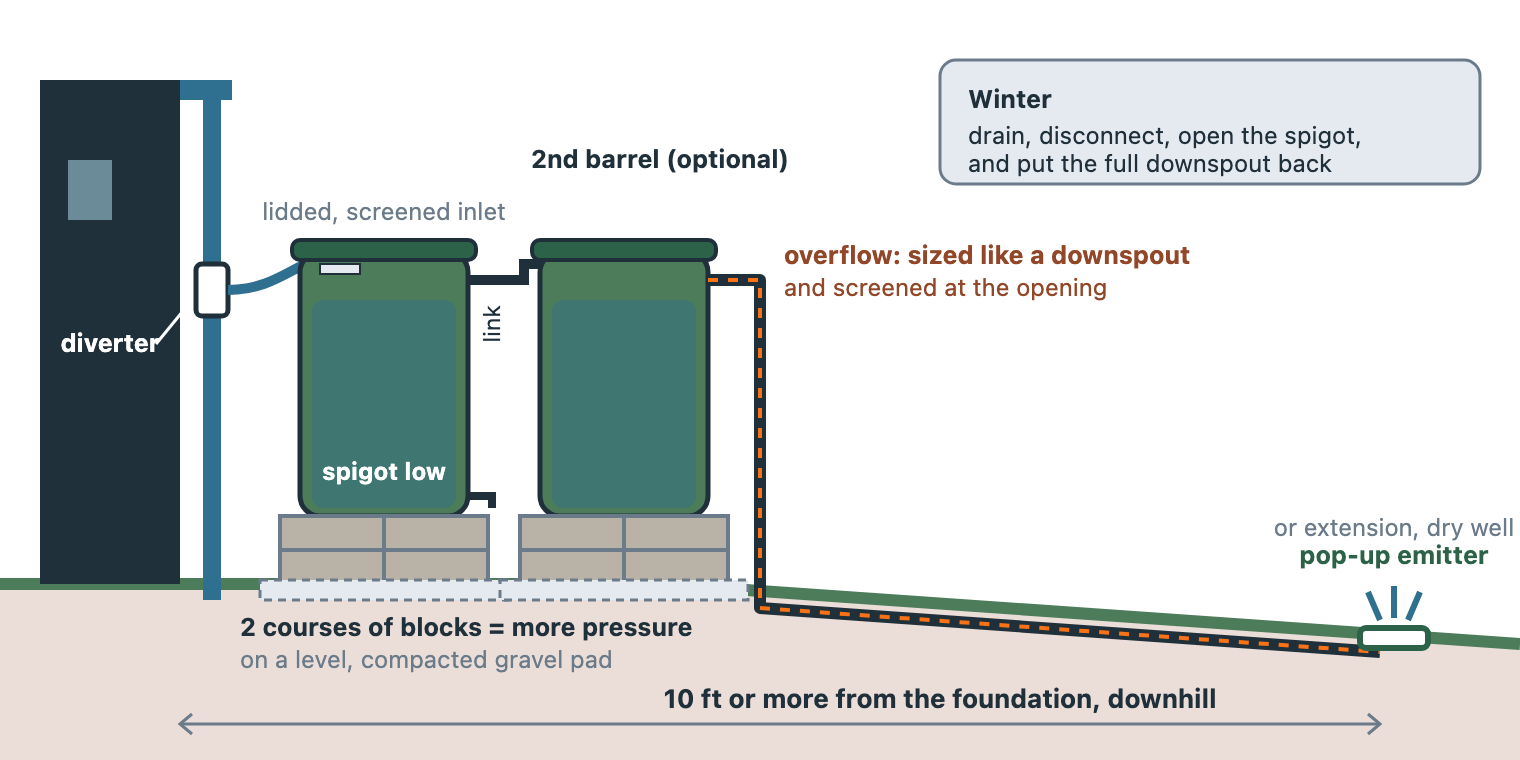
You need a lidded barrel with a screened inlet, a spigot near the bottom, an overflow fitting near the top, a level base 8 to 16 inches high, and either a diverter or a cut downspout. Then:
- Pick the downspout that drains the most roof and sits where the ground falls away from the house.
- Build a level base on compacted gravel, one or two courses of cinder blocks high.
- Connect the barrel with a diverter, or cut the downspout to feed the lid.
- Route the overflow at least 10 feet from the foundation, downhill.
- Screen every opening, and drain and disconnect it before the first hard freeze.
A 55-gallon barrel under 500 sq ft of roof is full after about 0.22 inch of rain, so the overflow handles most of every storm.
Before you buy anything, check that your state allows it and whether it caps storage: our rainwater collection laws by state page covers every state from its own law. This page covers the hardware and the water.
1. Choose the downspout
The best downspout is not always the one nearest the garden. Look for three things:
- Roof area. A downspout draining a big section fills a barrel in the first minutes of a storm; one draining a small porch roof may barely fill it. Either works, but the bigger the roof, the more the overflow matters.
- Somewhere for the overflow to go. The ground beyond the barrel should fall away from the house, or you need room to carry the overflow out. A downspout in a corner hemmed in by a patio, a walkway or a neighbour's line is a poor choice.
- Reach. You will carry water from the spigot, so a barrel 10 feet from the beds gets used and one at the far side of the house tends not to.
Avoid a downspout that already ends in a buried line, unless you are using a diverter that leaves that line working, and avoid spots where overflow or spigot drips would freeze across a path.
2. A level, raised base, and why height matters
A full 55-gallon barrel holds about 460 lb of water (8.34 lb a gallon), before the weight of the barrel. That weight sits on a footprint about two feet across, in the one spot of the yard that gets the most water: right under a downspout, beside the overflow and the spigot. Soft ground there settles unevenly, and a barrel that leans a few degrees when empty can tip when full.
- Dig out the turf and set 2 to 3 inches of compacted gravel, wider than the blocks.
- Level it both ways before the blocks go on, then check the blocks again.
- Use solid blocks or lay hollow blocks flat, side by side, so the barrel's whole base is carried. A purpose-built stand works too if it is rated for the full weight.
- Keep the base clear of the foundation so it does not hold water against the wall.
Height is your water pressure. A barrel has no pump; the only pressure is the height of the water above the end of your hose, at 0.433 psi per foot. With the spigot about 3 inches up the barrel and a hose lying on the ground:
| Base height | Pressure, barrel full | Pressure, barrel low |
|---|---|---|
| On the ground | 1.2 psi | 0.3 psi |
| One block (8 in) | 1.5 psi | 0.6 psi |
| Two blocks (16 in) | 1.8 psi | 0.9 psi |
| Three blocks (24 in) | 2.1 psi | 1.2 psi |
"Full" assumes about 30 inches of water above the spigot and "low" about 6. A house tap typically runs at 40 to 60 psi, so even a tall stand gives a gentle flow. Raising the barrel mostly helps when it is getting low, and it lifts the spigot high enough to fit a watering can under it. Two blocks is the usual balance: higher stacks become tippy, and the base has to grow wider with them. A barrel will not run a sprinkler or standard drip emitters; use a watering can, an open hose, or a soaker or drip line made for low pressure.
3. Diverter or cut the downspout?
This is really a decision about where the overflow goes.
| Diverter | Cut downspout | |
|---|---|---|
| How it works | A fitting in the downspout sends water to the barrel through a short hose | The downspout ends above the barrel and pours into the lid |
| When the barrel is full | Water backs up in the hose and carries on down the downspout | Everything leaves through the barrel's overflow fitting |
| Overflow route | The downspout's existing discharge | A new one you have to build |
| Captures in a downpour | Less; the small hose can't take it all | All of it, until the barrel is full |
| Winter | Close or remove the diverter; the downspout still works | Put a full-length downspout and extension back |
If the downspout already has a good discharge, an extension onto ground that falls away, or a buried line to a pop-up emitter, a diverter keeps it. If you cut the downspout, the barrel's overflow becomes the downspout, and it has to be sized and routed like one. A single garden-hose overflow can't pass what a downspout delivers in a downpour, so water spills over the lid at the base of the wall. Use an overflow at least as big as the inlet, or a downspout-sized adapter.
4. Where the overflow goes
This is the part most guides skip, and it decides whether the barrel helps or harms the foundation. Our rainwater harvesting calculator works it out as roof area × rain × 0.623 gallons per square foot per inch × the share that reaches the barrel (80% for an asphalt shingle roof, inside the 75–85% range the Texas Water Development Board says installers use). For a 1-inch rain on 500 sq ft of roof:
- About 310 gallons fall on that roof section.
- About 250 gallons reach the barrel.
- One 55-gallon barrel is full after 0.22 inch, and about 190 gallons (76% of what arrived) go out of the overflow.
| Barrels linked | Storage | Full after | Overflow in a 1-inch rain |
|---|---|---|---|
| 1 | 55 gal | 0.22 in | 190 gal |
| 2 | 110 gal | 0.44 in | 140 gal |
| 3 | 165 gal | 0.66 in | 84 gal |
| 4 | 220 gal | 0.88 in | 29 gal |
Most storms are bigger than a barrel. Your area's monthly rainfall is on our rainfall by zip code page, and the calculator runs your own roof and zip month by month.
So treat the overflow exactly like a downspout:
- Carry it at least 10 feet from the foundation, onto ground that keeps falling away. An overflow that spills at the base of the barrel is a downspout ending at the wall, and it leads to water pooling near the foundation.
- Short, open ground: a downspout extension or flexible pipe onto a lawn that slopes away. See gutter drainage for the options and setbacks.
- Longer runs or around obstacles: a buried line to a pop-up emitter or to daylight.
- Flat or low lots: a dry well or a rain garden sized for the roof area, not the barrel.
- Never onto a neighbour's lot, across a sidewalk, or towards a septic field.
Tool
How much would your barrel actually keep?
Enter your zip, roof area and storage to see, month by month, how much a barrel or tank collects, how much you'd use, and how much goes over the top, plus the overflow from your area's 2-year storm.
5. Screening for mosquitoes and debris
Mosquitoes go from egg to adult in about 7 to 10 days (CDC), so any opening a mosquito can reach turns the barrel into a nursery. Cover the inlet with fine window screen, about 1/16-inch mesh, and screen the overflow opening too: it is a way in. Keep the lid sealed, check the screen after storms for gaps or a sagging patch, and clear the gutter leaves that collect on it. Larvicide dunks made with Bti are an option if larvae appear. A first-flush diverter or a leaf-catching downspout filter keeps most grit and shingle granules out of the barrel. Rinse the barrel out once a year.
6. Linking multiple barrels
There are two ways to connect them:
- Top to top: the first barrel's overflow feeds the second barrel's inlet. Each fills in turn, and the bases can sit at different heights. The last barrel's overflow is the one you route away from the house.
- Bottom to bottom: a hose between fittings low on each barrel. They fill and empty together, so one spigot draws from all of them, but every barrel must sit on the same level, and a leak drains them all.
Every barrel needs its own solid base. Before adding storage, check whether your state caps it on the rainwater collection laws by state page.
7. Winterizing
Where it freezes, water expanding in a barrel, a spigot or a diverter hose can split them. Before the first hard freeze:
- Drain the barrel onto beds or the lawn, well away from the house.
- Disconnect it. Close or remove the diverter, or if you cut the downspout, put a full-length downspout and its extension back, so winter rain still leaves the wall.
- Leave the spigot open and store the barrel upside down or indoors.
The second step is the one people forget: a barrel stored for winter beside an open-ended downspout means every winter storm lands at the foundation.
8. DIY: build one from a food-grade drum
A homemade barrel works as well as a kit if the parts are right.
Parts: a food-grade plastic drum, ideally opaque so algae can't grow, that has never held chemicals, oils or pesticides; a ¾-inch spigot or hose bibb with a bulkhead fitting or nut and rubber washers; an overflow fitting at least as big as the inlet; fine window screen; plumber's tape and an outdoor-rated sealant. Tools: a drill with hole saws to match the fittings.
- Rinse the drum with soapy water. Don't use bleach.
- Drill the spigot hole about 3 inches up the side. Fit the spigot with a washer on each side of the wall and tighten until snug, without cracking the plastic.
- Drill the overflow near the top, on the side facing the route you've planned.
- Cut the inlet in the lid to suit your diverter hose or downspout, and screen it.
- Fill it with a hose and wait a day to check for leaks before it goes on the base.
9. What you can and can't use the water for
Rain barrel water is not drinking water. It runs off a roof that collects bird droppings, dust and shingle grit, and sits in a barrel. Use it for ornamental beds, lawns, compost and washing tools or cars. Don't use it for drinking, cooking, bathing or pets' water.
For vegetables, extension guidance varies. The University of Minnesota Extension advises against using it on the edible parts of plants; others allow it if you water the soil and not the plant. The cautious approach is to pour at the base of trellised or fruiting plants, keep it off leafy greens, and wash all produce in tap water. Whether your state regulates using harvested rain for drinking is covered on the rainwater collection laws by state page.
Related
- Rainwater harvesting calculator: your roof, zip and storage, month by month
- Rainwater collection laws by state: whether it's allowed and any storage limits
- Gutter drainage: where every downspout's water should go
- Pop-up drain emitters: the usual outlet for a buried overflow line
- Gutter size calculator: whether the gutters can deliver the water to the barrel
FAQs
How high should a rain barrel be off the ground?
Eight to 16 inches, one or two courses of cinder blocks, on a level, compacted gravel pad. Height is the only water pressure a barrel has: about 0.433 psi per foot of water above the hose end, so a full barrel on two blocks gives roughly 1.8 psi against 40 to 60 psi at a house tap. Going higher adds little and makes a 460 lb load easier to tip.
Where should the rain barrel overflow go?
At least 10 feet from the foundation, onto ground that keeps falling away: through an extension, a buried line to a pop-up emitter, or into a dry well or rain garden. A 55-gallon barrel under 500 sq ft of roof is full after about 0.22 inch of rain, so in a 1-inch storm about 190 gallons leave through the overflow. Never send it onto a neighbour's lot or across a sidewalk.
Is a diverter better than cutting the downspout?
A diverter is usually simpler for drainage: when the barrel is full, water carries on down the downspout to its existing discharge, and winter means closing it. Cutting the downspout captures more in a downpour, but the barrel's overflow then becomes the downspout and needs a fitting as big as the inlet and a route at least 10 feet from the house.
How do you keep mosquitoes out of a rain barrel?
Seal the lid and cover the inlet and the overflow opening with fine window screen, about 1/16-inch mesh. Mosquitoes go from egg to adult in about 7 to 10 days, so check the screen after storms and fix gaps quickly. Bti larvicide dunks are an option if larvae appear.
Do you need to empty a rain barrel in winter?
Where it freezes, yes. Drain it, disconnect it, leave the spigot open and store it upside down or indoors. Then close the diverter, or put a full-length downspout and extension back if you cut it, so winter rain still leaves the foundation.
Can you drink rain barrel water or use it on vegetables?
Don't drink it. Roof runoff carries droppings, dust and shingle grit, and a barrel is not a treated system. For vegetables, extension guidance varies: water the soil rather than the plant, keep it off leafy greens and wash produce in tap water. State rules on drinking harvested rain are on our rainwater collection laws by state page.
Sources consulted
- Texas Water Development Board — rainwater harvesting FAQ (75–85% collection efficiency)
- USGS Water Science School — water density (62.4 lb per cubic foot)
- CDC — mosquito life cycle (egg to adult in 7–10 days)
- University of Minnesota Extension — rain barrels and edible plants
- Rhode Island DEM — how to build a rain barrel
By Under Your Home Team · Last reviewed 2026-11-07