Yard French Drain Pipe: Corrugated vs PVC, and Why Not to Use a Sock
For a yard French drain, rigid perforated PVC is the better pipe where you can manage it: it carries more water, silts up more slowly, can be snaked or jetted, and holds its shape under load. Corrugated is cheaper and bends without fittings, a fair trade on a short, easy-to-reach run. Either way, the filter fabric goes around the gravel, not around the pipe as a sock.
Corrugated vs PVC at a glance
| Rigid perforated PVC | Corrugated perforated pipe | |
|---|---|---|
| Inside wall | Smooth | Ribbed |
| Water carried per inch of diameter | More | Less: every rib drags at the flow |
| Sediment | Silts up more slowly | Ribs trap silt in their valleys |
| Cleaning | Can be snaked or jetted | Ribs catch a snake; thin pipe won't survive aggressive jetting |
| Under load | Holds its shape | Thin tubing deforms and can flatten |
| Bends and fittings | Straight lengths joined with fittings | Bends around obstacles without fittings |
| Price and laying | Costs more, slower to lay | Cheaper, easier and quicker to lay |
| Best fit | A run you never want to dig up again | A short, easy-to-reach run in open ground |
The video walks through the four differences, the one job where corrugated wins, and the sock mistake, with each failure animated in section.

The four differences that decide it
Flow. Water slides along a smooth wall; in ribbed pipe every rib drags at it. Smooth-wall pipe carries more water per inch of diameter, so the same size pipe has more capacity.
Silt. Every drain carries some fine sediment. In smooth pipe most of it keeps moving. In corrugated pipe the ribs act as a row of small traps, silt settles in the valleys, and the bore slowly narrows.
Cleaning. When a line clogs, smooth PVC can be snaked or jetted. In corrugated pipe the ribs catch a snake, and thin corrugated pipe will not survive aggressive jetting: it is possible to turn a clog into a hole. If you ever expect to clear the line, that alone settles it.
Strength. Rigid pipe holds its shape. Thin corrugated tubing deforms under load, and a crushed section is a dig-up, not a cleaning job.
When corrugated is a fair trade
Corrugated pipe is not always wrong. It is cheaper, it bends around trees and obstacles without fittings, and it is easier to lay. The question is whether this particular run will ever need to be reached again.
| Your run | Lean toward | Why |
|---|---|---|
| Short, in open lawn, easy to dig up if it ever fails | Corrugated is a fair trade | Lower cost and fast to lay; the downsides are cheap to fix here |
| Lots of bends around trees, beds or utilities | Corrugated, or PVC with more fittings | Corrugated bends without fittings; PVC needs a planned joint at each turn |
| Long run you never want to dig up again | Smooth PVC | Silts up more slowly and can be cleaned in place |
| Anywhere the pipe has to take weight | Smooth PVC | Thin corrugated tubing deforms under load |
| You expect to snake or jet it later | Smooth PVC | A snake catches on ribs; jetting can hole thin corrugated pipe |
These are planning judgements, not rules: soil, the size of the catchment, and how the trench is built all matter more than the pipe. If you are unsure whether a run needs 4-inch or 6-inch pipe, the French drain sizing calculator works it out.
The sock: wrap the gravel, not the pipe
Some perforated pipe comes wrapped in a fabric sleeve, sold as a "French drain sock". It looks like the safe choice. But the fabric's job is to keep fine soil out of the stone, so it belongs around the gravel, lining the whole trench and folded over the top, not around the pipe.
Wrap only the pipe and every rain washes a little more silt into the gravel from the trench walls. The voids fill, water can no longer reach the pipe, and the drain quietly loses capacity. A drain built without fabric around the gravel commonly declines within three to eight years; one built with washed angular stone, fabric around the gravel, consistent fall and a real outlet should give twenty-five years or more.
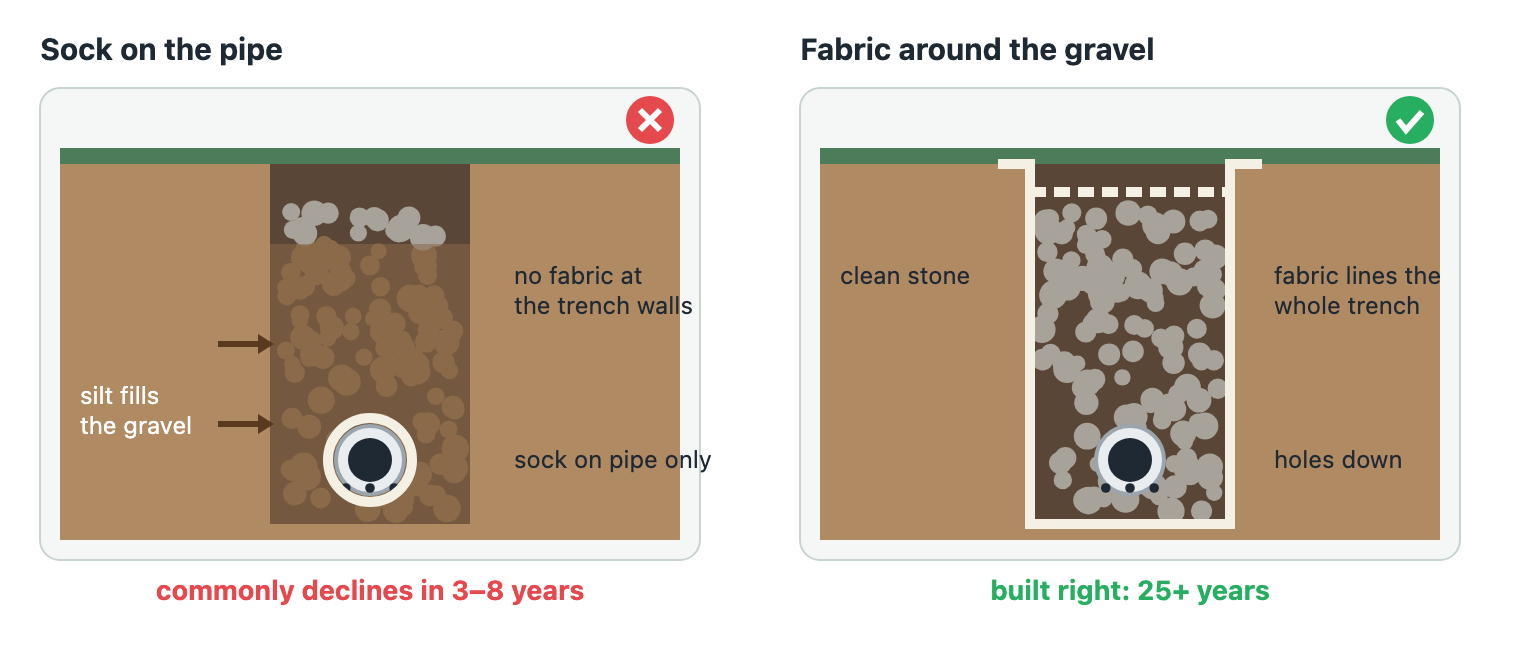
If you already have socked pipe, it can still be used; the point is that the trench needs its own fabric lining whether or not the pipe wears a sock.
The gravel is the drain, the pipe is the carrier
The gravel is not filler. It is the part of the system that actually collects water; the pipe just carries it away. That is why a yard French drain trench is nine to twelve inches wide: a wider envelope of stone gathers water from a wider area. It also means the best pipe in the world cannot save a trench whose gravel is choked with silt.
Three details make the envelope work:
- Washed, angular stone, about ¾ inch. Not pea gravel: rounded stone packs tightly and leaves less room for water. Anything with fines in it silts up the voids.
- Holes facing down. It looks backwards, but water then enters the pipe as soon as it reaches the bottom of the gravel, so the drain starts working at the lowest possible water level.
- Fabric around the stone, as above.
The gravel and materials calculator turns your trench size into stone, pipe and fabric quantities, and the step-by-step install covers the build in order.
Perforated vs solid: which job
Perforated pipe is for collecting water out of wet ground. A line that only carries water, such as a downspout run, should be solid pipe; perforated pipe there releases roof water into the soil beside the house. See solid pipe for downspout lines.
When a drain has already failed
When a French drain stops working it is usually one of five things: silt filling the gravel where the fabric was skipped or wrapped only around the pipe, a belly in the pipe from uneven fall, roots, a crushed or disconnected section, or an outlet that is blocked or buried. Which one it is decides whether the drain can be cleaned or has to be rebuilt; clogged yard drain walks through how to tell them apart before you dig.
FAQs
Which is better for a French drain, PVC or corrugated pipe?
Rigid perforated PVC, where you can manage it. Its smooth wall carries more water per inch of diameter, silts up more slowly, can be snaked or jetted, and holds its shape under load. Corrugated pipe is cheaper, bends around obstacles without fittings and is easier to lay, which makes it a fair trade on a short run in open ground that would be easy to dig up again.
Do you need a sock on a French drain pipe?
No. The fabric's job is to keep fine soil out of the gravel, so it belongs around the gravel, lining the trench and folded over the top. A sock on the pipe alone lets silt fill the stone, which is the most common reason a drain that worked at first declines within a few years. Socked pipe can still be used, but the trench still needs its own fabric lining.
What is a French drain sock?
A fabric sleeve sold already wrapped around perforated drain pipe, intended to keep soil out of the pipe. The problem is that it protects the pipe rather than the gravel envelope, which is the part of a French drain that actually collects water.
Should French drain holes face up or down?
Down. Water enters the pipe as soon as it reaches the bottom of the gravel, so the drain starts working at the lowest possible water level. With holes up, water has to rise the full diameter of the pipe before any of it drains.
What size pipe for a yard French drain?
Four-inch pipe handles most yard drains. A long run or a large catchment can need 6-inch; the French drain sizing calculator works out which from your run and the area draining to it.
Can you snake or jet a corrugated French drain?
With difficulty. Flush with a garden hose first; light silt often moves. A snake tends to catch on the ribs, and thin corrugated pipe will not survive aggressive jetting, so keep any pressure washing moderate. Smooth PVC is far easier to clear, which is the practical argument for using it on runs you expect to maintain.
Sources consulted
- French Drain Man — corrugated vs PVC and pipe socks (cited for contrast)
- HomeFixated — corrugated vs PVC for exterior and French drains
- NDS — drainage pipe types
By Under Your Home Team · Last reviewed 2026-10-08